Ministry of Environment Announces 'Resource Circulation Policy Paradigm Shift Plan'
Reducing Waste Generation and Strengthening Responsibilities of Companies and Local Governments
Promoting 'Excessive Packaging Reporting System'... Achieving Zero Single-Use Products
Responsible Waste Management at Source... Introducing Local Government Evaluation
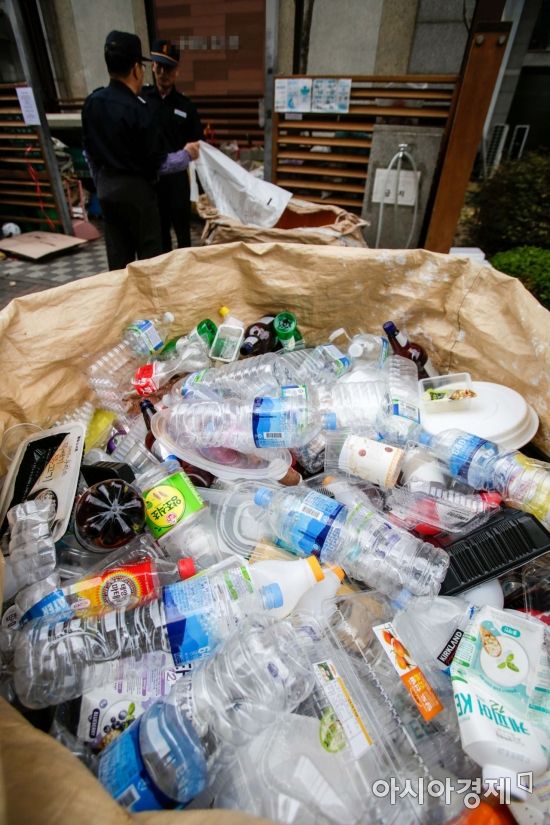 Asia Economy DB=Photo by Jinhyung Kang aymsdream@
[Asia Economy Reporter Kim Bo-kyung] The responsibility for recycling by companies will be expanded. By increasing the Producer Responsibility Recycling (EPR) fees, support will be extended to recycling collection and sorting companies. The government also plans to establish standards for distribution packaging such as delivery boxes within this year.
On the 23rd, the Ministry of Environment finalized the "Resource Circulation Policy Transformation Plan," which includes comprehensive improvement measures from waste generation to final disposal, at the Social Relations Ministers' Meeting. This plan was prepared to supplement problems in the waste management system and transition to a stable resource circulation system. It is also a response to the recent surge in waste due to the expansion of non-face-to-face consumption and the ongoing stagnation of the recycling market caused by economic downturn and low oil prices, which raises concerns about a waste crisis. Minister of Environment Cho Myung-rae emphasized, "Due to the increase in waste caused by COVID-19 and the stagnation of the recycling market, unprecedented measures different from before are necessary."
First, the Ministry of Environment plans to reorganize the scope and targets of EPR. Since its implementation in 2003, EPR has been a system that imposes a certain amount of recycling obligations on product producers for waste generated from products and packaging they manufacture. The items subject to recycling obligations range from paper packs, glass bottles, metal cans, vinyl products to electrical and electronic products.
Under this plan, the EPR fees paid by producers are expected to increase. The scope of producers' recycling responsibility will be gradually expanded by 2025 from the existing "collection-recycling" to "collection-recycling-disposal-reproduction." A Ministry of Environment official stated, "Through EPR fees, support will increase not only for existing recycling processing companies but also for collection and sorting companies." The fees will be differentiated according to market conditions. If the market situation worsens due to the COVID-19 crisis, producers will have to pay higher fees. To this end, the Ministry plans to revise the Resource Recycling Act next year. An incentive plan was also introduced to reward companies with high performance in using recycled raw materials during the production process.
In this regard, the Ministry of Environment will sign an agreement on the same day with Amorepacific, TK Chemical, and the Korea Packaging Recycling Business Cooperative to use more than 250 tons annually of recycled raw materials made from domestic PET bottles in Amorepacific cosmetic containers.
To prevent repeated collection stoppages and refusals that have occurred whenever the recycling market stagnates, a "public responsibility collection" system will also be introduced. The contracting party with collection companies will be the local government, not individual apartment complexes. Public responsibility collection will be gradually introduced by 2024.
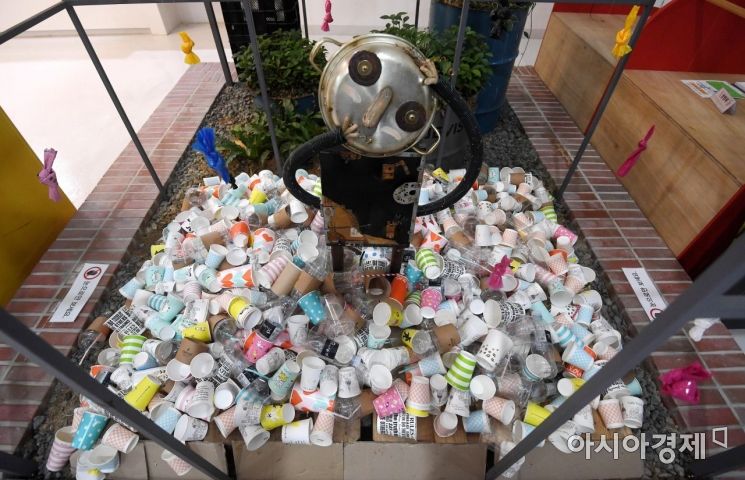
Policies to reduce waste generation such as single-use products will continue. First, packaging standards for distribution packaging such as delivery boxes will be established within this year. Next year, a legal amendment will be pursued to impose improvement obligations on companies violating packaging standards. In the mid to long term, a reporting system for excessive packaging will be introduced. Systems to reduce single-use items, such as the introduction of a deposit system for disposable cups and reduction of straw usage, will also be gradually expanded. Through these measures, the goal is to reduce major single-use items by 35% and plastic packaging waste by 10% by 2022.
Furthermore, the principle of responsibility for waste treatment at the waste generation site will be established. This aims to minimize social costs and regional conflicts caused by long-distance waste transportation. For waste crossing city or provincial boundaries, an "import cooperation fee" will be imposed and used as funds to support areas around treatment facilities. For combustible household waste such as volume-based waste bags, direct landfill will be prohibited from 2030, and only incineration or intermediate treatment residues will be landfilled. The metropolitan area will promote "zero direct landfill" from 2026 through inter-city and provincial agreements.
The Ministry of Environment will evaluate local governments' waste treatment capabilities starting next year. It will comprehensively and objectively assess local governments' reduction efforts, securing treatment facilities, and the proportion of waste treated at the generation site. Based on the evaluation results, implementation orders will be issued to local governments requiring additional efforts such as facility expansion. Incentives will be given to local governments with excellent waste management. A "smart management system" will also be established to monitor the entire waste treatment process and proactively respond to abnormal signs.
Minister Cho stated, "By faithfully implementing the resource circulation policy transformation, we will establish a stable management system without inconvenience to the public and build a sustainable resource circulation system, thereby contributing to greenhouse gas reduction and green transition."
© The Asia Business Daily(www.asiae.co.kr). All rights reserved.
![Clutching a Stolen Dior Bag, Saying "I Hate Being Poor but Real"... The Grotesque Con of a "Human Knockoff" [Slate]](https://cwcontent.asiae.co.kr/asiaresize/183/2026021902243444107_1771435474.jpg)















