Helsinki University Researchers in Finland Conduct Experiment Using Detection Dogs to Identify Confirmed Cases at Airport
[Asia Economy Reporter Naju-seok] Can detection dogs find confirmed cases of the novel coronavirus infection (COVID-19)? Researchers at the University of Helsinki in Finland have embarked on an experiment to determine whether dogs' sense of smell can detect COVID-19 positive individuals.
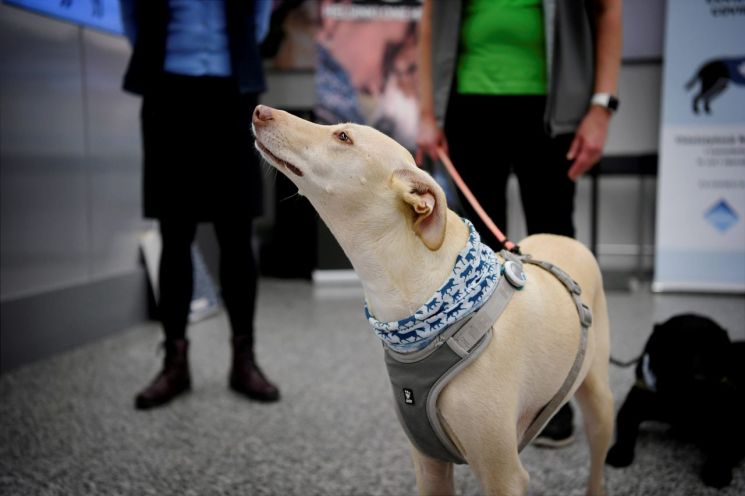 A dog named Koshi, trained to detect COVID-19 positive cases by smell alone, appeared at Helsinki Airport.
 [Image source=Reuters Yonhap News]
According to the Washington Post (WP) on the 22nd (local time), researchers including Anna Helm Bjerkman from the University of Helsinki are conducting a large-scale experiment at Helsinki Airport to see if dogs can detect COVID-19 using their sense of smell. They expect that if the research succeeds, dogs could play a significant role in the COVID-19 quarantine process.
The University of Helsinki research team stated, "Since the test using dogs' sense of smell takes only 10 seconds, airport users will spend less than a minute undergoing the test."
Similar experiments have already been conducted in the United States and the United Arab Emirates (UAE). At Dubai Airport in the UAE, this summer detection dogs were tasked with analyzing sweat samples from randomly selected airline passengers. Although the study was limited in scope, the detection dogs demonstrated over 90% accuracy.
Dogs have long been used for detecting explosives and drugs. Some have even claimed that dogs' sense of smell alone can identify health abnormalities.
The University of Helsinki research team plans to expand the scale of the experiment from the 23rd, larger than that in the UAE. Through this, they aim to determine whether COVID-19 detection using dogs is effective enough for practical use. To this end, the researchers plan to have detection dogs identify samples without direct contact with passengers, similar to the UAE method. Passengers who consent to participate in the experiment will have sweat collected from their necks to create samples, which they will submit at the arrival hall. The detection dogs will then sniff these samples.
The Finnish government plans to conduct PCR (polymerase chain reaction) tests on passengers arriving at Helsinki Airport separately from this experiment. The researchers will compare PCR results with the detection dogs' test results to assess the accuracy of COVID-19 detection using dogs' sense of smell. They also intend to verify how long detection dogs can continuously detect COVID-19 without fatigue.
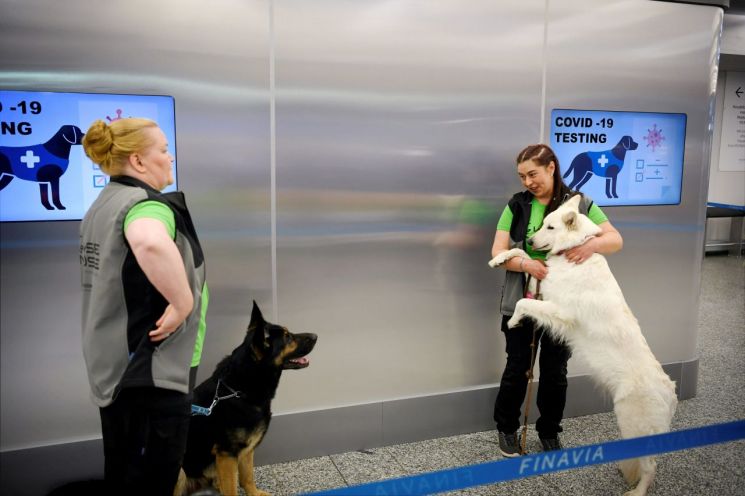 A dog named Balro (left) and ET, trained to detect COVID-19, appeared at Helsinki Airport with their trainer.
 [Image source=Reuters Yonhap News]
Helm Bjerkman introduced findings from a preliminary survey showing that diagnosis using dogs' sense of smell identified COVID-19 positive cases better than other tests. Among those flagged as suspected COVID-19 cases by detection dogs, some initially tested negative by PCR but were confirmed positive a week later.
The Finnish research team trained 16 dogs for this experiment; among them, 4 are ready for field deployment, 6 are still in training, and the remaining 6 were deemed unsuitable for busy environments like airports.
Experts have expressed skepticism about using detection dogs for COVID-19 diagnosis. Regardless of effectiveness, training requires significant time and money, and large-scale deployment is challenging. However, researchers expect that detection dogs could help alleviate the already overloaded COVID-19 testing burden.
The research team stated that neither the detection dogs nor their trainers will contract COVID-19 during this experiment.
© The Asia Business Daily(www.asiae.co.kr). All rights reserved.
![Clutching a Stolen Dior Bag, Saying "I Hate Being Poor but Real"... The Grotesque Con of a "Human Knockoff" [Slate]](https://cwcontent.asiae.co.kr/asiaresize/183/2026021902243444107_1771435474.jpg)

















