Seoul City Survey: 8 out of 10 Citizens Say "High Possibility of COVID Recrudescence After Chuseok"
More Than Half of Respondents Say "Government's Recommendation to Refrain from Travel is Appropriate"
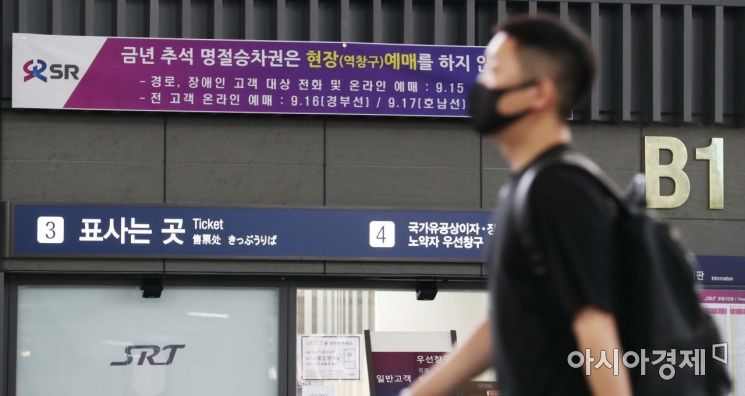 On the 15th, when ticket reservations for the Suseo High-Speed Railway (SRT) Chuseok holiday trains began, related notices were installed at SRT Suseo Station in Gangnam-gu, Seoul. This year, due to concerns about the spread of the novel coronavirus (COVID-19), reservations are conducted 100% online, and only window seats can be reserved to maintain social distancing. On this day, 10% of the total seats are preferentially allocated to the elderly and disabled, with reservations available through the website and phone. For the general public, advance sales for the Gyeongbu Line tickets will be held on the 16th, and for the Honam Line on the 17th. Photo by Moon Honam munonam@
[Asia Economy Reporter Jo In-kyung] Eight out of ten Seoul citizens expect a high possibility of a resurgence of COVID-19 after the Chuseok holiday. Because of this, more than six out of ten said they would not visit family or relatives during the Chuseok holiday period.
Seoul City announced on the 23rd that a survey conducted by Realmeter from the 19th to 20th, targeting 1,000 citizens aged 18 and over, showed these results as part of preparations for special quarantine measures during the Chuseok holiday.
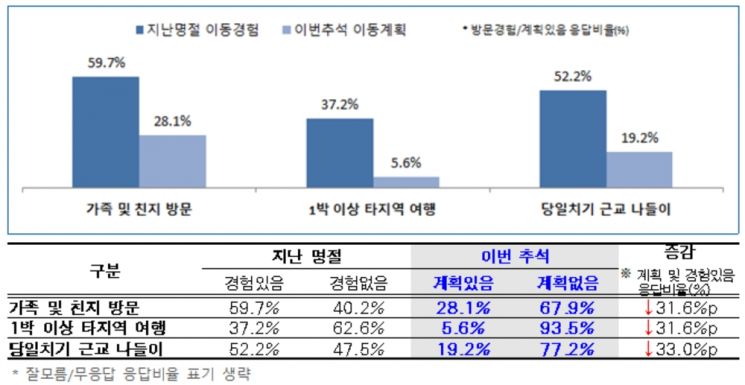
According to the survey, 67.9% of Seoul citizens said they do not plan to visit family or relatives who do not live with them during this Chuseok holiday. Among the respondents, 79.2% cited "because of COVID-19" as the reason for not visiting. In particular, more than half (56.5%) of those who visited family or relatives during the last holiday responded that they would not visit this Chuseok.
There was a difference in the degree of visits this Chuseok depending on the usual holiday visit region; compared to the Seoul metropolitan area including Seoul, Gyeonggi, and Incheon, those who usually visit relatively distant regions were more likely to say they would not visit this Chuseok.
The number of citizens planning to travel to other regions also noticeably decreased. During this holiday period, 5.6% of respondents planned to travel overnight to other regions, and 19.2% planned day trips to nearby areas. Compared to the last holiday, overnight travel decreased by 31.6 percentage points, and day trips decreased by 33 percentage points.
Regarding the possibility of a COVID-19 resurgence after Chuseok, 80.7% of citizens responded that the possibility of resurgence is high. Also, more than half of the citizens (51.3%) viewed the government's recommendation to refrain from traveling during Chuseok as an appropriate level of intervention, while 37% expressed the opinion that stronger restrictions are necessary. Only 11.2% thought the recommendation to refrain was excessive.
During the Chuseok holiday, Seoul citizens planned to stay in Seoul for an average of 4.5 days. Citizens who planned to stay in Seoul for the entire five-day holiday accounted for 76.5% of respondents. Four out of ten citizens (39%) had no plans to go out or engage in outdoor activities at all, but about half (48.6%) planned limited outings such as purchasing daily necessities or visiting parks, walking trails, or hiking.
While staying at home, relatively high responses were given for spending time watching TV or videos (25.7%), resting (24.8%), and doing house chores (11.6%).
Meanwhile, as the time spent at home has increased since COVID-19, the biggest concern among citizens was "health problems due to lack of exercise (36.8%)." This was followed by "boredom (22.2%)," "emotional issues such as depression and anxiety (15.8%)," and "family conflicts (13.8%)." Regarding whether family conflicts have increased since COVID-19, 74.7% of respondents said "about the same as before," 12.4% said "increased compared to before," and 11.3% said "decreased."
© The Asia Business Daily(www.asiae.co.kr). All rights reserved.


















