After Passing the National Assembly, Total Expenditure Reduced by 27.4 Billion KRW Compared to Government Proposal
Communication Expenses Excluded from Support for Some Age Groups Including Ages 35-64
7.8 Trillion KRW Expenditure Mostly Funded by National Bond Issuance... Fiscal Deficit Deterioration Inevitable
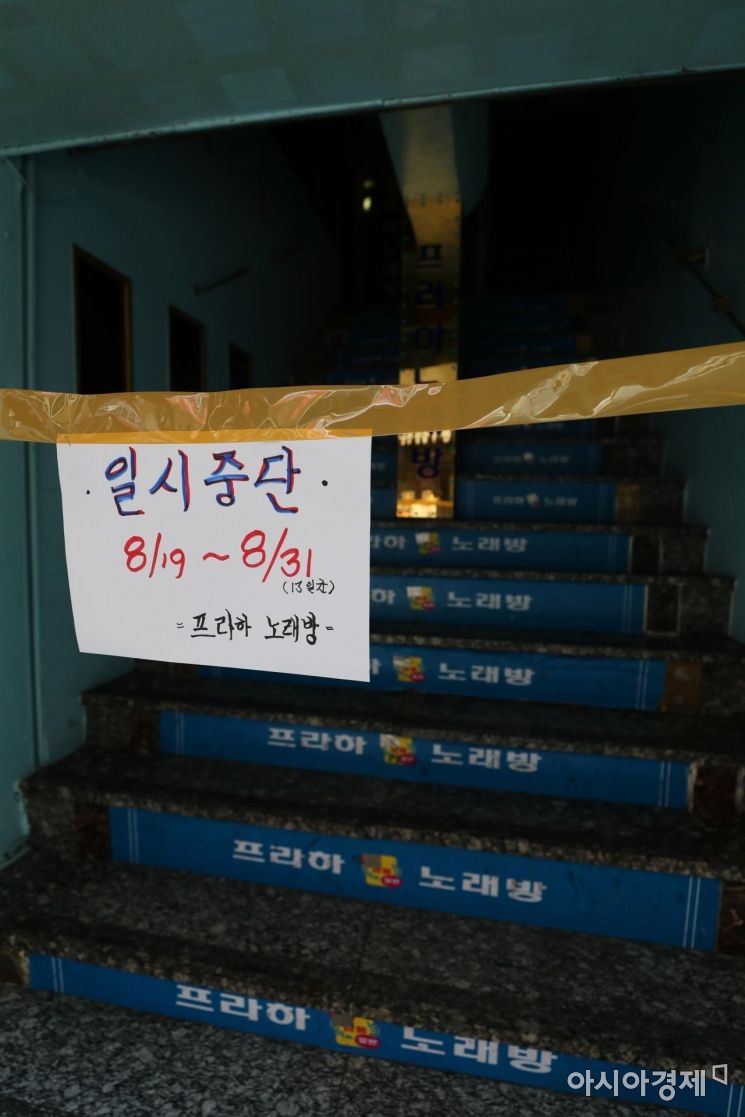 On the 19th, the government strengthened social distancing measures in the Seoul metropolitan area to curb the explosive spread of the novel coronavirus infection (COVID-19). Gatherings and events with more than 50 people indoors and more than 100 people outdoors are, in principle, prohibited until the 30th of this month. This applies not only to exhibitions, public hearings, commemorative ceremonies, and recruitment exams but also to private gatherings such as weddings, alumni meetings, 60th birthday parties, funerals, and first birthday parties, which cannot be held with many people present. Twelve types of high-risk facilities will be required to suspend operations. These facilities include clubs, room salons, and other entertainment bars, colatecs, danran bars, emotional bars, hunting pochas, karaoke rooms, indoor standing concert halls, indoor group exercise (intense GX types), buffets (including those in wedding halls), PC rooms, direct sales promotion centers, and large academies (with 300 or more people). The photo shows the scene of the Youth Street in Jonggak, Seoul, on that day. Photo by Moon Honam munonam@
[Sejong=Asia Economy Reporter Kim Hyunjung] As the 4th supplementary budget (supplementary budget) for responding to the novel coronavirus infection (COVID-19) passed the National Assembly, the selective support targets include corporate taxis and entertainment establishments, and the universal support nature of the communication fee payment was partially excluded according to age groups. The total scale is 7.8 trillion won, which is 27.4 billion won less than the previously announced government plan.
According to the Ministry of Economy and Finance on the 23rd, the 4th supplementary budget plan with these contents was approved at the plenary session of the National Assembly held the day before. This is the fourth supplementary budget following the first supplementary budget (11.7 trillion won) on March 17, the second supplementary budget (12.2 trillion won) on April 30, and the third supplementary budget (35.1 trillion won) on July 3, and it is the first time in 59 years since 1961 that such a supplementary budget has been pushed forward.
◆Major overhaul of controversial support projects... communication fee reduced and contingency funds cut= The 4th supplementary budget plan passed by the National Assembly was reduced by 27.4 billion won in total amount and did not change significantly, but the support scale of controversial projects changed significantly. Overall, there was an increase of 590.3 billion won and a decrease of 617.7 billion won.
In summary, the changes are strengthening quarantine, reducing universal support, and expanding selective support. First, the payment target of 20,000 won for communication fees, which was originally planned for all citizens aged 13 and over, was changed to those aged 16-34 and 65 and over, as discussed by the ruling party. Those aged 13 and over but under 16, corresponding to middle school students, were excluded because they receive support for non-face-to-face learning activities. The payment was changed to be given only to youth and young adults who have many non-face-to-face activities and low income, and the elderly. The related budget was reduced by 52.06 billion won from 92.89 billion won to 40.83 billion won. The contingency fund, which was planned at 10 billion won in the government plan, was cut to 5 billion won, and the interest expenses on government bonds and administrative support expenses for supplementary budget projects were cut by 3.96 billion won and 750 million won, respectively.
The saved budget will be used for an emergency quarantine support package and newly established middle school student learning support. The emergency quarantine support package was increased by 23.32 billion won, including 18.39 billion won for purchasing vaccines to enable vaccination of 20% of the total population (10.37 million people) if a COVID-19 vaccine is developed. In addition, 3.15 billion won is provided to vulnerable groups of 1.05 million people, including 700,000 medical aid recipients and 350,000 recipients of disability pensions and allowances, for free influenza vaccination benefits. A total of 1.79 billion won is provided for counseling, healing, and training costs for 34,000 healthcare workers for recharging.
The care cost, which was included only up to elementary school students in the government plan, is expanded to middle school students. Non-face-to-face learning support costs of 150,000 won per person are provided, and a total of 27.4 billion won is allocated to support 1.38 million people aged 13-15, including 1.32 million middle school students and 60,000 out-of-school children.
Support for small business owners and vulnerable employment groups was also increased by 14.5 billion won. A total budget of 81 billion won was allocated to provide 1 million won per person to corporate taxis, which had been excluded from the support target, and 64 billion won was increased to provide 2 million won each to 32,000 entertainment bars and colatecs that could not receive the New Hope Fund. In addition, 2.6 billion won was additionally reflected for early deployment of counseling and treatment specialists and improvement of counseling facilities to strengthen protection for children in blind spots, and 2.1 billion won was provided for infrastructure expansion to support psychological recovery of affected children.
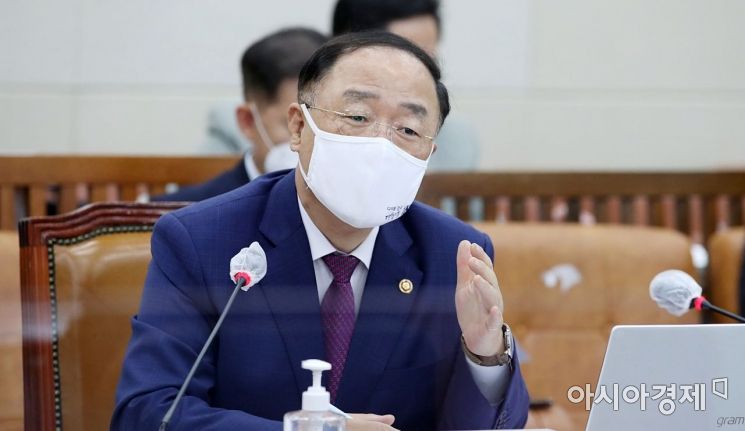 Deputy Prime Minister for Economy Hong Nam-ki is attending the plenary session of the Planning and Finance Committee held at the National Assembly on the 21st, responding to questions from lawmakers. Photo by Yoon Dong-joo doso7@
◆Most of the 7.8 trillion won raised by issuing deficit bonds... deterioration of fiscal balance inevitable= The 7.8 trillion won cost for the 4th supplementary budget projects will mostly be raised by issuing deficit bonds. With the four supplementary budgets following this year's main budget, total expenditure reaches 554.7 trillion won.
Due to the issuance of deficit bonds, national debt will increase by 7.5 trillion won compared to the 3rd supplementary budget, reaching 846.9 trillion won. The national debt ratio to GDP will rise by 0.4 percentage points from 43.5% after the 3rd supplementary budget to 43.9%, the highest ever.
The integrated fiscal balance (total revenue - total expenditure) deficit is 84 trillion won, the largest since related statistics began in 1979. The integrated fiscal balance ratio to GDP is expected to fall by 0.5 percentage points from -3.9% after the 3rd supplementary budget to -4.4%. The managed fiscal balance deficit, which excludes social security fund balances such as the National Pension Fund and Employment Insurance Fund from the integrated fiscal balance, also increases by 7.1 trillion won from 111.5 trillion won after the 3rd supplementary budget to 118.6 trillion won. The managed fiscal balance deficit ratio to GDP increases from 5.8% to 6.1% on the same basis, also reaching the highest ever.
© The Asia Business Daily(www.asiae.co.kr). All rights reserved.
![Clutching a Stolen Dior Bag, Saying "I Hate Being Poor but Real"... The Grotesque Con of a "Human Knockoff" [Slate]](https://cwcontent.asiae.co.kr/asiaresize/183/2026021902243444107_1771435474.jpg)

















