Hansung Baekje Museum Online Special Exhibition 'Excavation, Then: Cheongjin District' Until November 29
Recreating Sijeon Street and Exhibiting Pottery and Currency... First Display of 'Naegyo-in' Used by the Queen
[Asia Economy Reporter Jo In-kyung] Over 700 artifacts excavated and unearthed from the hotspot area of Cheongjin-dong, Jongno-gu, Seoul, where the core commercial district of the Joseon Dynasty, Sijeon (marketplace), was located, will be revealed to the public for the first time.
The Hansung Baekje Museum announced on the 23rd that it will hold a special exhibition titled 'Excavation, and After: Cheongjin District' online from the 25th to November 29. The exhibition carefully selects over 700 items from more than 6,200 artifacts excavated between 2010 and 2018 in Seoul’s Cheongjin-dong, Seorin-dong, Songhyeon-dong, Gwanhun-dong, Janggyo-dong, and Tongui-dong.
Since the 2000s, Seoul City has systematically preserved and managed cultural relics in accordance with the 'Preservation Plan for Cultural Heritage within the Four Great Gates' while promoting urban revitalization strategies and redevelopment projects. Facilities such as Donuimun History Museum, Gongpyeong Urban Relics Exhibition Hall, Gun-gi-si Relics Exhibition Room, and Myeongdong Cathedral Relics Exhibition Hall have preserved relics and opened exhibition halls, while relics in Jongno’s Cheongjin-dong, Seorin-dong, and Janggyo-dong are partially displayed using building lobbies or open public spaces.
In particular, the 'Cheongjin District,' centered around Cheongjin-dong, was a core commercial area with government-run stores called Sijeon during the Joseon Dynasty and housed the largest permanent market in Joseon, raising expectations as many artifacts that reveal the economic life of the time were unearthed.
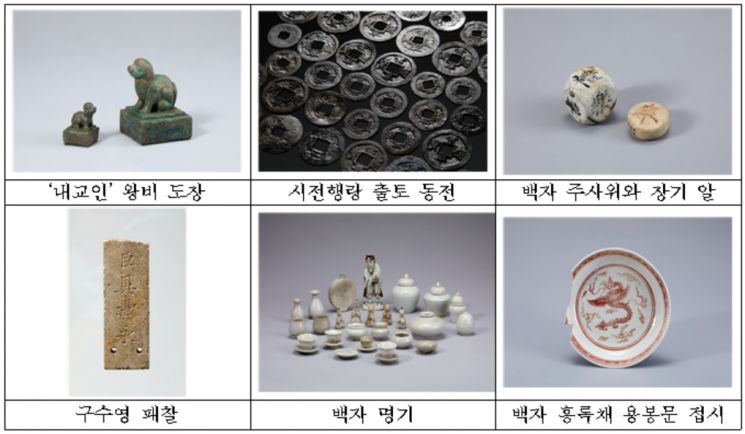
The excavated artifacts from the Cheongjin District include ceramics such as Buncheong ware, white porcelain, and blue-and-white porcelain sold at the Sijeon, scales and weights used for measuring, and metal coins from the Joseon Dynasty through the Japanese colonial period, offering a glimpse into the lives of market merchants and commoners of the time. The exhibition hall recreates the Sijeon arcade where goods were sold, including a pottery shop selling Buncheong ware and white porcelain, preserving the market atmosphere, and even reconstructs traditional hanok houses inhabited by people living in the back alleys of the Sijeon.
The most notable artifacts are two royal seals called 'Naegyo-in (內敎印)' used by Joseon queens. These were excavated from the site at 70 Tongui-dong in 2018 and are estimated to have been made in the late 19th century. The seal features a lion-shaped handle (innyu) on top, and the seal face is engraved with 'Naegyo (內敎),' indicating it was a seal used by a queen, making it a treasure-level artifact.
This special exhibition will be available on the Hansung Baekje Museum’s website and YouTube channel, and once the COVID-19 social distancing level 2 is lifted, on-site visits will be possible by advance reservation.
In connection with the special exhibition, ten lectures titled 'Restoring the Scenery of Hanyang through Archaeological Excavations' will be held. Interested parties can apply through the museum’s website or contact the museum’s Education and Public Relations Department.
© The Asia Business Daily(www.asiae.co.kr). All rights reserved.
![Clutching a Stolen Dior Bag, Saying "I Hate Being Poor but Real"... The Grotesque Con of a "Human Knockoff" [Slate]](https://cwcontent.asiae.co.kr/asiaresize/183/2026021902243444107_1771435474.jpg)
















