Companies on the Blacklist
Unable to Buy or Sell Goods with China
Company Executives Restricted from Entering China
Possibility of TikTok Sale Stalling
[Asia Economy Reporter Kwon Jae-hee] The Chinese government is reportedly targeting the American company Cisco as a countermeasure against the U.S. sanctions on Huawei. This move comes in response to the Trump administration's increased sanctions on Chinese companies, ranging from Huawei to WeChat. Since Cisco is a competitor of Huawei in the networking industry, there are expectations of a tit-for-tat retaliation. As tensions between the two countries escalate, concerns are also rising that the TikTok acquisition deal, which had barely reached an agreement, may face new difficulties.
According to the Wall Street Journal (WSJ) on the 21st (local time), the Chinese Ministry of Commerce is said to have included Cisco in the blacklist currently being prepared. Although China has not yet made the blacklist public, retaliation against Cisco is understood to have already begun. WSJ reported that contracts with Chinese state-owned telecommunications companies, to which Cisco had long supplied, have been terminated. Recently, the Chinese government reportedly instructed domestic companies to break contracts with American companies even if they have to pay penalties.
The blacklist being promoted by the Chinese Ministry of Commerce includes restrictions on sales and purchases within China. The Chinese Ministry of Foreign Affairs stated, "Companies and individuals on the blacklist will be prohibited from sales and purchases within China, and investments into China will also be banned," adding, "Entry restrictions for company executives and employees into China and cancellation of residence qualifications may also be imposed." The blacklist is said to be nearly finalized.
Originally, China announced plans to create a blacklist of American companies for the first time in May 2019, shortly after the U.S. began regulating Huawei, but the plan was postponed ahead of the signing of the Phase One trade agreement between the U.S. and China. However, after the U.S. increased sanctions on Huawei starting from the 15th of this month, China responded with countermeasures. The U.S. Department of Commerce prohibited the sale of semiconductors produced using American semiconductor technology or software to Huawei without prior approval and recently intensified its offensive against Chinese companies such as WeChat.
Currently, Vice Premier Hu Chunhua is reportedly conducting a final review of the Chinese version of the blacklist called the "Unreliable Entities List." However, there is no internal consensus on the timing of its release. WSJ cited sources saying that senior Chinese officials, including Vice Premier Liu He, who is in charge of trade negotiations with the U.S., argue that releasing the blacklist could provoke harsher regulations against Chinese companies by the U.S. and therefore should be postponed until after the U.S. presidential election.
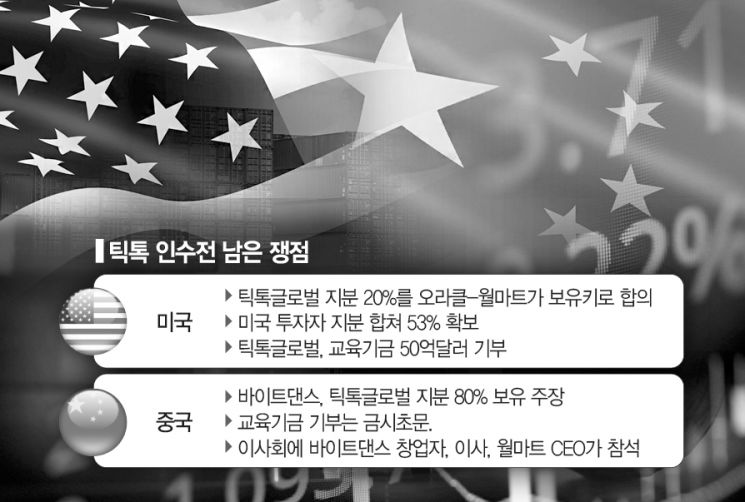
As tensions between the two countries reach a peak, the TikTok acquisition deal has also fallen into uncertainty again. The parties involved in the agreement have conflicting claims over the largest shareholder position in the so-called "TikTok Global," a key point of the agreement. While both sides agreed on Oracle and Walmart holding a 20% stake, they disagree on the remaining shares. ByteDance, TikTok's parent company, claims to hold 80%, whereas Oracle insists that Americans will hold the majority stake. President Trump warned, "If Oracle does not have full control, I will not approve this deal," signaling difficulties ahead.
AFP reported that the differing explanations about the new company's shares have cast doubt on the agreement regarding TikTok's ownership restructuring following President Trump's remarks. Bloomberg interpreted the president's comments as indicating an expectation that China's influence will be diluted through a future public offering of the new company's shares.
China is also negative about the TikTok sale. Hu Xijin, editor-in-chief of the Global Times, known as an unofficial spokesperson for the Chinese government, tweeted last night, "As far as I know, China will not approve the deal between ByteDance, Oracle, and Walmart due to national security threats." The English edition of the Global Times published an editorial on the 22nd titled "Say 'No' to America's Robbery of TikTok," calling the deal unfair and stating, "It is hard to believe China will approve such a deal."
With the conflict over Huawei reaching its peak, a Cold War between the two countries is expected to continue for the time being, but some voices suggest that China's response will be limited. Peng Chucheng, a political risk analyst at Plenum, a risk consulting firm based in China, said, "At this point, ahead of the U.S. presidential election in November, the U.S. actions are limited, so China will not take dramatic countermeasures," adding, "China will not take substantive actions but will symbolically criticize the U.S. for unilateral moves against Chinese tech companies."
© The Asia Business Daily(www.asiae.co.kr). All rights reserved.

















