Even Combined Market Caps of Top 4 Landowners Fall Short of Expected KakaoBank Valuation
Potential Domino Collapse of Corporate Value...Red Flags on Bank Asset Soundness
Financial Authorities Encourage Only COVID Support, Request Dividend Restraint...Blocking Stock Price Boost
[Asia Economy Reporter Kangwook Cho] Since the outbreak of the novel coronavirus disease (COVID-19), the stock prices of financial holding companies have been unable to escape a downward trend. In fact, even when combining the market capitalization of the four major financial holding companies, it has fallen below the valuation (expected market capitalization) of KakaoBank, which is preparing for an initial public offering (IPO). This is due to concerns over a potential 'domino collapse' involving financially vulnerable marginal companies and low-income households, which has triggered red flags regarding the asset soundness of the banking sector. There is criticism that the financial authorities, who emphasize only support and put brakes on policies to boost financial companies' stock prices, bear significant responsibility. Recently, it has been reported that measures to legally enforce dividend restraint by financial holding companies in emergencies are also being considered, deepening the concerns of financial firms.
Shinhan Financial Group Recruits Foreign Private Equity Shareholders... Financial Authorities Request Dividend Restraint
According to the financial sector on the 22nd, the financial authorities recently requested Shinhan Financial Group to "refrain from dividends" in preparation for the prolonged economic and financial crisis caused by the COVID-19 pandemic. This is interpreted as a response to Shinhan Financial Group's recent recruitment of foreign private equity funds as shareholders. On the 4th, Shinhan Financial Group held a board meeting and decided on a paid-in capital increase of 1.1582 trillion KRW. Through a third-party allotment, foreign private equity funds Affinity Equity Partners and Baring Private Equity Asia invested 605 billion KRW and 553.2 billion KRW respectively, securing 4.0% and 3.6% of Shinhan Financial Group's shares. While the capital increase decision is a negative factor due to immediate dilution of shares, it was anticipated that it could be a positive factor in the long term by strengthening shareholder returns through measures such as interim dividends and treasury stock cancellations.
However, this optimistic view quickly diminished due to the financial authorities' intervention. The authorities' stance is that it is inappropriate to use funds raised to strengthen loss absorption capacity for dividends to shareholders.
Financial Authorities Considering Institutional Grounds for Dividend Restrictions
The financial authorities are recommending other financial holding companies to maintain capital soundness as conservatively as possible through dividend restraint and other measures. Considering the uncertainties caused by the COVID-19 pandemic, the authorities argue that capital outflows such as dividends should be minimized.
Financial companies have so far actively aligned themselves with government policies. Various financial sectors have invested tens to hundreds of trillions of KRW through funds such as the Industrial Stability Fund and Stock Market Stabilization Fund. They have also implemented interest deferrals and loan maturity extensions as part of COVID-19 financial support, and recently announced financial support plans targeting the Korean New Deal policy. Analysts suggest that the financial authorities' policy, which prohibits stock price boosting activities while encouraging financial support, combined with risk concerns, has caused stock prices to plummet.
Moreover, the authorities are currently reviewing institutional grounds to require dividend restrictions. This move is believed to have been triggered by Hana Financial Group's decision to pay an interim dividend (500 KRW per share) in July despite the authorities' request for restraint.
Yoon Jong-kyu, Chairman of KB Financial Group, Expresses "Stock Price at a Dire Level"
Within the financial sector, there are growing concerns about the continued stock price slump due to government policies. Yoon Jong-kyu, who recently effectively secured a third term as chairman of KB Financial Group, cited the stock price decline as the most regrettable aspect during his two previous terms. Chairman Yoon said, "The stock price remains at a dire level," adding, "While there are concerns about the Korean economy and Korean finance, this also reflects worries about whether traditional financial companies can maintain competitiveness in an untact (contactless) world."
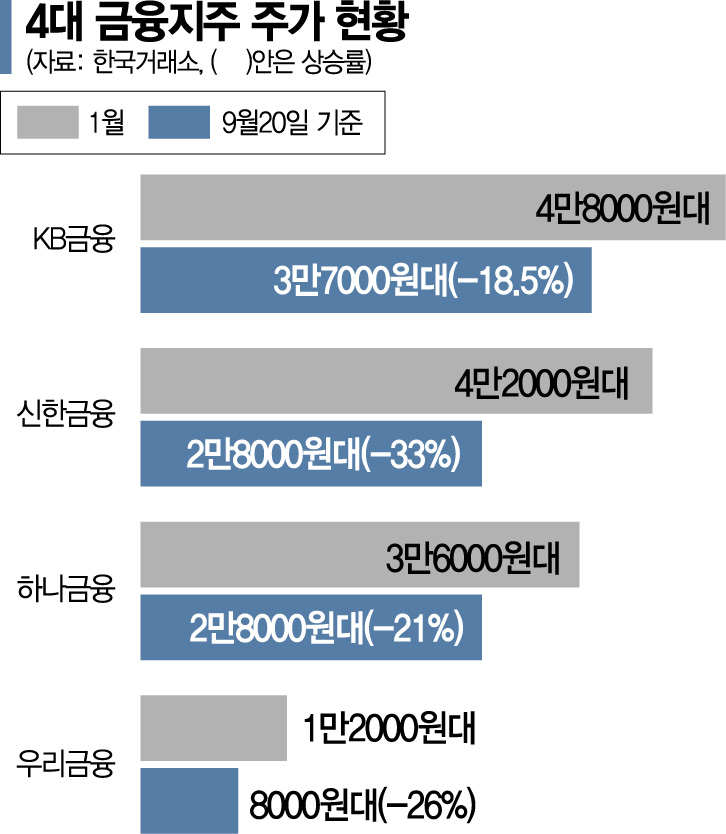
In fact, KB Financial Group's stock price has fallen more than 18% this year, Hana Financial Group by 21%, and Woori Financial Group by about 26%. Shinhan Financial Group's stock price plunged by as much as 33%. Due to this situation, Woori Financial Group has faced setbacks in complete privatization as the government has been unable to sell its shares in a timely manner due to low stock prices. Despite Woori Financial Group Chairman Sohn Tae-seung purchasing treasury stocks four times this year, and Woori Bank CEO Kwon Kwang-seok, along with major subsidiary heads and 41 executives from the holding company and Woori Bank participating, it was insufficient to revive the falling stock price. Previously, other financial holding companies' chairmen and executives also purchased large amounts of treasury stocks or engaged in treasury stock cancellations, but currently, instead of active stock price boosting policies, the atmosphere is one of cautiousness toward the financial authorities. Some financial holding companies even had their treasury stock purchases canceled due to opposition from the financial authorities.
A financial sector official said, "Financial stocks were traditionally popular as dividend stocks, but currently, with the prolonged COVID-19 situation and increased cost burdens on financial holding companies due to support for the Korean New Deal policy, the market sees reduced investment attractiveness," adding, "In a situation where it is impossible to hold direct investor relations (IR) meetings overseas, the financial authorities are effectively demanding financial companies not to implement stock price boosting policies, making it inevitably difficult to attract investors."
© The Asia Business Daily(www.asiae.co.kr). All rights reserved.
![Clutching a Stolen Dior Bag, Saying "I Hate Being Poor but Real"... The Grotesque Con of a "Human Knockoff" [Slate]](https://cwcontent.asiae.co.kr/asiaresize/183/2026021902243444107_1771435474.jpg)
















