Resolution of the Amendment to the Enforcement Decree of the Employment Insurance Act at the Cabinet Meeting on the 22nd
50% of Average Wage Paid to Workers During Unpaid Leave, Up to 180 Days
Relaxation of Paid Leave Training Support Requirements...Mandatory Compensation Education for Training Instructors
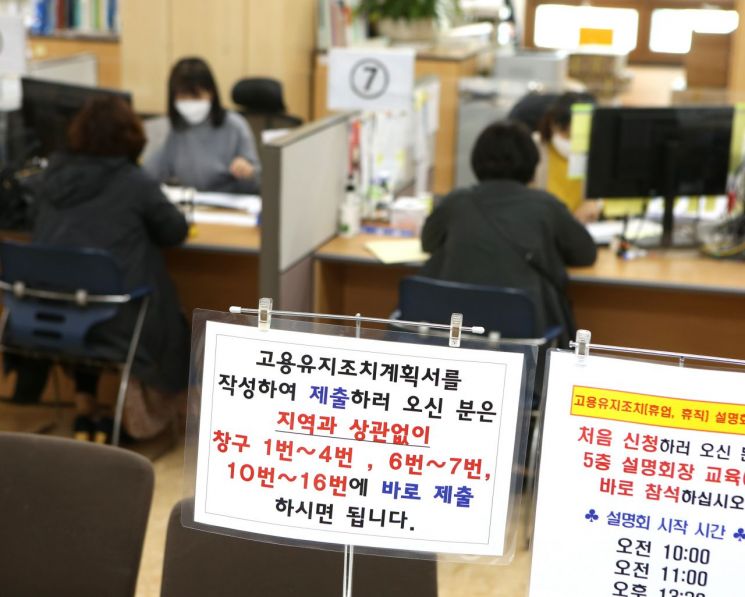
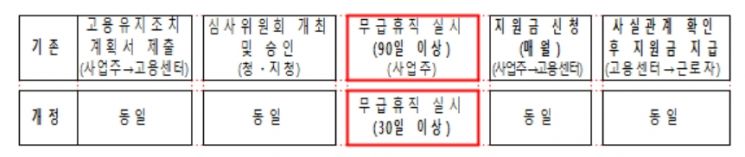
[Asia Economy Reporter Kim Bo-kyung] The regulation requiring workers to take unpaid leave for at least 90 days to receive the unpaid leave employment retention subsidy has been changed to 'at least 30 days.'
On the morning of the 22nd, the government reviewed and approved two Ministry of Employment and Labor-related legislative bills, including the Enforcement Decree of the Employment Insurance Act and the Enforcement Decree of the Worker Vocational Competency Development Act, at the Cabinet meeting.
The amendment to the Enforcement Decree of the Employment Insurance Act is part of follow-up measures following the 'Tripartite Agreement to Overcome the COVID-19 Crisis' on July 28. It was agreed to relax the requirements for the unpaid leave employment retention subsidy and paid leave training support.
The unpaid leave employment retention subsidy is a system that provides financial support to workers who are forced to take unpaid leave due to business deterioration. Support is available for up to 180 days within 50% of the worker's average wage.
Previously, workers had to take unpaid leave for at least 90 days to receive the subsidy, but after the amendment, support will be available if unpaid leave is taken for at least 30 days. However, the requirement that the employer must have conducted paid leave for at least three months in advance remains in place.
The government has improved the system so that companies experiencing employment crises due to the prolonged COVID-19 pandemic can utilize the employment retention subsidy more extensively.
For small and medium-sized enterprises (priority support companies), support for paid leave and leave allowances has been increased up to 90% until the end of this month, and a rapid support program for unpaid leave has been established, providing 500,000 KRW per month for up to three months to workers on unpaid leave.
According to the Ministry of Employment and Labor, as of the 31st of last month, about 63,000 workplaces and 650,000 workers (1.38 million in total) have received employment retention subsidies.
Paid leave training support is a system where employers provide paid leave to employees for vocational competency development training and receive support for training expenses (training fees, accommodation, meals, etc.) and part of the wages paid to workers.
Previously, priority support companies had to provide at least 5 days of leave and conduct at least 20 hours of training, while other companies had to provide at least 60 days of leave and conduct at least 180 hours of training to be eligible for support.
In response to the prolonged employment crisis caused by COVID-19, the government has relaxed the paid leave training requirements for workplaces that meet any of the following: those eligible for employment retention subsidies, employment crisis areas, or special employment support industries.
Through the amendment of the enforcement decree, priority support companies can now receive support for training expenses and labor costs if they provide at least 3 days of leave and conduct at least 18 hours of training. Other companies can receive support if they provide at least 30 days of leave and conduct at least 120 hours of training.
However, considering the special circumstances due to COVID-19, the validity period is limited until December 31 of this year. Extension measures will be considered depending on the situation.
 She is receiving vocational training at the Jungnang-gu Women's Human Resources Development Center.
Additionally, following the amendment of the Worker Vocational Competency Development Act, the enforcement decree was revised to include detailed provisions necessary for the implementation of the law.
Until now, training instructors and lecturers voluntarily participated in refresher training to improve their skills and qualifications, but going forward, all instructors and lecturers conducting training will be required to participate in refresher training to ensure minimum training quality. They will receive refresher training within 24 hours annually on professional knowledge and skills related to the training occupation and teaching methods for training courses.
The results of completing refresher training will be reflected in the evaluation of training courses, which is expected to provide high-quality vocational competency development training services.
Sanctions against fraudulent training institutions will also be strengthened. Institutions that have had their consignment contracts terminated or training course approvals revoked and have fraudulently received more than 30 million KRW over three years will have their institution names, violations, and disciplinary details posted for one year on the Ministry of Employment and Labor and local employment and labor offices' websites, as well as on the Vocational Training Portal (HRD-net).
Procedures have also been established to go beyond simply providing information about training courses by conducting job competency assessments and counseling for vocational training participants. In the future, those wishing to take training courses for employment, job transition, or certification acquisition will be able to receive training counseling services.
© The Asia Business Daily(www.asiae.co.kr). All rights reserved.
![Clutching a Stolen Dior Bag, Saying "I Hate Being Poor but Real"... The Grotesque Con of a "Human Knockoff" [Slate]](https://cwcontent.asiae.co.kr/asiaresize/183/2026021902243444107_1771435474.jpg)

















