Workshop for the 2020 Bank of Korea Press Corps on the 23rd
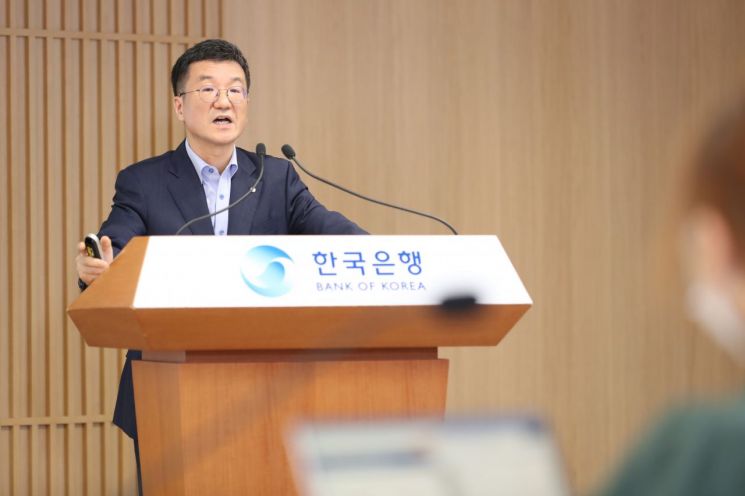
[Asia Economy Reporter Jang Sehee] The Bank of Korea analyzed that even reflecting the resurgence of COVID-19 since mid-August, there is no need to adjust the initial forecast for the domestic gross domestic product (GDP) growth rate.
On the 23rd, Kim Woong, Director of the Bank of Korea's Research Department, stated during a Q&A session with reporters following the '2020 Bank of Korea Press Corps Workshop,' regarding the downward revision of the growth rate, "At the time of the growth rate forecast in August (-1.3%), we expected more than 100 confirmed COVID-19 cases until October, and currently, the situation remains within that range."
At the August Monetary Policy Committee meeting, the Bank of Korea projected that this year's GDP growth rate for South Korea would be -1.3%. The years when the Korean economy experienced negative growth were 1980 during the oil shock (-1.6%) and 1998 during the International Monetary Fund (IMF) foreign exchange crisis (-5.1%).
He added, "Looking at the indicators that have appeared since the August forecast, there are no particular indicators that warrant changing the growth rate."
The Bank of Korea expects that concerns about COVID-19 will persist, causing the recovery of face-to-face services and overseas consumption to be delayed for a considerable period. In particular, it forecasted that the recovery of private consumption would be slower than expected. However, it analyzed that the increase in non-face-to-face demand and involuntary savings would have a positive effect.
According to the Bank of Korea's August Consumer Sentiment Survey, the Consumer Confidence Index (CCSI) rose by 4.0 points from the previous month to 88.2. However, since the survey period was from August 10 to 14, the impact of the second wave of COVID-19 was not reflected.
Regarding COVID-19 consumption trends, although the overall slump somewhat eased in the second quarter, the recovery speed differed between goods and services consumption. The goods sector, centered on durable goods, showed a sharp rebound, whereas the service sector's recovery was more gradual compared to goods consumption.
It also analyzed that the decline in overseas consumption is increasing. The Bank of Korea stated, "Due to restrictions on international travel and avoidance of overseas trips, overseas consumption has significantly decreased." Overseas consumption fell by 30% and 70% in the first and second quarters, respectively.
Meanwhile, with the social distancing level raised to 2.5, it analyzed that small business owners in the metropolitan area suffered significant damage. According to data confirmed by the Bank of Korea through Korea Credit Data, sales decreased sharply during both the first (-29.9%) and second (-24.9%) waves. The Bank of Korea attributed this to the concentration of business-restricted sectors such as academies, restaurants, and sports facilities in the metropolitan area.
© The Asia Business Daily(www.asiae.co.kr). All rights reserved.
![Clutching a Stolen Dior Bag, Saying "I Hate Being Poor but Real"... The Grotesque Con of a "Human Knockoff" [Slate]](https://cwcontent.asiae.co.kr/asiaresize/183/2026021902243444107_1771435474.jpg)















