IMO Strengthens Ship Fuel Environmental Standards
LNG Gains Spotlight with Sulfur Content Limits
Immediate LNG Refueling upon Port Berthing
Dedicated Terminal and Vessel Construction in Tongyeong
Joint Ventures with Refining, Port, and Logistics Companies
Leading Eco-Friendly Market through Infrastructure Development
[Asia Economy Reporter Moon Chaeseok] "We will expand various eco-friendly fuel transition projects to lead Korea's low-carbon eco-friendly energy era."
Chae Hee-bong, President of Korea Gas Corporation, stated in the 37th anniversary speech on the 19th of last month that based on expertise in the liquefied natural gas (LNG) sector, the company will create new business models aligned with the eco-friendly trend. In particular, Gas Corporation is actively advancing the LNG bunkering business as part of its eco-friendly new ventures.
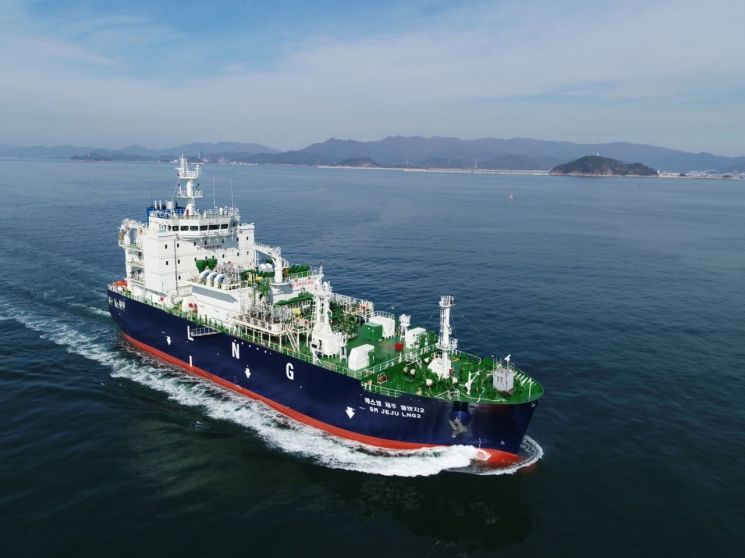 The SM Jeju LNG No. 2, Asia's first LNG bunkering dual-purpose vessel, sailing. (Photo by Korea Gas Corporation)
LNG bunkering refers to the act of supplying fuel to LNG-powered ships. When an LNG-powered vessel docks at a port, LNG is immediately refueled. LNG bunkering has emerged as a new eco-friendly business due to regulations by the International Maritime Organization (IMO). With growing global environmental concerns, the IMO mandated that from 2020 onwards, the sulfur content in all ship fuels be reduced from the previous 3.5% or less to 0.5% or less. Ships that do not meet this standard are prohibited from entering ports of IMO member countries. Separately, Europe and North America have designated their coastal waters as Emission Control Areas (ECA), limiting sulfur content in ship fuels to 0.1% or less.
As a result, LNG has emerged as an alternative fuel for ships. Compared to conventional ship fuels, LNG can reduce sulfur oxides (SOx) and particulate emissions by 100%, nitrogen oxides (NOx) emissions by 15-80%, carbon dioxide (CO2) emissions by 20%, and fine dust by up to 99%.
With the IMO's strengthened regulations on ship emissions, the use of LNG as ship fuel is expected to increase, and related preparations have been underway domestically.
In Korea, the 'Natural Gas for Ships Business' was newly established, and a revision to the Gas Business Act passed the National Assembly in January, allowing registered operators to autonomously import and sell natural gas. This legislative amendment laid the institutional foundation for the LNG bunkering business, which has been in effect since August 5.
Korea Gas Corporation, which owns the world's largest natural gas facilities, completed four LNG loading-only facilities at the Tongyeong LNG terminal, the only ones of their kind in Korea. Subsequently, it built the domestic LNG vessel No. 29, 'SM Jeju LNG 2'. The 'SM Jeju LNG 2', Asia's first LNG bunkering dual-purpose vessel, is equipped with LNG supply facilities for ship fuel and operates between the Tongyeong and Jeju terminals. It is the key vessel leading the corporation's LNG bunkering business.
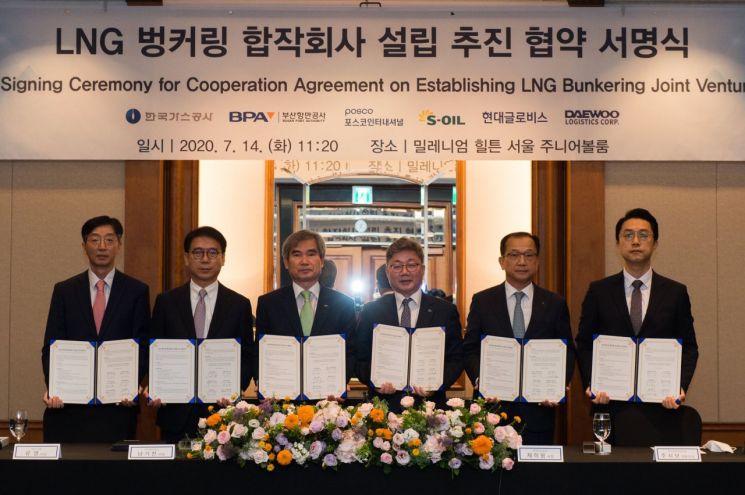 Korea Gas Corporation held the 'LNG Bunkering Joint Venture Establishment Promotion Agreement Signing Ceremony' last July with five companies including Busan Port Authority. From the left: Seongcheol Lee, Executive Director of Hyundai Glovis; Yeol Ryu, President of S-Oil; Gichan Nam, President of Busan Port Authority; Heebong Chae, President of Korea Gas Corporation; Sibo Joo, CEO of POSCO International; Seokhoon Yang, CEO of Daewoo Logis. (Photo by Korea Gas Corporation)
In July, Korea Gas Corporation held a signing ceremony for the 'LNG Bunkering Joint Venture Establishment Agreement' with Busan Port Authority, POSCO International, S-Oil, Daewoo Logistics, and Hyundai Glovis, setting plans to establish a joint venture. The six companies will participate in the joint venture to proactively lead natural gas import, storage, shipment, and supply. Representatives from Korea's natural gas, cargo, refining, port, and logistics sectors are involved, which is expected to secure both early demand and medium- to long-term domestic and international competitiveness.
Gas Corporation set a goal to sell 1.36 million tons of LNG for gas-powered ships and achieve approximately 1 trillion KRW in sales by 2030 through the LNG bunkering joint venture. It plans to reduce 8,315 tons of sulfur oxides and 2,557 tons of fine dust. To this end, it will secure two bunkering vessels for the East and South Seas, one bunkering vessel for the West Sea, and one loading facility at the Dangjin LNG receiving terminal to promote LNG bunkering business at ports nationwide.
Additionally, based on the joint venture's own short- and medium- to long-term business plans, it will secure the LNG bunkering demand base and gradually build infrastructure such as bunkering vessels. A new LNG bunkering dedicated vessel will be constructed (delivered in 2022) and operated to meet increasing LNG bunkering demand in the southeastern ports, including Busan, through shipyard sea trials. President Chae emphasized, "The corporation will proactively invest in the LNG bunkering sector to contribute to the early activation of the bunkering industry."
© The Asia Business Daily(www.asiae.co.kr). All rights reserved.
![Clutching a Stolen Dior Bag, Saying "I Hate Being Poor but Real"... The Grotesque Con of a "Human Knockoff" [Slate]](https://cwcontent.asiae.co.kr/asiaresize/183/2026021902243444107_1771435474.jpg)
















