Kim Jong-in "Opposition within the party itself is not very important"
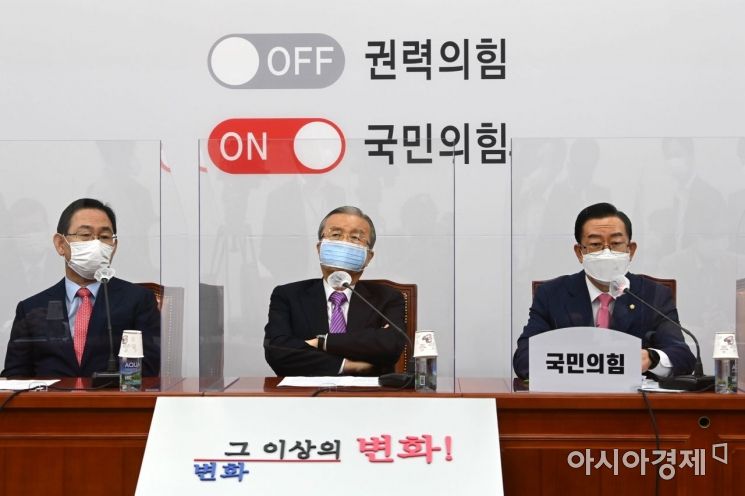 Kim Jong-in, the Emergency Committee Chairman of the People Power Party, is attending the Emergency Committee meeting held at the National Assembly on the 21st, wearing a serious expression. Photo by Yoon Dong-joo doso7@
[Asia Economy Reporter Park Cheol-eung] The People Power Party is expressing a positive stance on the so-called 'Fair Economy 3 Acts' (Commercial Act, Fair Trade Act, and Financial Group Integrated Supervision Act), citing the need to 'complement the market.' While anti-market elements should be removed, the overall framework is considered necessary. When Kim Jong-in, the emergency committee chairman of the People Power Party, previously directly proposed related bills, it only led to extreme confrontations between the ruling and opposition parties. However, now that Chairman Kim has shifted his position and reintroduced economic democratization as a catchphrase, momentum is rapidly building.
On the 21st, Chairman Kim told reporters, "(The Fair Economy 3 Acts) themselves are not a big problem. If there are a few things to correct during discussions by some lawmakers, they might be somewhat amended, but the three acts themselves should not be rejected or dismissed." He also mentioned, "Since there are many lawmakers, opposing opinions are also presented, but I don't think that itself is very important." This was a statement regarding dissenting opinions within the party.
People Power Party lawmaker Sung Il-jong appeared on MBC Radio's 'Kim Jong-bae's Focus' on the same day, saying, "The market is not omnipotent, so these laws play a role in supplementing what the market lacks," and added, "'Fair Economy' or 'Corporate Regulation' both have significant intent from the outset, so it is necessary to approach them from a different angle." He also said, "I don't know why people think our People Power Party cannot take a progressive stance." He serves as an emergency committee member of the People Power Party and the opposition party whip on the National Assembly's Political Affairs Committee, which oversees the Fair Trade Act and the Financial Group Integrated Supervision Act.
With Chairman Kim indicating willingness to accept the bills, the Democratic Party is trying to accelerate the process. Kim Tae-nyeon, floor leader of the Democratic Party, said at the Supreme Council meeting that "The Democratic Party will process the Fair Economy 3 Acts during this regular session of the National Assembly. They are a major pillar enabling sustainable growth," and emphasized, "Although these were pursued in the 20th National Assembly, they were repeatedly blocked by opposition parties. Recently, Emergency Committee Chairman Kim Jong-in has repeatedly expressed support for the Fair Trade Act and Commercial Act. We hope the opposition party will be different this time."
The multiple derivative lawsuit system, which allows minority shareholders of a parent company to sue subsidiary executives, and the proposal to separately appoint audit committee members to check the influence of major shareholders, are core elements of the government's proposed amendments to the Commercial Act and were also included in the bill Chairman Kim proposed in 2016. These are among the representative measures of economic democratization advocated by Chairman Kim.
Lawmaker Sung said, "Both I and Chairman Kim agree that, in the big picture, we should amend and complement the market," adding, "However, if there are anti-market elements that constrain companies or weaken competitiveness, the ruling and opposition parties should negotiate to open those parts."
Despite strong opposition from the business community, a different voice is emerging within the conservative opposition party. There was also mention of sensitive issues such as 'preferential treatment of affiliated companies.' Sung said, "They are called chaebols, but large corporations often engage in private profit appropriation," and added, "In simple terms, this is called preferential treatment of affiliated companies. I think it is necessary to significantly strengthen regulations on such private profit appropriation. If orders are not concentrated within a group’s special affiliates but are distributed to small and medium-sized enterprises that trade independently, it would greatly benefit our economy."
This issue is closely related to the multiple derivative lawsuit system. In the 20th National Assembly, there were several intense debates in the Legislation and Judiciary Committee over amendments to the Commercial Act, with the multiple derivative lawsuit system at the center. Sometimes, the disputes escalated to 'verbal fights.' According to the transcript of the Legislation and Judiciary Committee’s first subcommittee on February 27, 2017, then-lawmaker Kim Jin-tae of the Liberty Korea Party interrupted a Ministry of Justice official’s response, and committee chairman Park Beom-gye intervened, saying, "Let's listen until the end," leading to a scuffle. During this, Kim said things like "(slamming the desk with documents) Please be quiet!" and "What are you, some kind of gangster?" Chairman Park also had a verbal exchange with lawmaker Yeo Sang-gyu of the Liberty Korea Party, telling him, "Please stay still!"
At that time, the Liberty Korea Party was generally negative, fearing burdens such as excessive lawsuits against companies and insisted that thorough supplementary measures were necessary. The business community actively opposed the issue, claiming threats to management rights. The confrontation in the subcommittee arose from the power struggle between the Democratic Party, which tried to push the bill through, and the Liberty Korea Party, which tried to block it.
The Democratic Party’s landslide victory in the general election and Chairman Kim’s 'defection' shifted the balance of power. Of course, within the People Power Party, many still view the bills as corporate regulations and oppose them. Lawmaker Sung said, "It is a sensitive issue, and I expect many parts will contradict the market economy order to some extent," adding, "Since there are also members who emphasize the market, I plan to report at the party caucus meeting, gather various opinions, and reflect them during the bipartisan bill subcommittee discussions."
© The Asia Business Daily(www.asiae.co.kr). All rights reserved.
![Clutching a Stolen Dior Bag, Saying "I Hate Being Poor but Real"... The Grotesque Con of a "Human Knockoff" [Slate]](https://cwcontent.asiae.co.kr/asiaresize/183/2026021902243444107_1771435474.jpg)















