ICT Sector Operates Total of 5 'Workplaces' in Seoul Metropolitan Area... No Restrictions on Commuting, Hub, or Remote Work, Freely Choose 4 Days a Week
[Asia Economy Reporter Ki-min Lee] Hanwha Systems ICT division announced on the 21st that it will be the first among Hanwha Group affiliates to switch to a 'Smart Work System' to secure work flexibility based on untact (contactless) and digital platforms.
The core of Hanwha Systems' Smart Work System is the 'remote work system' that minimizes personnel density and commuting times while maintaining work continuity from anywhere. Centered on the Yeouido workplace, the main worksite of Hanwha Systems ICT division, 'hub offices' will be operated in the Seoul areas of Janggyo-dong, Sinseol-dong, Bulgwang-dong, and the Pangyo Research Center in Seongnam, Gyeonggi Province.
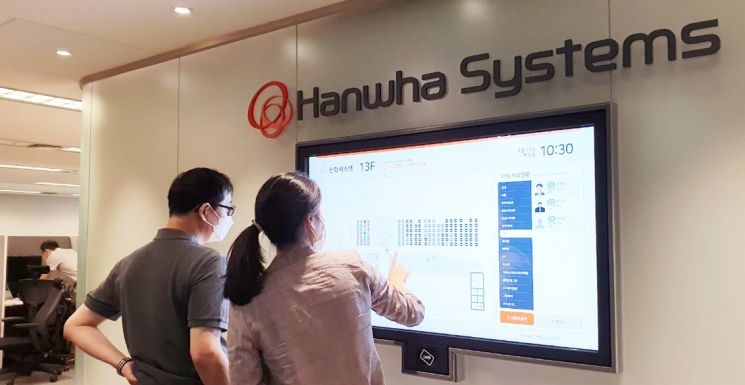
Hanwha Systems ICT division explained that it analyzed employees' address data and conducted surveys on main work areas and preferred locations to identify the demand for hub offices. A total of five workplaces and seats can be selected through a reservation system, which is available in both web and mobile environments, allowing status checks and reservations anytime and anywhere.
The hub offices are composed of six themes designed to foster creative idea generation and improve work efficiency. Personal workspaces are equipped with smart name tags displaying reserved seat status and basic monitors. Depending on the seat type, spaces are divided into work zones for general tasks and focus zones resembling study rooms. There are also agile zones for projects and task forces (TF), and communication zones for video conferencing.
Within four days a week, there are no restrictions on commuting to the main workplace, hub office work, or working from home. Employees conduct a 'Collabo Day' once a week where the entire team comes to the office to enhance teamwork and conduct offline work. The 'flexible work system,' which allows employees to choose commuting times according to personal circumstances, is equally applied during remote work.
Since 2015, Hanwha Systems ICT division has implemented a free seating system by removing wired phones and establishing wireless internet environments. They have built a work environment for smart work inside and outside the company, including schedule reservations, video conferencing via internal messengers, and mobile intranet.
To introduce this smart work system, Hanwha Systems plans to enhance the real-time work sharing system through its self-developed and operated internal intranet 'Circle,' supporting the sharing of work content and progress.
Kim Yeon-cheol, CEO of Hanwha Systems, said, “Through the implementation of an advanced smart work system, Hanwha Systems aims to prepare for unpredictable situations such as COVID-19 to ensure no interruption in work and services, and to improve the work-life balance of employees. We will continue to strive to establish an efficient and flexible work environment and corporate culture.”
© The Asia Business Daily(www.asiae.co.kr). All rights reserved.
![Clutching a Stolen Dior Bag, Saying "I Hate Being Poor but Real"... The Grotesque Con of a "Human Knockoff" [Slate]](https://cwcontent.asiae.co.kr/asiaresize/183/2026021902243444107_1771435474.jpg)















