Prediction of Turbulent Transition Phenomena in Flow Around Objects,
Development of Techniques Enabling Precise Simulation
Expectations for High-Speed Aircraft and Eco-Friendly Transport Development
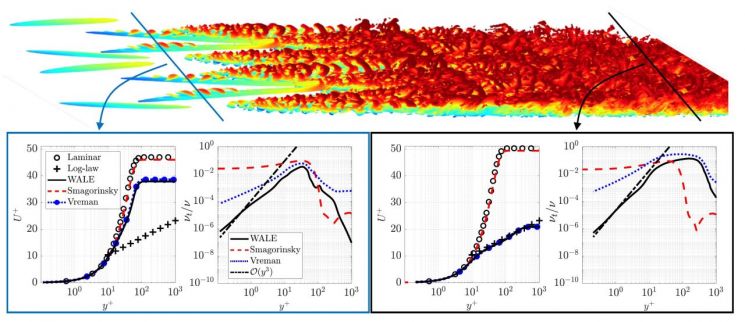 Vortex structures generated during the transition process of boundary layer flow (top) and velocity distribution and turbulent viscosity before transition (bottom left), as well as velocity distribution and turbulent viscosity after transition (bottom right). Analysis of various large eddy simulation models (WALE). It demonstrates that the WALE model is effective in predicting the transition process.
[Asia Economy Reporter Junho Hwang] A technology has been developed that can predict the starting point of turbulent flow, which causes air resistance when an airplane flies in the sky. It is expected to be a useful technology for the development of airplanes, ships, cars, etc., as it can predict the actual airflow and create similar environments.
The research team led by Professor Solgeun Ji of the Department of Mechanical Engineering at Gwangju Institute of Science and Technology, in collaboration with Professor Donghoon Park of the Department of Aerospace Engineering at Pusan National University, developed a method to accurately predict the transition phenomenon, which is the beginning of turbulent flow around an object. The research results are scheduled to be published in November in the international journal in the field of mechanical engineering and multidisciplinary engineering, Computer Methods in Applied Mechanics and Engineering. The atmosphere contains laminar flow, where air flows smoothly, and turbulent flow, where air velocity and pressure change abruptly. The phenomenon of changing from laminar flow to turbulent flow is called flow transition.
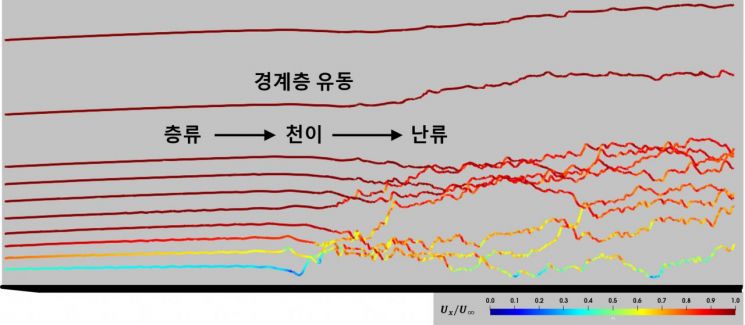 Schematic diagram of the laminar-turbulent transition process in fluid flow. The flow was visualized based on numerical analysis results of the boundary layer flow over a flat plate.
The research team developed a numerical analysis method applicable up to the flow transition phenomenon, which is the start of turbulence. This method combines flow stability theory with large eddy simulation (LES). LES is a numerical analysis technique that directly simulates large vortices with significant kinetic energy among turbulent motions of various sizes without using a model.
The team verified several turbulence models used in LES and was able to identify turbulence models that are effectively activated during the transition from laminar to turbulent flow. Turbulence models generally do not guarantee performance during the transition process; in this study, additional analysis was conducted to determine whether the model equations are suitable for the flow physics.
Professor Solgeun Ji said, "This research is a fundamental study that can be utilized for predicting boundary layer transition necessary for the development of supersonic/hypersonic high-speed vehicles," and added, "The flow simulation method developed in this study is expected to contribute to clearly elucidating the transition phenomenon where turbulence, a challenging problem in engineering, begins."
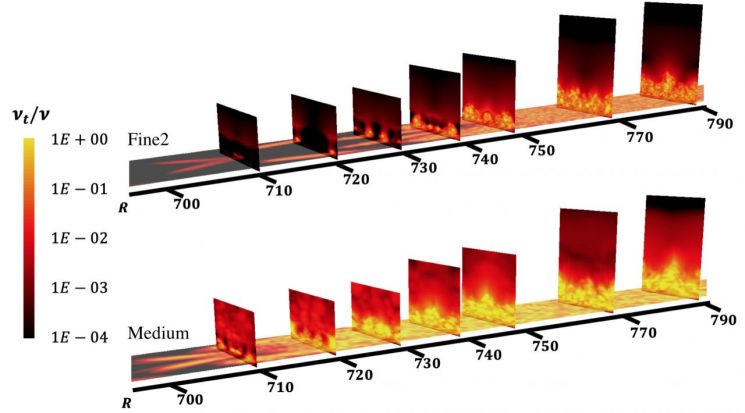 In the numerical analysis of large eddy simulation for the laminar-turbulent transition process in boundary layer flow, it was confirmed that the turbulence viscosity from the large eddy simulation model becomes active from the late transition stage by comparing it with the fluid viscosity.
© The Asia Business Daily(www.asiae.co.kr). All rights reserved.
![Clutching a Stolen Dior Bag, Saying "I Hate Being Poor but Real"... The Grotesque Con of a "Human Knockoff" [Slate]](https://cwcontent.asiae.co.kr/asiaresize/183/2026021902243444107_1771435474.jpg)

















