Dongkuk Steel, Hyundai Steel, and Others Temporarily Store Scrap Metal at Worksites
Maximum Radiation Levels 0.52~54.7uSv/h, 5 to 500 Times Above Permissible Limits
12 of 17 Cases Left Unattended Due to Cost Adjustment Issues with Scrap Metal Distributors and Suppliers
No Regulations on Cost Burden or Processing Deadlines... "Government to Handle First, Then Seek Reimbursement"
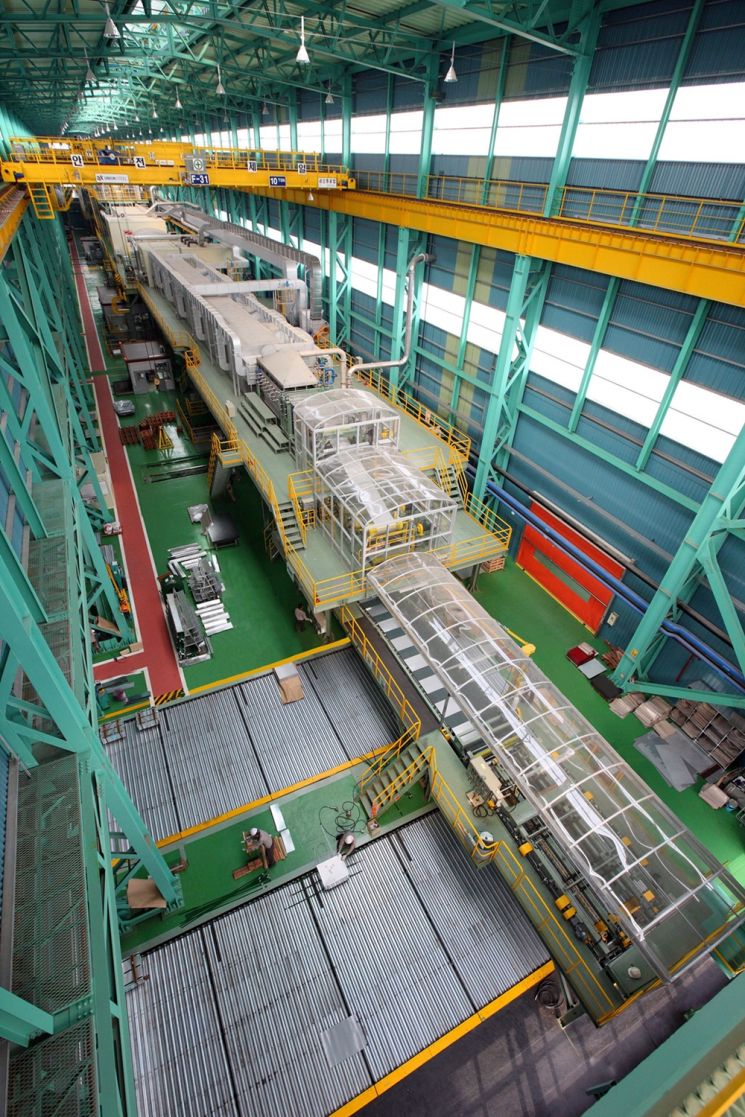
[Asia Economy Reporter Moon Chaeseok] It has been revealed that approximately 6 tons of 'radioactively contaminated scrap metal' were detected through radiation monitors on recycled scrap metal over the past five years. Of this, more than a quarter, over 1.3 tons, remain unprocessed and unreturned, left abandoned nationwide.
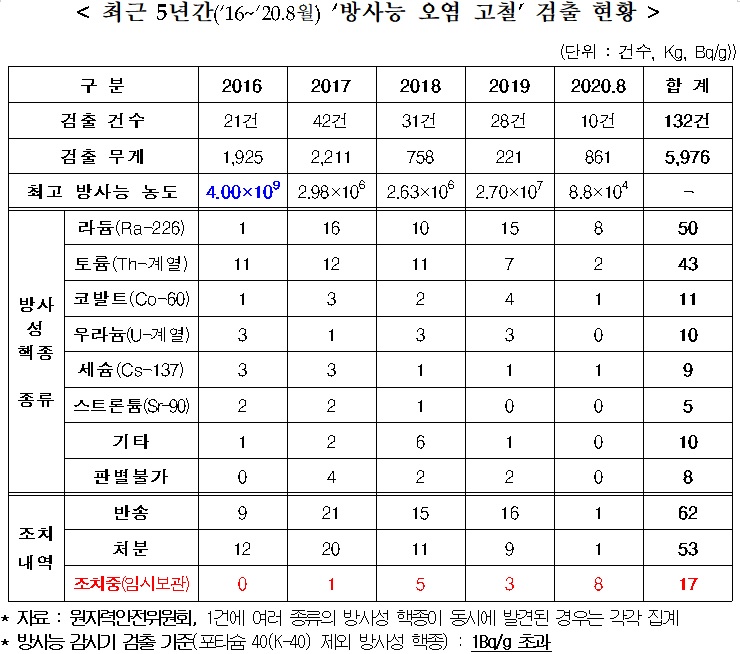
According to data received by Cho Jeongsik, a member of the National Assembly's Science, Technology, Information and Broadcasting Committee from the Nuclear Safety and Security Commission, during the national audit on the 21st, a total of 5,976 kg (132 cases) of radioactively contaminated scrap metal were recorded from 2016 to August this year.
Among these, 1,380 kg (17 cases) of scrap metal have yet to be returned to the importing countries or disposed of and are temporarily stored at scrap metal handlers' sites such as Dongkuk Steel and Hyundai Steel.
Of the 132 cases of recycled scrap metal where 'notable substances' were detected, 62 cases were returned to the importing countries, 53 cases were disposed of according to relevant regulations such as the 'Nuclear Safety Act,' but 17 cases are still stored in warehouses within each business site.
A representative case is a motor fan in which thorium was detected at Dongkuk Steel's Pohang plant in July 2017, which has been temporarily stored in Dongkuk Steel's storage room for more than three years.
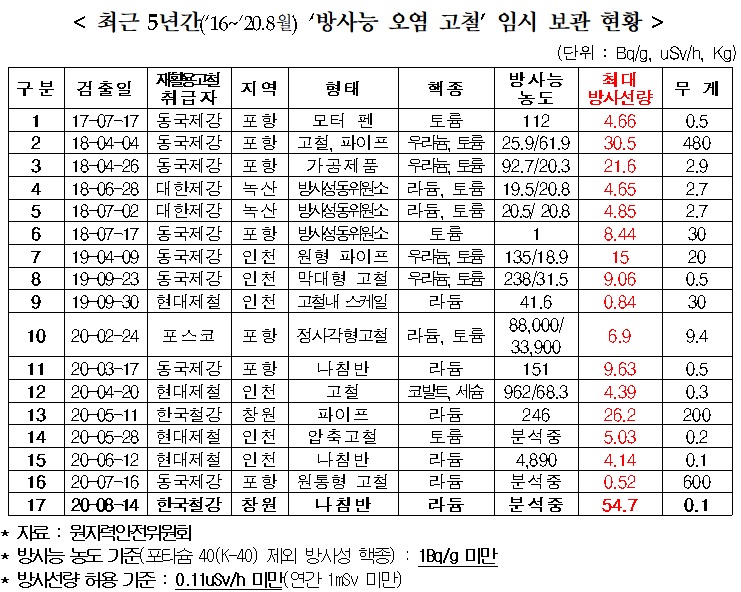
The temporarily stored radioactively contaminated scrap metal was found in various forms such as motor fans, circular pipes, and compressed scrap metal. The maximum radiation dose ranged from 0.52 to 54.7 microsieverts (uSv/h), which is 5 to 500 times higher than the permissible exposure limit of 0.11 uSv/h.
The detected radioactive nuclides include thorium, uranium, radium, and cobalt. Long-term exposure to these can cause cancer and leukemia. In particular, radon, which is produced by the decay of uranium, is classified as a Group 1 carcinogen along with asbestos. It is the second leading cause of lung cancer after smoking.
According to the 'Living Radiation Act,' 'recycled scrap metal handlers' who operate electric melting facilities of 30 tons or more to recycle scrap metal are required to install radiation monitors and take measures such as supplementing, returning, or collecting 'radioactively contaminated scrap metal' that exceeds certain standards.
As of last year, 13 steelmakers including Hyundai Steel, POSCO, and Korea Steel have installed and operated 57 radiation monitors nationwide.
Due to the nature of recycled scrap metal, which is frequently cut and damaged, it is difficult to trace the origin, distribution path, and intended use of notable substances unlike original products, often causing delays in processing due to cost adjustments.
Among the 17 cases of 'temporary measures for radioactively contaminated scrap metal' left unattended, 12 cases have been delayed due to cost negotiations with scrap metal distributors and suppliers.
For example, in April 2018, Dongkuk Steel's Pohang plant detected radiation approximately 277 times the permissible limit (maximum dose about 30.5 uSv/h) from about 480 kg of scrap metal including compressed scrap and pipes, and reported it to the Korea Foundation for Nuclear Safety in April last year.
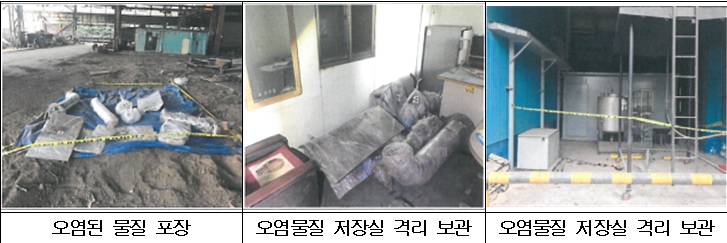
The Nuclear Safety and Security Commission requested a plan of action for the notable substances in July last year according to relevant regulations, but due to cost negotiations, the contaminated materials are still temporarily stored in Dongkuk Steel's contaminated materials storage room.
In February of this year, POSCO's Pohang plant detected radiation approximately 70 times the permissible limit (maximum dose about 6.9 uSv/h) while receiving about 16 tons of stainless steel (STS) recycled scrap and reported it to the Korea Institute of Nuclear Safety in the same month.
However, due to the lengthy process of investigating and analyzing radiation concentration and tracing the origin and distribution path of notable substances, the Nuclear Safety and Security Commission has yet to finalize the investigation results. The radioactively contaminated scrap metal is still stored in the radioactive isotope storage room at the Pohang Steelworks.
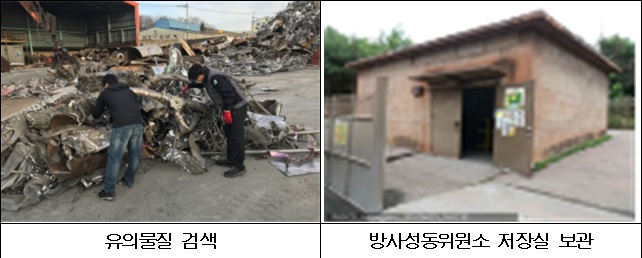
The problem is that more than 1.3 tons of 'radioactively contaminated scrap metal' are abandoned in Incheon, Pohang in North Gyeongsang Province, and Changwon in South Gyeongsang Province, but there are no regulations on who bears the cost of scrap metal disposal or the disposal deadline, making it uncertain when these contaminated scrap metals will be processed.
Representative Cho stated, "In a situation where public concern over radioactive substances such as radon beds in 2018 and thorium and uranium detected in Japanese cosmetics this year is high, the relatively neglected 'radioactively contaminated scrap metal' being left abandoned across the country until now is a dereliction of duty by the Nuclear Safety and Security Commission, the competent authority."
He emphasized, "Since there have been multiple issues raised regarding the handling of recycled scrap metal, the Nuclear Safety and Security Commission should urgently devise a processing plan. In particular, for cases delayed due to processing costs, the government should prioritize processing first, then claim compensation from the responsible parties, and consider establishing regulations on the processing deadlines for recycled scrap metal."
© The Asia Business Daily(www.asiae.co.kr). All rights reserved.
![Clutching a Stolen Dior Bag, Saying "I Hate Being Poor but Real"... The Grotesque Con of a "Human Knockoff" [Slate]](https://cwcontent.asiae.co.kr/asiaresize/183/2026021902243444107_1771435474.jpg)

















