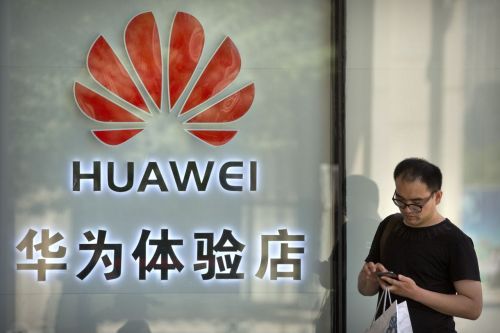
[Asia Economy Reporter Joselgina] The additional US sanctions targeting China's Huawei are inevitably causing a seismic shift in the global smartphone market. Following the Google Android OS restrictions, global companies such as Samsung Electronics and SK Hynix are now also cut off from semiconductor supply. Amid concerns that Huawei could be completely pushed out of the smartphone market in the worst-case scenario, competitors like Samsung Electronics, Apple, and Xiaomi are expected to benefit from the fallout. Samsung Electronics' smartphone shipments are projected to exceed 300 million units again next year.
According to industry sources on the 19th, market research firm Strategy Analytics (SA) forecasted that Huawei's global smartphone market share, estimated at around 15% this year, will plummet to 4.3% next year. SA expects that the chipset stockpiled by Huawei in preparation for the US-China trade war will be depleted by next year, causing Huawei's smartphone shipments to sharply decline from 190 million units this year to 59 million units next year.
During this period, Huawei's market share in China is expected to be taken over by other Chinese companies with similar cost-performance strategies such as Xiaomi, Oppo, Vivo, and Realme, while globally Samsung Electronics and Apple are anticipated to capture the share. In particular, it is predicted that Huawei's position will shrink even within China, where it had maintained strength through so-called 'patriotic demand' despite US pressure.
Samsung Electronics' shipments are estimated to rise from 265.5 million units this year to nearly 300 million units next year. Market research firm Canalys analyzed, "Samsung Electronics has established itself as a stable alternative option following Huawei's exclusion."
The additional sanctions, effective from the 15th, prohibit supplying Huawei with products made using US equipment, software, or design technology without prior approval from the US Department of Commerce. This is a powerful measure that effectively halts transactions with third countries following the US. Violations can result in up to 20 years imprisonment, fines of $1 million per case, and the risk of becoming a US target, prompting busy movements among companies worldwide.
This inevitably delivers a direct blow to Huawei's core business. This is why foreign media reports have repeatedly stated that the US administration has effectively issued a death sentence to Huawei. Huawei is known to have stockpiled key chips and other inventory since late 2018 as the US-China trade war intensified, but it remains unclear whether it has secured detailed components such as advanced displays and camera lenses.
Huawei has also acknowledged that the sanctions could negatively impact its future smartphone sales. It is highly likely that Huawei will adopt a strategy to secure low-cost Chinese-made substitute parts to circumvent US sanctions. However, the industry expects that this will inevitably degrade the product competitiveness Huawei has built up so far. For competitors like Samsung Electronics, this represents a major opportunity to expand both market share and technological gaps.
© The Asia Business Daily(www.asiae.co.kr). All rights reserved.
![Clutching a Stolen Dior Bag, Saying "I Hate Being Poor but Real"... The Grotesque Con of a "Human Knockoff" [Slate]](https://cwcontent.asiae.co.kr/asiaresize/183/2026021902243444107_1771435474.jpg)















