⑪History of Korea's Cement Industry (Final Episode)
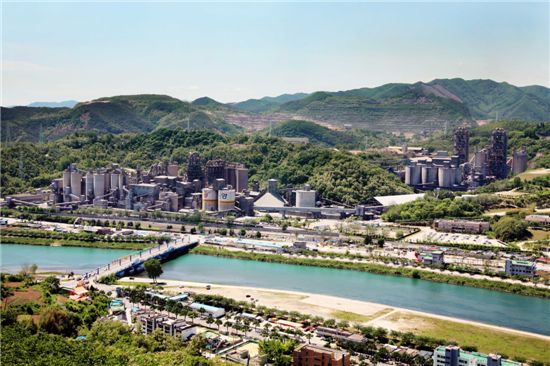 Sampyo Cement Factory located in Samcheok, Gangwon-do.
 [Photo by Asia Economy DB]
[Asia Economy Reporter Kim Jong-hwa] While researching the history of Korea's cement industry, the old Chinese proverb 'Ugong Yishan (愚公移山)' came to mind. It means that a person who persistently digs one well will eventually achieve great results.
Hanil Cement, which has grown into the largest cement producer in Korea, started in 1961 when the late Chairman Heo Chae-kyung, the founder of Hanil Cement, visited Udeok-ri, Maepo-eup, Danyang-gun, Chungbuk, which was a barren mountain with nothing on it. However, Chairman Heo was determined to create something out of nothing. He named the company 'Udeok' after the place name and devoted himself to completing the cement plant.
The late Kim Sang-soo, the founder of Sungshin Cement, devoted himself to the cement industry with the belief that "when the country needs it, I will do what is necessary," after the independence movement and liberation, overcoming numerous crises and challenges while maintaining the spirit of serving the country through industry. All the founders who built the cement industry were 'Ugong' (persistent workers).
In 1958, the domestic cement industry produced about 290,000 tons, but it has now grown 175 times to 50.6 million tons, making Korea one of the world's top 10 producers. The quality and technology of cement have improved to be on par with Europe and Japan. The cement industry, along with automobile, shipbuilding, construction, steel, and petrochemical industries, has been a key infrastructure industry driving Korea's economic development.
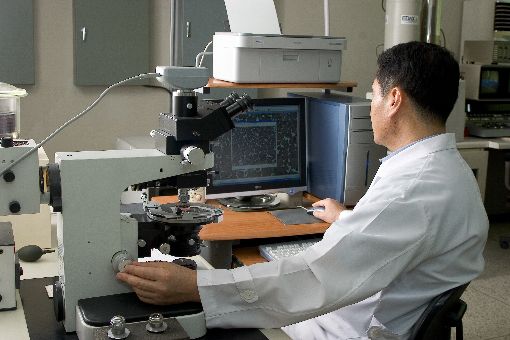 A researcher at Ssangyong Cement is analyzing cement components using an X-ray analyzer. The cement industry is transforming into an eco-friendly industry.
 [Photo by Asia Economy DB]
The industry has contributed too much to be dismissed as a declining or polluting industry due to unclear eco-friendly arguments. A representative from the Korea Cement Association said, "Experts with a deep understanding of the cement industry argue that it is difficult to develop alternative building materials to replace cement, and even if invented, it is questionable whether they can compete with cement in terms of economy and versatility." He added, "It is regrettable that the cement industry is considered a declining industry simply because it has a long history and is not at the center of industries leading the 4th Industrial Revolution, such as IT."
Currently, the challenges surrounding the domestic cement industry are far from easy. Although it overcame the IMF financial crisis, it has not fully recovered from the deep wounds. Sales decline and profitability deterioration due to fluctuations in the construction market are typical examples of factors that hamper industry management like a roller coaster.
The cause is the cement price, which directly affects sales. Cement prices are lower now (61,500 KRW/ton) than 17 years ago in 2003 (66,000 KRW/ton). Cement prices are among the lowest internationally. According to KOTRA, the average cement price in 2019 in 11 major countries including the U.S., Japan, China, and Germany was about 112,000 KRW/ton, approximately 50,000 KRW higher per ton.
Domestic cement prices are even lower than those in Indonesia (70,300 KRW/ton) and Brazil (about 116,600 KRW/ton). If the domestic cement industry collapses due to management difficulties, imports from neighboring countries such as China and Japan would be necessary, but related industries like construction and ready-mix concrete would not be able to bear this.
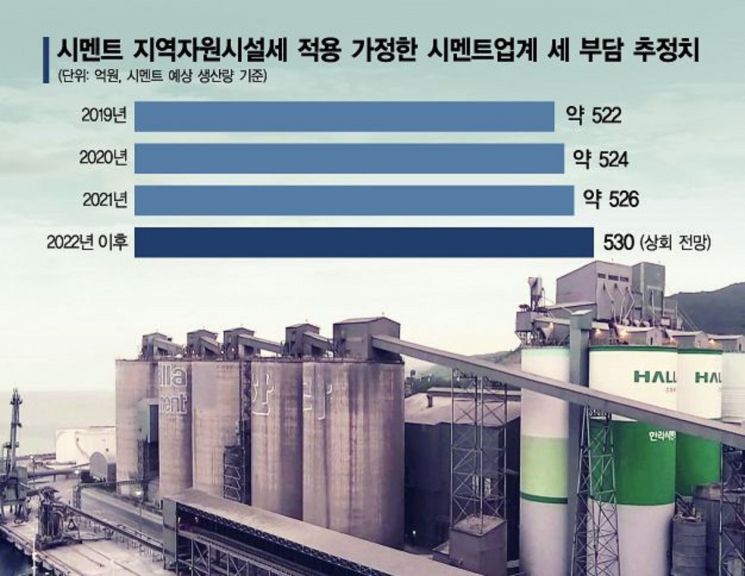
The proposed legislation to impose a local resource facility tax of about 1,000 KRW per ton of cement is also a burden. The government and local governments promote reshoring, offering various tax benefits and deregulation to companies that have moved production bases overseas due to labor costs, to bring them back domestically. However, some worry that the populist policy to make local cement companies, which have contributed to the development of underdeveloped regional economies, share local finances is "inconsistent and will ultimately lead to the collapse of the regional economy, losing more than it gains."
Rather, the government, which should cooperate with the cement industry to realize a resource-recycling society, is moving in the opposite direction. The waste problem caused by the surge in single-use containers due to COVID-19 can be solved by fuel conversion at cement production facilities. There is ample experience from the 1990s when waste tires were recycled to solve environmental problems. Advanced countries such as Europe and Japan have long used the cement industry to address environmental issues, but the domestic cement industry's recycling rate is relatively low despite having the same technology. Unnecessary social costs reduce national competitiveness. Being trapped in the simplistic logic of "reducing individual consumption to prevent waste generation" risks missing the golden time.
Also, since the current government is committed to improving relations with North Korea and unification, attention should be paid to the future role of the cement industry. Although inter-Korean relations are currently not smooth, North Korea's estimated limestone reserves are about 10 times those of South Korea. When full-scale economic cooperation begins, the cement industry will be responsible for supplying cement needed for various infrastructure expansions to reduce the gap between North and South Korea, as well as providing technical support.
At the cement industry's New Year's meeting earlier this year, Lee Hyun-jun, chairman of the Korea Cement Association (and current CEO of Ssangyong Cement), mentioned 'Yujigyeongseong (有志竟成),' meaning that those with determination will surely succeed. It was an encouragement to "have faith in Yujigyeongseong and work together despite uncertain and difficult management environments."
A representative from the Cement Association said, "Since its inception, Korea's cement industry has faced unexpected challenges and survived by overcoming them," adding, "We will continue to challenge ourselves with the spirit of Ugong Yishan and the attitude of Yujigyeongseong to become a more mature infrastructure industry as an eco-friendly and clean industry."
© The Asia Business Daily(www.asiae.co.kr). All rights reserved.
![Clutching a Stolen Dior Bag, Saying "I Hate Being Poor but Real"... The Grotesque Con of a "Human Knockoff" [Slate]](https://cwcontent.asiae.co.kr/asiaresize/183/2026021902243444107_1771435474.jpg)















