WSJ·THE University Rankings
Eight Ivy League Schools in the US Northeast Secure Top 15 Spots
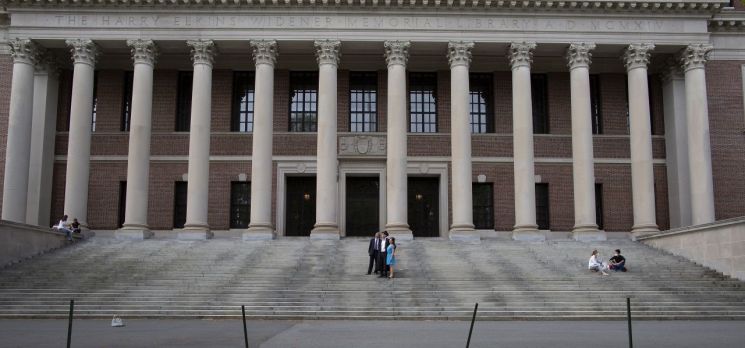
[Asia Economy Reporter Kwon Jae-hee] Harvard University has once again ranked first in the U.S. college rankings this year.
The Wall Street Journal (WSJ) announced on the 17th (local time) that Harvard University ranked first for the fourth consecutive year in the U.S. university evaluation conducted this year in collaboration with the university ranking agency THE (Times Higher Education).
Following Harvard, the Massachusetts Institute of Technology (MIT) ranked second, and Yale University ranked third.
Brown University ranked fifth, Princeton University seventh, Cornell University ninth, Dartmouth College twelfth, the University of Pennsylvania thirteenth, and Columbia University fifteenth, with all eight private universities in the U.S. East Coast known as the Ivy League placing within the top 15.
Excluding Stanford University (4th), Duke University (tied 5th), California Institute of Technology (tied 7th), and Northwestern University (10th), more than half of the top 10 universities are located in the Northeastern United States.
The WSJ and THE university evaluation is based on 15 key factors across four categories. 'Student outcomes,' including graduates' salaries and student loan repayment levels, account for 30%; 'academic dimension,' such as the university's investment in teaching, accounts for 30%; 'student engagement,' which evaluates how students intend to contribute to society with the knowledge they have gained, accounts for 20%; and 'learning environment,' reflecting the diversity of students and faculty, accounts for 10% of the score.
Notably, this year's evaluation was conducted in a situation where most universities replaced in-person classes with online courses starting from last spring semester due to the COVID-19 pandemic, drastically changing the campus environment.
Ted Mitchell, president of the American Council on Education (ACE), said, "This year, it will be incredibly difficult to apply any standard to higher education," adding, "So much is fluid that it is hard to know what will happen even two seconds from now."
Meanwhile, WSJ and THE explained that most of the data used in this year's evaluation were collected before campuses shut down, and factors such as the quality of online classes or compliance with safety standards during face-to-face classes were not considered.
© The Asia Business Daily(www.asiae.co.kr). All rights reserved.
![Clutching a Stolen Dior Bag, Saying "I Hate Being Poor but Real"... The Grotesque Con of a "Human Knockoff" [Slate]](https://cwcontent.asiae.co.kr/asiaresize/183/2026021902243444107_1771435474.jpg)















