Collecting Petitions from Eunma Residents
Judging Actual Residence Requirement for Union Members
Claiming Criteria Based on Household Members, Not Heads of Household
Requesting Withdrawal of Exception Recognition and Retroactive Application When Unable to Move In Under Contract Renewal Rights
[Asia Economy Reporter Donghyun Choi] Residents of major reconstruction apartment complexes continue to express dissatisfaction over the introduction of a 2-year actual residence obligation for reconstruction apartment association members. Although some exceptions were recently established through government-party consultations, some complexes have begun collective actions such as submitting petitions, arguing that the measures still do not adequately reflect reality.
According to industry sources on the 18th, residents of Eunma Apartment in Daechi-dong, Gangnam-gu, Seoul, have recently started collecting petitions requesting the establishment of exception rules for the 2-year actual residence obligation. The residents are demanding that the actual residence requirement for association members be judged based on household members rather than the head of the household. They want cases where the head of the household is working overseas or in a provincial area and only other household members such as children are registered as residents to be recognized as actual residence. They also included opinions requesting that situations where the owner cannot move in for 2 years due to the introduction of the contract renewal right be recognized as exceptions, and that retroactive application be withdrawn.
The actual residence obligation for reconstruction association members is a policy that, after the scheduled revision of the Urban and Residential Environment Improvement Act at the end of the year, requires association members in reconstruction complexes located in speculative overheated districts who apply for association establishment approval to fulfill a 2-year actual residence requirement to qualify for moving into the new apartments. The government announced this policy during the June 17 real estate measures, and recently, Assemblyman Cho Eung-cheon of the Democratic Party of Korea submitted a representative bill for the revision of the Urban and Residential Environment Improvement Act after government-party consultations. The bill is expected to be submitted after a legislative notice period until the 20th.
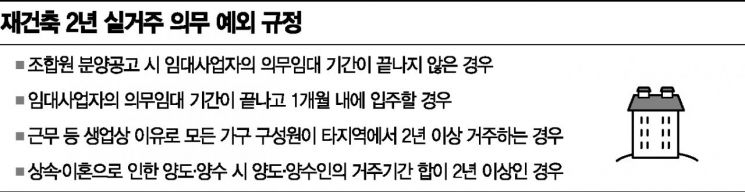
According to the revision bill, unlike the initial policy announcement, various exceptions to the 2-year actual residence obligation have been established for rental business operators and long-term absentees. Specifically, when announcing the association member sale notice, if the mandatory rental period of a rental business operator has not ended, or if the owner moved in within one month after the rental period ended but did not complete 2 years, they will be recognized as exceptions. Also, if all household members live in another region for more than 2 years due to work or other livelihood reasons, actual residence is considered impossible, and exceptions will be made. In cases of inheritance or divorce, if the combined residence period of the transferor and transferee in the relevant house is more than 2 years, it will be considered an exception.
Despite these exceptions, opposition to the introduction of this bill remains strong. Currently, about 490 citizen opinions have been submitted to the National Assembly legislative notice system regarding Assemblyman Cho’s proposed revision of the Urban and Residential Environment Improvement Act. This is the highest number among the 33 bills announced for legislative notice by members of the Land, Infrastructure and Transport Committee this month. Regarding reasons for opposing the bill, Mr. Kim stated, "Applying the 2-year actual residence regulation indiscriminately to both single-homeowners and multi-homeowners treats actual residents and speculators equally," and added, "If a single-homeowner fails to meet the actual residence requirement and is forced to cash out, are they supposed to live on the streets?" Mr. Park said, "People who buy reconstruction complexes plan long-term housing assuming they will live in the new homes to be built. If the 2-year residence clause had existed at the time of purchase, they obviously would not have bought it, but the government’s policy has disrupted their plans." The petition opposing the bill has also been posted on the Blue House National Petition Board, currently with over 600 supporters.
Seo Jin-hyung, President of the Korea Real Estate Society (Professor at Gyeongin Women’s University), pointed out, "Laws should be predictable and sustainable, but forcing existing owners to meet the 2-year residence requirement constitutes retroactive application and may be unconstitutional," adding, "It would be desirable to apply this regulation only to new acquirers after the law’s introduction to effectively curb speculation and stabilize housing."
Meanwhile, until the Urban and Residential Environment Improvement Act revision is enacted in December, if association establishment approval is not applied for, the 2-year actual residence obligation will apply, prompting many reconstruction complexes to hasten their association establishment. Representative examples include Sinbanpo 2nd Complex in Jamwon-dong, Seocho-gu, and Apgujeong 3rd to 5th Districts in Apgujeong-dong, Gangnam-gu.
© The Asia Business Daily(www.asiae.co.kr). All rights reserved.
![Clutching a Stolen Dior Bag, Saying "I Hate Being Poor but Real"... The Grotesque Con of a "Human Knockoff" [Slate]](https://cwcontent.asiae.co.kr/asiaresize/183/2026021902243444107_1771435474.jpg)















