Shinsegae Gyeonggi Renewed After 14 Years
Galleria Gwanggyo Attracting 3 Major Luxury Brands
Huge Commercial Area with Population Larger Than Seoul
Outlet and Shopping Malls Compete to Open Stores Nearby
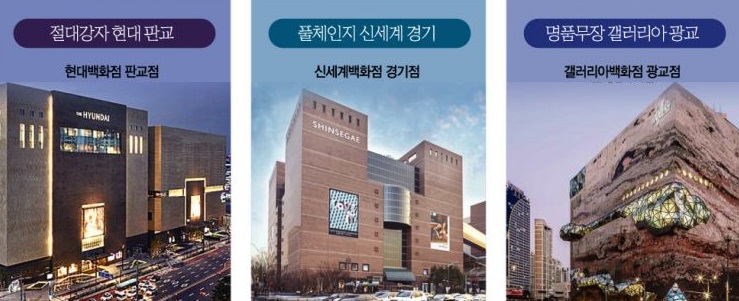
[Asia Economy Reporter Lim Hye-seon] The retail industry is intensifying competition over the southern Gyeonggi commercial district. The population of Seongnam City, including Pangyo and Bundang, and Yongin City alone totals 2 million. Additionally, with new apartment move-ins centered around Hwaseong, Yongin, and Suwon, the population is rapidly increasing. Customers have high income levels and strong purchasing power, prompting retailers to actively invest to capture shopping demand in the southern Gyeonggi region.
On the 18th, according to the retail industry, Shinsegae Department Store is undergoing a revamp 14 years after the opening of its Gyeonggi branch. The 8th floor of the parking building, previously occupied by Uniqlo and Muji, is being transformed into a sports and outdoor specialty zone. Scheduled to open in November, this area will be approximately 3,305m² (1,000 pyeong) in size. In addition to outdoor brands, camping-related brands will newly enter. A 'Shoes Stage' featuring only 20 to 30 shoe brands and introducing luxury new products first will also be launched. A 'Welcome Stage' showcasing the latest sports and outdoor trends and new products will be set up as well.
Starting with the sports and outdoor specialty zone, Shinsegae Department Store plans to sequentially renovate all spaces including luxury goods, fashion, lifestyle, and food. This large-scale renewal of the Gyeonggi branch is the first since its opening in March 2007. Considering the high income level of residents in southern Gyeonggi, Shinsegae is expected to further strengthen its luxury offerings, which is its strong point. Currently, the Gyeonggi branch houses Louis Vuitton, Gucci, Burberry, Salvatore Ferragamo, Saint Laurent, Prada, among others. Jewelry and watch brands include IWC, Cartier, and Bulgari. A Shinsegae Department Store official said, "Through this renewal, we will be reborn as the representative department store of the southern Gyeonggi commercial district."
Galleria Department Store plans to make its newly opened Gwanggyo branch this year the 'second luxury hall' following Apgujeong branch. The Gwanggyo branch includes stores such as Gucci, Fendi, Balenciaga, Celine, Saint Laurent, Bottega Veneta, Prada, Berluti, and Loro Piana. A Dior store will open this month. Discussions are also underway for the entry of the three major luxury brands: Herm?s, Chanel, and Louis Vuitton.
Currently, the sales leader is Hyundai Department Store Pangyo branch. Pangyo branch, which maintained sales in the 800 billion KRW range, recorded 920 billion KRW in sales last year. Shinsegae Department Store Gyeonggi branch, a long-established player in southern Gyeonggi, maintains sales in the 550 billion KRW range. Galleria Department Store Gwanggyo branch, opened this year, posted sales of 140 billion KRW in the first half of this year.
Southern Gyeonggi is home not only to department stores but also to outlets and shopping malls. In Yongin, there are Lotte Mall Suji branch and Lotte Outlet Gwanggyo branch; in Suwon, Lotte Premium Outlet Giheung branch and Lotte Mall are located. Additionally, Shinsegae Group's fourth Starfield complex shopping mall, 'Starfield Anseong,' will open on the 7th of next month. Starfield Anseong is the largest shopping mall in southern Gyeonggi, with a total floor area of 240,000m² spanning from basement level 2 to ground level 3, housing about 300 stores.
The reason retailers are focusing on southern Gyeonggi is that they see great growth potential. This area, close to Seoul, boasts excellent transportation and accessibility, high income levels, strong purchasing power, and high customer loyalty due to its residential focus. Recently, population has increased with the development of new towns. According to data from the Gyeonggi Research Institute, as of November last year, the population of southern Gyeonggi was 9.79 million, surpassing Seoul's 9.73 million, making it the most populous region nationwide. Since 2000, the average annual population growth rate has been 1.9%, higher than the national average of 0.4%. The per capita regional gross income (GRI) was 36.39 million KRW in 2017, ranking fourth highest nationwide.
© The Asia Business Daily(www.asiae.co.kr). All rights reserved.
![Clutching a Stolen Dior Bag, Saying "I Hate Being Poor but Real"... The Grotesque Con of a "Human Knockoff" [Slate]](https://cwcontent.asiae.co.kr/asiaresize/183/2026021902243444107_1771435474.jpg)















