Confirmed Cases and Contacts Express "Fear of Being Blamed by Others"
One in Three Non-Infected Individuals Say "Infection Responsibility Lies with Confirmed Cases"
Experts and Health Authorities Urge "Confirmed Cases Are Patients... Refrain from Blaming"
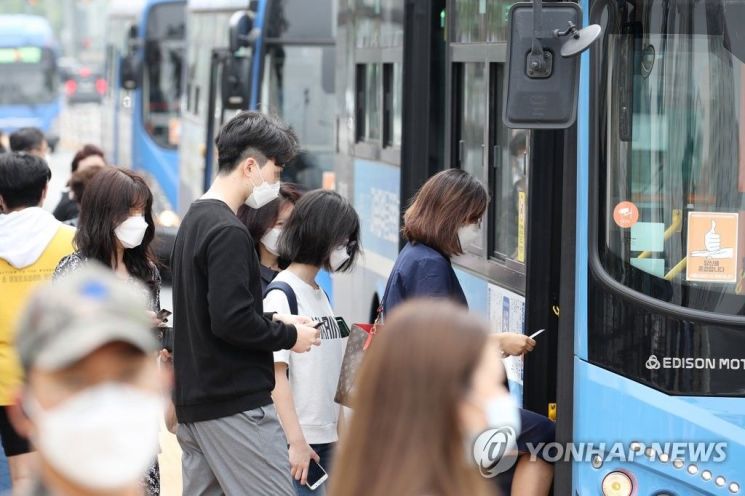 Citizens wearing masks are using buses at a bus stop near the Express Bus Terminal Station in Seocho-gu, Seoul. Photo by Yonhap News
[Asia Economy Reporter Kim Gayeon] As the impact of the novel coronavirus infection (COVID-19) continues, criticism is mounting not only against confirmed cases but also against those who violate quarantine rules. The reason for the criticism is that these individuals ultimately disrupt daily life by causing social distancing measures to be strengthened. Experts have pointed out that such situations can eventually lead to adverse effects.
According to the Central Disease Control Headquarters (CDCH) on the 16th, as of 12 noon that day, the cumulative number of confirmed cases in the metropolitan area was 9,644, approaching 10,000. By region, there were 4,794 in Seoul, 3,998 in Gyeonggi, and 852 in Incheon.
The proportion of patients with unknown infection routes has been increasing over the past two weeks. On the 11th, it was 22.1%, on the 13th, 23.9%, on the 15th, 25%, on the 16th, 25.4%, and on the 17th, it reached 26.4%, the highest since data collection began.
As a result, quarantine authorities are responding by implementing measures such as social distancing level 2.5 or easing to level 2. The problem is the stress that inevitably arises during this process. Some citizens say they strictly follow the authorities' infection prevention rules, such as wearing masks daily, but they complain about suffering due to people who have tested positive for COVID-19 or cause problems.
Choi, a man in his 20s who was classified as a close contact and underwent two weeks of self-quarantine, said, "I had to stay confined for two weeks because of a colleague who attended church," and expressed frustration, "I don't understand why people don't follow quarantine rules when it's not just me who suffers."
Choi added, "Because of that person, work was disrupted, and all my personal plans were ruined, so the stress is huge. Even though I know rationally that I shouldn't feel this way, I can't help but be angry at that person."
According to a recent survey, there is a perception gap between confirmed cases and non-confirmed individuals, as Choi claimed. According to the 'COVID-19 Confirmed Cases and Contacts Perception Survey' conducted in July by the Gyeonggi Public Health Medical Support Group and Professor Yum Yoosoon's team at Seoul National University Graduate School of Public Health, there is a significant difference in the perception of infection responsibility between the general public (non-infected) and confirmed case groups.
In response to the question "The responsibility for infection lies with the patient," 30.7% of the general public agreed, while only 9.1% of confirmed cases and 18.1% of contacts agreed. Regarding the question "It is not the patient's fault that they were infected with COVID-19," 60% of confirmed cases agreed, but only 34.6% of the general public agreed.
As a result, confirmed cases and contacts are reporting severe stress due to criticism and social stigma from those around them. They complain about personal criticism from supervisors, colleagues, and acquaintances, as well as being held accountable for work progress and some invasive remarks about their private lives.
A man in his 30s, who said he underwent a COVID-19 test after overlapping movements with a confirmed case last month, said, "I reported to the company that I took the test and worked from home for a few days. Just because of that, my boss said, 'Work isn't going well because of you,'" and added, "I was not classified as a close contact and tested negative, but the company kept pointing fingers at me."
He added, "I didn't intentionally try to contact the confirmed case; it just happened by chance, so it's absurd and unfair that everything is blamed on me."
Since COVID-19 is a highly contagious infectious disease and the number of confirmed cases with unknown infection routes is increasing, there are calls to refrain from criticism. Contact with COVID-19 infection and confirmed cases cannot simply be considered an individual's fault.
In a previous survey measuring the level of fear related to COVID-19 among confirmed cases, the fear of "criticism and harm from those around" scored 3.87 out of 5.
In contrast, the fears of "not being fully cured" and "re-infection after recovery" scored relatively low at 2.75 and 3.46, respectively. Among contacts, the fears of "being criticized and harmed by others because they are contacts" and "being confirmed infected" scored 3.53 and 3.77, respectively.
The quarantine authorities also urged an end to social criticism of confirmed cases. On the 3rd, at a briefing at the Osong Disease Control Headquarters in Chungbuk, Kwon Jun-wook, deputy head of the Central Disease Control Headquarters, said, "If patients are criticized for having COVID-19, they will suffer serious mental aftereffects even after overcoming the disease," and warned, "If people who need to be tested refuse due to fear of social criticism, additional infections could increase significantly."
He continued, "Even if you do your best to prevent COVID-19 infection, anyone can be infected at any time, regardless of their will. COVID-19 patients are patients only; please do not hold prejudices or criticize them beyond that."
Experts emphasized that social perspectives can cause confusion in quarantine efforts and urged restraint in criticizing confirmed cases.
Professor Kwak Geum-ju of the Department of Psychology at Seoul National University pointed out, "Sometimes people blame others to feel relieved that 'it's not my fault,'" and said this psychology can lead to social stigma against confirmed cases.
Professor Kwak advised, "The COVID-19 situation has been prolonged, and the end is uncertain, so people tend to shift responsibility to confirmed cases or contacts. If this phenomenon continues socially, more people may follow suit, so caution is needed."
© The Asia Business Daily(www.asiae.co.kr). All rights reserved.
![Clutching a Stolen Dior Bag, Saying "I Hate Being Poor but Real"... The Grotesque Con of a "Human Knockoff" [Slate]](https://cwcontent.asiae.co.kr/asiaresize/183/2026021902243444107_1771435474.jpg)
















