Proposal to Designate Separate Funds for Fines from Disabled Parking Violations
High Likelihood of Rejection in Plenary Session Due to Opposition from Some Lawmakers Citing 'Violation of Ministry of the Interior Guidelines'
Officials from 55
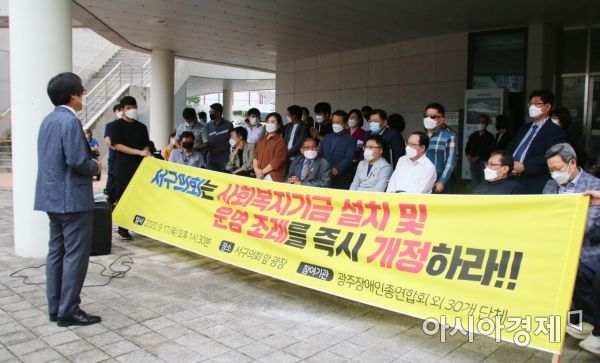 The Gwangju Metropolitan City Seo-gu Social Welfare Fund Ordinance amendment regarding the use of fines from violations of parking spaces reserved for persons with disabilities faced difficulties passing the plenary session due to conflicts among council members. In response, the Gwangju Disabled People's Federation and 55 other organizations are issuing a statement in front of the Seo-gu Council.
[Asia Economy Honam Reporting Headquarters Reporter Yoon Jamin] There is a conflict among district council members in Seo-gu, Gwangju Metropolitan City, over the revision of the ordinance regarding the use of the ‘revenue from fines for violations of parking spaces designated for the disabled’ within the social welfare fund.
An ordinance amendment proposing that the revenue from fines for violations of disabled parking spaces be used to enhance welfare for the disabled has been introduced, but some council members are showing reluctance, arguing that it contradicts the basic guidelines of the Ministry of the Interior and Safety.
According to Seo-gu and the Seo-gu Council in Gwangju on the 17th, currently, the revenue generated from fines for violations of disabled parking spaces is recorded as general accounting.
This differs from the revenue from general illegal parking fines, which is used for traffic facility improvements and other purposes.
In this regard, Seo-gu is showing a movement to revise the ordinance so that the revenue from fines for violations of disabled parking spaces can also be used for welfare for the disabled.
The ordinance amendment, led by Seo-gu Council member Jeong Wooseok, includes establishing a separate account funded by the revenue from fines for violations of disabled parking spaces and using it for the promotion of welfare for the disabled and support for their self-sufficiency and independence.
The intention is to create a new fund to manage fines incurred in disabled parking spaces and use it for the benefit of disabled people.
Currently, Seo-gu has a severe shortage of budgets for education, welfare, and facility improvements, except for 17 million won allocated for support to organizations for the disabled and events such as the Harmony Festival, and 24.9 million won for procuring convenience items like wheelchairs.
It is also expected that the budget shortfall for projects for the disabled, such as education and facility improvements, can be supplemented.
In Seo-gu, the fines for violations of disabled parking spaces have amounted to 300 to 400 million won annually over the past three years.
Specifically, 337.67 million won was collected in 2017, 317.93 million won in 2018, 445.08 million won last year, and 265.54 million won as of August this year.
If the ordinance passes, the funds will be allocated as budgets for the disabled, which, according to Council member Jeong, could lead to the expansion of the ‘disabled employment project’ and various supports for the disabled.
The ‘disabled employment project’ currently has 131 participants, with 100 people on the waiting list.
However, there are council members opposing the ordinance amendment, making its passage uncertain.
The opposing members first cite the Ministry of the Interior and Safety’s basic guideline of ‘minimizing the establishment of funds’ as their reason.
They argue that the ordinance contradicts the Ministry’s directive to abolish funds that can be covered by the general budget and to consolidate funds with overlapping purposes. They claim that even if the ordinance is amended, the Ministry may recommend its abolition.
They also state that the revenue from fines currently included in the general accounting can be used flexibly in emergencies such as COVID-19 and recent heavy rain disasters, making it difficult to designate a specific use.
Furthermore, they point out issues with Seo-gu’s regulations.
The Seo-gu ordinance stipulates five funds: ▲Resident Income Support and Living Stabilization Fund ▲Scholarships for Children of Low-Income Residents ▲Senior Welfare Fund ▲Self-Sufficiency Fund ▲Disabled Welfare Fund, among which only the scholarships for children of low-income residents and the senior welfare fund are operated using interest income generated in the current year.
However, Article 34 of the lower-level ‘Regulations’ states that the use of the Disabled Welfare Fund is limited to the scope of interest income, so they argue that this regulation should be amended first to use the 200 million won budget before anything else.
Given this situation, 55 organizations including the Gwangju Disabled People’s Federation issued a statement on the same day urging the ‘immediate revision of the ordinance.’
A Seo-gu council member opposing the ordinance amendment said, “There is already a Disabled Welfare Fund, so creating a similar fund could be problematic,” and “Amending the regulations should take priority.”
In response, a Seo-gu official stated, “It is true that it is difficult to allocate additional budgets related to the disabled, but if the revenue from fines for violations of disabled parking spaces is allocated, it will facilitate the expansion of employment projects and others.”
Meanwhile, the ordinance amendment passed the relevant standing committee on the day and will be finally decided by a vote of all council members at the plenary session on the 22nd.
© The Asia Business Daily(www.asiae.co.kr). All rights reserved.
![Clutching a Stolen Dior Bag, Saying "I Hate Being Poor but Real"... The Grotesque Con of a "Human Knockoff" [Slate]](https://cwcontent.asiae.co.kr/asiaresize/183/2026021902243444107_1771435474.jpg)















