Gyeonggi-do Announces Results of Independent Study
B/C Ratio '1.02' Indicates Feasibility
Major Benefit Crossing South of Hangang River
"Caution Needed Until Visualization," Critics Say
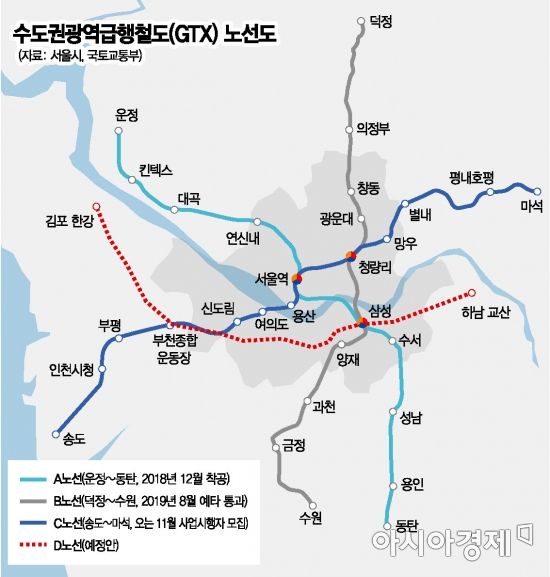
[Asia Economy Reporter Lee Chun-hee] The metropolitan area wide express railroad (GTX) is emerging as a new trigger for housing prices in the Seoul metropolitan area. Although the government maintains a fundamental stance of reviewing the 'Western GTX,' local governments in Gyeonggi Province are treating it as the de facto 'D Line' and are fiercely competing to attract it. With housing prices around existing GTX lines already on the rise, the 'D Line' is also expected to stimulate housing prices.
On the 16th, Gyeonggi Province held a 'Meeting for the Inclusion of the GTX-D Line in the National Railroad Network' at the Gyeonggi Provincial Government Office, attended by Governor Lee Jae-myung, mayors of Bucheon, Gimpo, Hanam, and local members of the National Assembly. They announced that their own feasibility study showed the economic feasibility analysis (B/C) of the line to be '1.02,' indicating the project is viable. Economic feasibility analysis evaluates benefits (B) against costs (C), and a figure above 1 is considered to indicate viability.
According to the study conducted by Korea Comprehensive Technology, GTX-D is projected to serve 430,000 passengers daily by its target opening year of 2030. The total cost and total benefits, based on 2019 present value, were estimated at 5.8098 trillion KRW and 5.9151 trillion KRW respectively, resulting in a B/C ratio exceeding 1. The study identified the optimal route as a total length of 68.1 km running from Gimpo to Geomdan, Gyeyang, Bucheon, southern Seoul, Gangdong, and Hanam.
Governor Lee emphasized, "Securing transportation infrastructure is Gyeonggi Province's most important task," adding, "The GTX-D line is a highly valuable project not only economically and socially but also in terms of regional balanced development." He continued, "We judge that routing through Bucheon, passing southern Seoul, and terminating in Hanam is reasonable, and the interim results of the study do not deviate significantly from this. We hope it will be confirmed as a metropolitan railroad network as soon as possible so that residents can use it routinely."
Accordingly, Gyeonggi Province plans to jointly request the government, along with the three cities, to include the line in the '4th National Railroad Network Construction Plan' scheduled to be announced next year. The GTX A, B, and C lines were included in the 2nd National Railroad Network Construction Plan announced in 2011.
 GTX
GTX
This is the first time detailed feasibility studies and other specifics have been released regarding the Western GTX, which the Ministry of Land, Infrastructure and Transport first announced it was considering in its '2020 Work Plan' last February. If the D Line materializes, it is speculated to cross the southern Han River area, which is currently a gap in existing lines, prompting active competition among local governments in the area. Incheon City also plans to complete a 'Pre-feasibility Study for GTX-D Introduction' next month and request its inclusion in the railroad network construction plan. Seoul's Gangdong District has collected over 100,000 resident signatures to attract the line.
Industry observers believe that if the Western GTX becomes a reality, it will be a major boon for the areas along the route. In particular, Gimpo City, set as the starting point in Gyeonggi Province's study, has been a focus of balloon effects as it has avoided the government's successive real estate regulation policies, making it highly likely to trigger another surge in housing prices.
For areas along existing GTX lines, the real estate market has shown price increases at key milestones such as the announcement of GTX plans, preliminary feasibility studies, groundbreaking, and completion. A representative example is the sharp turnaround in housing prices in Incheon, the starting point of the B Line, after it passed the preliminary feasibility study in August last year.
According to the Korea Real Estate Agency's monthly apartment sales price index, housing prices in Yeonsu District, Incheon, which had been declining for 14 consecutive months until August last year, turned to a 0.27% increase in September, the month following the announcement of the preliminary feasibility study's approval, and have continued to rise for 12 consecutive months. For example, the actual transaction price of an 84㎡ (exclusive area) unit at 'Songdo The Sharp First Park' in Songdo-dong, Yeonsu-gu, rose from 650 million KRW in June last year to 780 million KRW in October.
However, experts warn that premature investment based on unconfirmed transportation benefits is risky. An industry expert advised, "Even for existing GTX lines, more than 10 years have passed since the plans were announced, but except for the A Line, construction has not even started. Until plans such as budget allocation become visible, caution is necessary."
© The Asia Business Daily(www.asiae.co.kr). All rights reserved.
![Clutching a Stolen Dior Bag, Saying "I Hate Being Poor but Real"... The Grotesque Con of a "Human Knockoff" [Slate]](https://cwcontent.asiae.co.kr/asiaresize/183/2026021902243444107_1771435474.jpg)















