Pioneering New Export Markets in the Green New Deal Sector
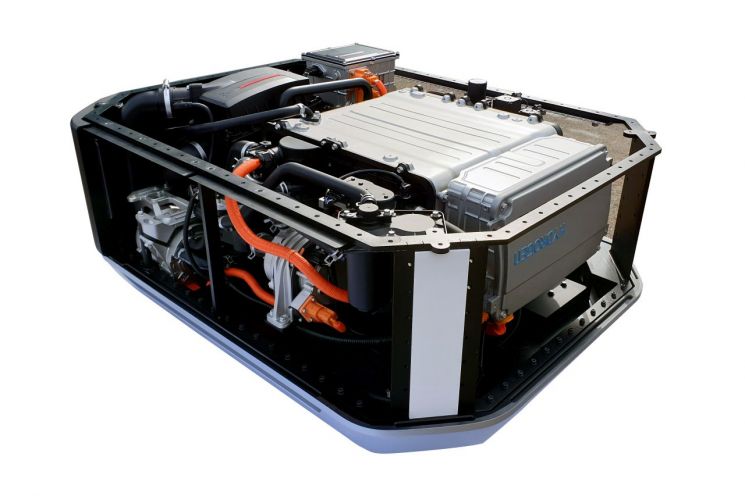
[Asia Economy Reporters Kim Bo-kyung and Woo Soo-yeon] The hydrogen fuel cell used in Hyundai Motor Company's hydrogen vehicle 'Nexo' has been exported overseas for the first time.
On the 16th, the Ministry of Trade, Industry and Energy and Hyundai Motor announced that four 95 kW-class hydrogen fuel cells for Nexo were exported to two European countries through Busan Port. A ministry official said, "The hydrogen fuel cells being exported this time will be provided to GRZ Technologies, a Swiss hydrogen storage technology company, and a European energy solution startup, and will be used in the eco-friendly power generation sector."
Hydrogen fuel cells correspond to the engine of internal combustion engine vehicles. As a core component of hydrogen vehicles accounting for 50% of the vehicle price, they can be widely used in eco-friendly energy and green mobility fields. Due to their characteristic of generating electricity from hydrogen, they can be used as eco-friendly power generators and applied to trains, ships, drones, and construction machinery that drive motors with electricity as power.
This export marks the first overseas export of hydrogen fuel cell systems, not complete vehicles, and is expected to be a starting point for pioneering new export markets in the green new deal sector. Hyundai Motor is currently negotiating sales of hydrogen fuel cells with more than 20 global companies and expects to expand overseas sales channels to the United States, China, and other countries. Hyundai plans to expand the hydrogen fuel cell system sector from complete vehicles to non-automotive sectors in the future, solidifying its global leadership in the hydrogen economy.
Jung Eui-sun, Executive Vice Chairman of Hyundai Motor Group, emphasized the potential of hydrogen energy as a future eco-friendly energy solution at the 'Korean New Deal National Report Conference' last July, stating, "Hydrogen fuel cell systems can be utilized in all areas such as ships, trains, urban aircraft, buildings, and power plants."
The government expects that this export will secure various eco-friendly markets such as energy and ships while laying the foundation to leap forward as a technological powerhouse in eco-friendly energy. Following hydrogen passenger cars and hydrogen trucks, hydrogen fuel cells will be fostered as a core export product to actively promote the global hydrogen economy expansion and the green new deal.
An official from the Ministry of Trade, Industry and Energy said, "The hydrogen fuel cell market is in its infancy with no international standards, so it is important to secure a lead faster than competing countries," adding, "To foster hydrogen fuel cells as a core driving force of the green new deal, we will accelerate efforts to improve performance and commercialize various hydrogen vehicle export models."
Meanwhile, unlike internal combustion engine vehicle exports, which have suffered due to the COVID-19 pandemic, hydrogen passenger car exports have rather increased. From January to July this year, hydrogen vehicle exports rose by 74.5% compared to the same period last year. In July, there was also an achievement of exporting hydrogen trucks to Europe, a powerhouse in truck technology. A total of 1,600 hydrogen trucks are planned to be exported to Switzerland by 2025.
© The Asia Business Daily(www.asiae.co.kr). All rights reserved.
![Clutching a Stolen Dior Bag, Saying "I Hate Being Poor but Real"... The Grotesque Con of a "Human Knockoff" [Slate]](https://cwcontent.asiae.co.kr/asiaresize/183/2026021902243444107_1771435474.jpg)















