China Becomes World's Largest Oil Importer... Quickly Filling US Vacuum
US Focuses on Mediation Between Israel and Arab States... Rather Reduces Troop Deployment
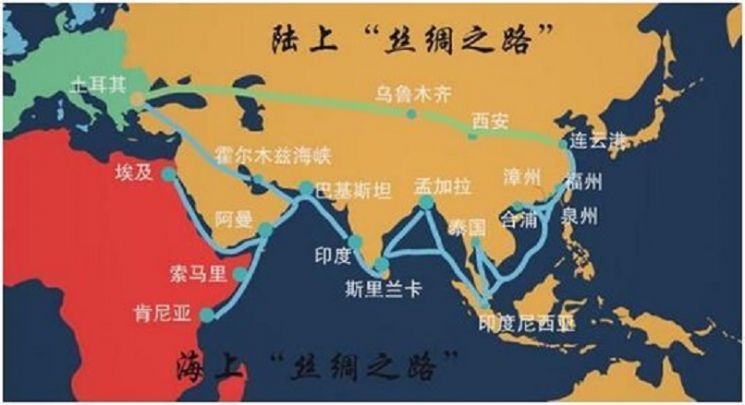
[Asia Economy Reporter Lee Hyun-woo] As the United States significantly reduces its troops stationed in Iraq and Afghanistan and withdraws from the Middle East, voices are growing that China is rapidly filling the vacuum and expanding its influence in the region. Not only anti-American countries like Iran but also key pro-American Middle Eastern countries such as Saudi Arabia and the United Arab Emirates (UAE) are rapidly aligning with China, which has emerged as the world's largest oil importer. Experts warn that China could exclude U.S. influence in the Middle East and rise as a new hegemonic power in the region, potentially causing major upheavals in international affairs.
According to the American diplomatic media outlet The Diplomat on the 13th (local time), the Asian Infrastructure Investment Bank (AIIB), which is in charge of investments in China's Belt and Road Initiative (land and maritime Silk Road) projects, announced that it will hold its 6th annual meeting in Dubai, UAE, in October next year. This is the first time AIIB will hold its annual meeting in the Middle East, coinciding with the Dubai Expo.
Alongside this, China is approaching the Taliban, the military faction leading the Afghan insurgents, with proposals to build road networks. According to major foreign media including AFP, China met with Taliban leaders in Pakistan's Balochistan region and promised investments to construct highways connecting major cities in Afghanistan.
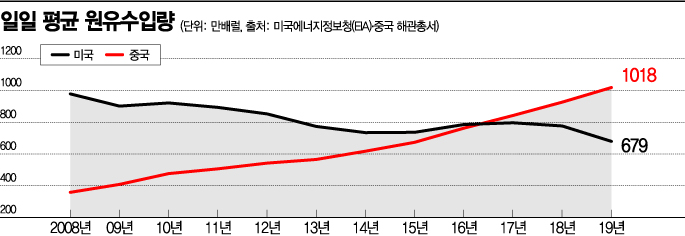
Major foreign media including Foreign Policy explained that after surpassing the U.S. to become the world's largest oil importer, China is rapidly strengthening ties with various Middle Eastern countries. According to data from the U.S. Energy Information Administration (EIA) and China's General Administration of Customs, China's average daily oil imports last year were 10.18 million barrels, significantly exceeding the U.S.'s 6.79 million barrels. In fact, since the shale gas development boom, U.S. daily oil production has increased to 13.1 million barrels since 2018, surpassing Saudi Arabia's 12 million barrels. This means the U.S. has transformed from the largest customer of Middle Eastern oil to its biggest competitor.
The U.S. is gradually withdrawing from the Middle East. Recently, President Donald Trump announced plans to reduce troops in Afghanistan from 8,600 to 4,000 and in Iraq from 5,200 to 2,000. Instead, the U.S. is positioning Israel to take over regional defense. The UAE and even Bahrain have been drawn into joint statements normalizing diplomatic relations with Israel. This is interpreted as the U.S. government's intention to mediate diplomatic ties between Israel and Arab League countries to expand alliances against Iran. The U.S. calculates that by broadening its alliance with Israel, it can gradually reduce the number of U.S. troops stationed in the region.
International relations experts are wary of China, which is seeking to fill the "power vacuum" as the U.S. gradually withdraws from the Middle East. They warn that if China seizes hegemony in the Middle East by occupying the U.S.'s position, it could negatively impact international affairs. According to The National Interest, a U.S. foreign policy and security journal, Michael Doran, a senior fellow at the Hudson Institute, stated in a recent report, "China is known to primarily seek economic gains such as oil and gas in the Middle East, but it is actively aiming for military hegemony, as evidenced by opening a naval base in Djibouti, a strategic point connecting the Gulf of Aden, the Red Sea, and the Suez Canal." He added, "China is actively working to expel the U.S. from the Middle East, and if China gains hegemony there, conflicts with the U.S. in Europe and other regions will increase." This could lead to instability in international affairs, contrary to U.S. hopes.
© The Asia Business Daily(www.asiae.co.kr). All rights reserved.
![Clutching a Stolen Dior Bag, Saying "I Hate Being Poor but Real"... The Grotesque Con of a "Human Knockoff" [Slate]](https://cwcontent.asiae.co.kr/asiaresize/183/2026021902243444107_1771435474.jpg)

















