Ulsan National Institute of Science and Technology Identifies New Role of Metal Ions in Carbonic Anhydrase
Enzyme Activity Changes Due to Stereoscopic Structural Changes in Binding
[Asia Economy Reporter Hwang Junho] It has been discovered that trace amounts of metal ions contained within enzyme protein clusters regulate the enzyme's activity. This finding is expected to bring significant progress in the development of new drugs that regulate enzyme activity and in research clarifying the correlation between metal ions and proteins.
The research team led by Professors Kim Cheolmin and Kim Chaewoon from the Department of Physics at Ulsan National Institute of Science and Technology (UNIST) announced on the 14th that they identified a new correlation showing that metal ions within the enzyme regulate the enzyme's reaction by tracking the three-dimensional structural changes of the carbonic anhydrase active site. This research was also published in Nature Communications on the 11th.
Metal ions regulate enzyme reactions
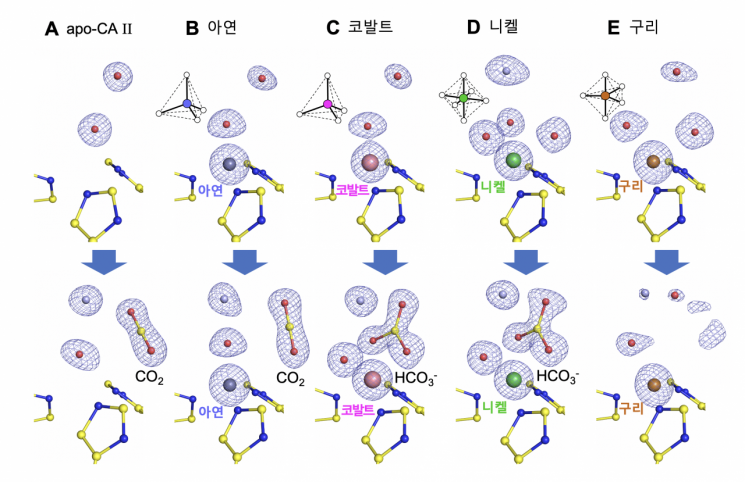
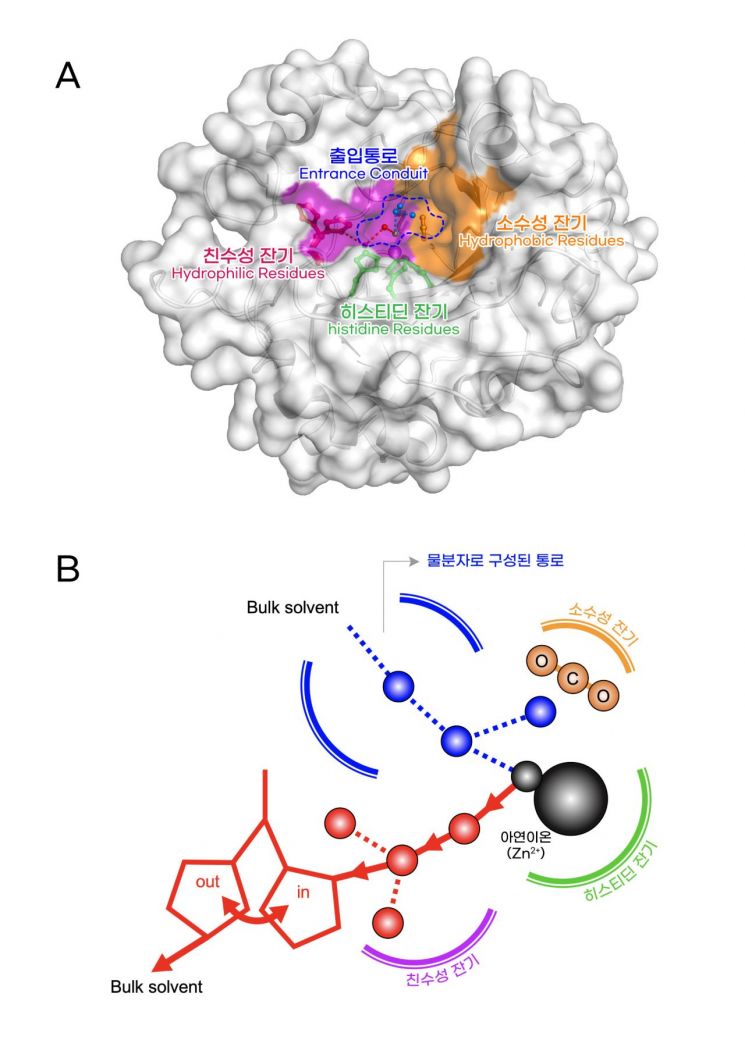
Carbonic anhydrase is an enzyme that helps convert carbon dioxide (the reactant) into a bicarbonate form (the product) that dissolves well in blood. In its natural state, this enzyme contains zinc ions. When these zinc ions are replaced with other metal ions having similar chemical properties, the enzyme's performance (activity) drastically decreases. However, the reason for this phenomenon had not been clarified.
Through this study, the research team revealed that the spatial geometry (coordination geometry) around the metal ion determines the degree of enzyme activity.
This structure regulates enzyme activity in two main ways. First, the spatial structure determines the rate at which the reactant (carbon dioxide) binds to the enzyme and the product (bicarbonate) detaches from the enzyme. For high enzyme activity, the reactant must bind well to the active site, and the product must detach easily. Second, the spatial structure delicately controls the structure and arrangement of surrounding water molecules, which also affects enzyme activity. Water molecules present within the enzyme directly participate in the reaction converting reactants to products or form the channels through which reactants and products pass.
Contributing to new drug development by regulating enzyme reactions
 Photo of the joint research team. Professor Kim Cheol-min (far right) and lead researcher Kim Jin-gyun (third from the left)
The research team obtained these results by capturing the brief moment when the enzyme reaction occurs using a high-pressure rapid cooling technique. This technique was developed by Professor Kim Chaewoon's team in previous research. By injecting carbon dioxide (the reactant) gas into the enzyme and then rapidly cooling it, the moment of reaction can be captured. The team prepared enzyme crystals containing four types of metal ions and enzyme crystals without metal ions using this technique and analyzed them with X-ray crystallography.
Jin Kyun Kim, the first author and an integrated master's and doctoral course researcher in the Department of Natural Sciences, said, "This study is the result of years of persistent efforts to capture the intermediate stages of enzyme reactions."
Professor Kim Chaewoon stated, "The significance of this study lies in discovering that trace amounts of metal ions within enzymes act as conductors overseeing enzyme activity through broad and delicate interactions."
Professor Kim Cheolmin explained, "If the role of metal ions is limited to Lewis acids, it cannot explain the decrease in enzyme activity when copper ions, cobalt ions, etc., which have the same number of valence electrons, are used as cofactors. Through this study, we identified another role of metal cofactors."
© The Asia Business Daily(www.asiae.co.kr). All rights reserved.
![Clutching a Stolen Dior Bag, Saying "I Hate Being Poor but Real"... The Grotesque Con of a "Human Knockoff" [Slate]](https://cwcontent.asiae.co.kr/asiaresize/183/2026021902243444107_1771435474.jpg)

















