
"The distinction of the internet industry will disappear, and the subscription economy will be activated."
Han Seong-sook, CEO of Naver, and Yeo Min-soo, co-CEO of Kakao, the heads of the two major domestic portals, diagnosed the future of the IT industry 10 years from now in this way. They predicted another level of innovation beyond the changes of the past decade.
On the 11th, Han, who is also the chairman of the Korea Internet Corporations Association (KICA), said in a congratulatory video released on the occasion of KICA's 20th anniversary, "Until now, the internet was a newly emerging innovative industry, something done by unique and 'geeky' people, but now IT seems to have entered a stage where it forms the foundation of all industries."

Han Seong-sook: "Internet is everything"... Yeo Min-soo: "Subscription economy is important"
Han focused on the 'convergence' between the internet industry and traditional industries. She predicted, "The distinction called the internet industry will disappear, and various industries will coexist with the internet and IT as the foundation." In the past, the 'internet' was regarded as a special business area, but with the development of PC environments and smartphones, all industries such as manufacturing, distribution, and education basically utilize the internet.
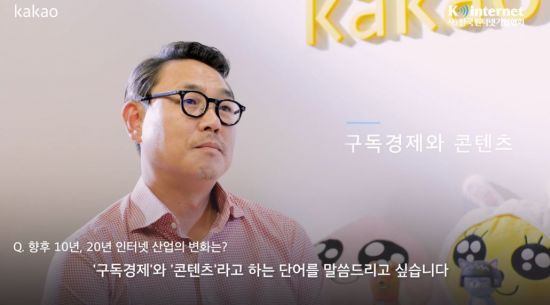
Co-CEO Yeo cited 'subscription economy' and 'content' as keywords for the internet industry 10 years from now. The subscription economy refers to users paying a fee monthly or weekly to receive necessary goods or services. Yeo said, "Efforts toward 'subscription' are continuing even in 'old economy' sectors like automobiles and home appliances," and expressed expectations that the subscription economy, which is already occurring in many companies, will be activated.
Yeo viewed the IT industry as driving the activation of the subscription economy. He said, "The remarkable development of subscription platforms has driven the growth of the subscription economy," and added, "We should pay attention to the fact that platforms where numerous content creators can express their creative will have been well prepared." In fact, Kakao is known to be preparing subscription services through KakaoTalk and the portal Daum.
Yeo also predicted that 'content' will be the future of the IT industry. He said, "Recently, with the COVID-19 situation, content consumption has grown through Netflix, Piccoma (Kakao's Japanese webtoon platform), KakaoPage, and others," adding, "Web novels, webtoons, and dramas and movies based on these IPs (intellectual property rights) are expanding, and global interest in K-content is focusing, creating a foundation for further expansion."
Naver focuses on 'SMEs', Kakao emphasizes 'globalization'
Han and Yeo identified Naver's and Kakao's future directions as 'SMEs (small and medium-sized enterprises)' and 'globalization,' respectively. Han explained, "Naver has been considering what services various creators, businesses, and users need," and added, "Recently, we have been focusing on creating tools to help SMEs with digital transformation." SMEs are major advertisers for Naver, whose main revenue source is search advertising. When SME businesses do well, advertising and search data increase, creating a virtuous cycle that allows Naver to generate profits.
Yeo set 'Kakao's globalization' as a task. He said, "The key question for internet companies thinking about growth is 'globalization'." Compared to Naver, which is active overseas in the US and Japan, Kakao has not shone as much abroad as it has domestically. Marking the 10th anniversary of KakaoTalk and entering its second season, Kakao's intention is interpreted as a commitment to achieving results globally in the future.
© The Asia Business Daily(www.asiae.co.kr). All rights reserved.
![Clutching a Stolen Dior Bag, Saying "I Hate Being Poor but Real"... The Grotesque Con of a "Human Knockoff" [Slate]](https://cwcontent.asiae.co.kr/asiaresize/183/2026021902243444107_1771435474.jpg)

















