3 Times More Orders Than 2nd Place China
Global Cumulative Orders in August Halved to 812 CGT
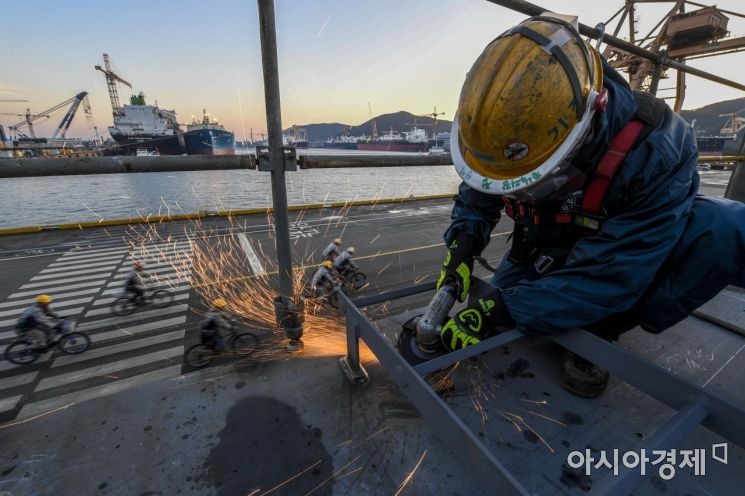 Since securing the top spot in annual orders in 2011, the shipbuilding industry was pushed to second place by China for six consecutive years from 2012 to 2017. However, from January to November this year, it secured 10.9 million CGT (Compensated Gross Tonnage), accounting for 42% of the global ship orders totaling 26 million CGT, signaling a turnaround in the shipbuilding industry. Next year is more important than ever for the shipbuilding sector, which has found opportunity after crisis. This is because the order performance in the second half of this year and last year presents a chance to escape the shadow of recession. We hope that the boom in shipbuilding in 2019 will serve as a driving force for South Korea's economic growth. Photo by Kang Jin-hyung shows a worker vigorously performing grinding work at Daewoo Shipbuilding & Marine Engineering's Okpo Shipyard in Geoje, Gyeongnam.
[Asia Economy Reporter Hwang Yoon-joo] Despite the order drought crisis, South Korea ranked first in global ship orders again in August, following July.
Clarkson Research, a UK-based shipbuilding and shipping market analysis firm, announced on the 8th that global ship orders in August totaled 860,000 CGT (36 vessels), with South Korea securing 630,000 CGT (23 vessels, 73%), ranking first. This is three times the size of China’s 210,000 CGT (12 vessels, 24%).
An industry insider said, "South Korea experienced a severe order drought in the first half of the year, but since June, orders for key ship types such as LNG carriers and VLECs have resumed, gradually increasing the order volume," adding, "From September onward, large LNG project orders from Mozambique, Russia, and others are expected to accelerate."
In August alone, the order volume by country was South Korea 630,000 CGT (23 vessels, 73%), China 210,000 CGT (12 vessels, 24%), and Vietnam 20,000 CGT (1 vessel, 3%).
From January to August, the global cumulative orders totaled 8.12 million CGT, less than half of the same period last year (17.47 million CGT). The cumulative order performance by country from January to August this year was China 4.37 million CGT (201 vessels, 54%), South Korea 2.39 million CGT (75 vessels, 29%), and Japan 680,000 CGT (43 vessels, 8%).
At the end of August, the global order backlog was 69.19 million CGT, the lowest level since January 2004, clearly reflecting the impact of poor orders in the first half of the year.
By ship type, S-Max class oil tankers maintained a steady level with 480,000 CGT (16 vessels) this year, the same as last year, while container ship orders decreased by 11%, from 570,000 CGT (10 vessels) to 510,000 CGT (7 vessels).
Orders for Very Large Crude Carriers (VLCC) decreased by 41% to 510,000 CGT (12 vessels), and A-Max class oil tankers dropped by 42% to 560,000 CGT (21 vessels).
Orders for bulk carriers and large LNG carriers (over 140,000㎥) sharply declined by 79%, to 340,000 CGT (10 vessels) and 770,000 CGT (9 vessels), respectively.
Regarding ship price trends by type, LNG carriers (based on 174,000㎥) were priced at $186 million, container ships (20,000~22,000 TEU and 13,000~14,000 TEU) at $144 million and $108 million respectively, and bulk carriers (Capesize) at $46.5 million, all unchanged from last month.
VLCC prices slightly decreased from $87.5 million to $87 million, S-Max oil tankers from $57 million to $56.5 million, and A-Max oil tankers from $48.5 million to $48 million.
© The Asia Business Daily(www.asiae.co.kr). All rights reserved.
![Clutching a Stolen Dior Bag, Saying "I Hate Being Poor but Real"... The Grotesque Con of a "Human Knockoff" [Slate]](https://cwcontent.asiae.co.kr/asiaresize/183/2026021902243444107_1771435474.jpg)















