Starting Next Year, All New and Renovated Public Offices and Welfare Facilities Will Apply... 2022 Certification System Introduced
First Local Government to Establish 'Universal Design Center' Dedicated to Customized Consulting and Policy Development
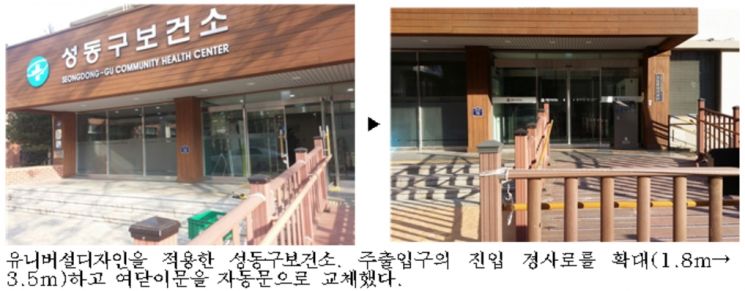
[Asia Economy Reporter Jo In-kyung] Starting next year, newly constructed or expanded public buildings and facilities in Seoul will be designed with 'Universal Design(Universal Design·범yong Design)' to ensure that everyone can use them conveniently without discrimination. From 2022, a 'Universal Design Certification System' for excellent buildings and products will be introduced, and related curricula will be developed in university courses to train professional practitioners.
Seoul City announced on the 6th that it has established the 'Seoul Universal Design Comprehensive Plan (2020~2024)' based on these contents and will implement it step by step.
Universal Design is a design concept that allows citizens to use facilities or services without discrimination regardless of age, gender, disability, or nationality.
For example, when creating a village park through urban regeneration, at least one entrance will have a flat access route without stairs or thresholds, and auxiliary handrails will be installed not only in restrooms for the disabled but also in those for non-disabled users for the elderly or those with mobility difficulties. Subway station information boards will be intuitively designed so that children and foreigners can easily understand them.
Previously, the city proactively introduced the then unfamiliar Universal Design in 2010 and enacted the 'Basic Ordinance on Universal Design City Formation' in 2016. In 2017, the city developed and applied the 'Seoul Universal Design Integrated Guidelines,' which comprehensively cover laws and related guidelines scattered across laws and ordinances for the convenience of transportation-vulnerable people, barrier-free buildings, parks, and more.
The city decided to make the application of these integrated guidelines mandatory for all public buildings from 2021, beyond the recommendation level. The target includes public buildings, facilities, and infrastructure supported by Seoul City's budget. To this end, the city plans to revise the 'Basic Ordinance on Universal Design City Formation' within this year.
To ensure consistency and efficiency in applying the guidelines, the city will operate an 'Integrated Architecture TF' that collaborates among the city's design policy general department, public architecture and architectural committee review department, and public building construction department. Also, before the mandatory application, focused consulting will be supported this year for cultural and welfare facilities frequently used by citizens.
From the end of the year, a TF involving all related departments will be formed to update the guidelines according to field conditions, and in addition to detailed guidelines for existing welfare facility types, guidelines for cultural facilities, pedestrian and transportation facilities, educational facilities, etc., will be developed annually by facility type.
The 'Seoul Metropolitan Universal Design Center,' which will serve as a think tank for universal design policy, will open in October, the first among local governments nationwide. This center will be responsible for ▲universal design policy execution research ▲public sector universal design consulting and monitoring ▲development of universal design certification indicators ▲development and operation of educational content for citizens.
To spread universal design in everyday living spaces, the city will promote it in connection with city projects such as urban planning, urban regeneration, transportation and walking, and park creation. A 'UD Lifestyle Platform,' a space where citizens can directly experience products, routes, and spaces incorporating universal design, will be created within Dongdaemun Design Plaza.
From 2022, Seoul will pilot the universal design certification system covering all individuals regardless of gender, age, nationality, or disability, and to train professionals, it will collaborate with universities and research institutes to establish curricula in university courses and conduct expert group education.
Yoo Yeon-sik, head of Seoul City's Culture Headquarters, said, "While past public design was about decorating the city aesthetically, functionally, and rationally, after the COVID-19 pandemic, design must carefully consider and embrace all citizens without excluding anyone due to disability, gender, or age in the changing urban environment. We expect the comprehensive plan established by the city this time to provide 'fair participation and enjoyment.'"
© The Asia Business Daily(www.asiae.co.kr). All rights reserved.
![Clutching a Stolen Dior Bag, Saying "I Hate Being Poor but Real"... The Grotesque Con of a "Human Knockoff" [Slate]](https://cwcontent.asiae.co.kr/asiaresize/183/2026021902243444107_1771435474.jpg)















