Two Consecutive Days of Decline... Major Tech Stocks Like Google and MS Also 'Stumble'
[Asia Economy Reporter Minwoo Lee] The U.S. stock market, which had been on an upward trend, fell for two consecutive days. While some view the sharp decline without specific reasons as a temporary correction due to profit-taking, concerns are also emerging that it could be a precursor to a financial crisis.
Volatile U.S. Stock Market... Two Consecutive Days of Decline
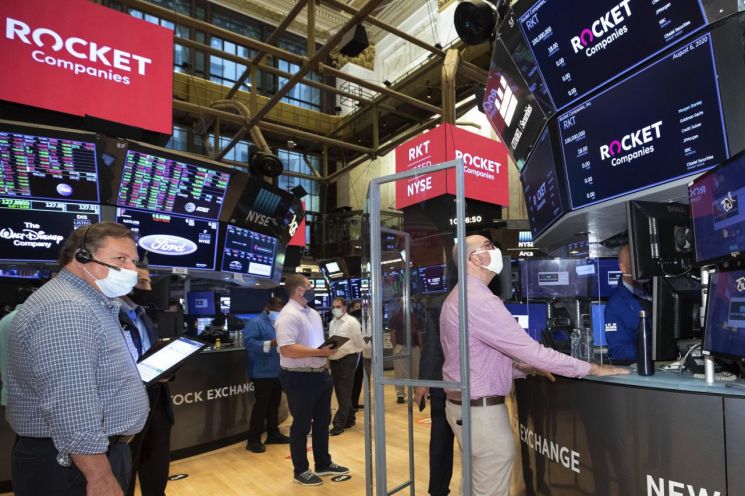
On the 5th (local time), the U.S. stock market in New York experienced significant volatility. Following a sharp drop the previous day, the market continued to fall until the morning but rebounded in the afternoon. Nevertheless, it could not avoid two consecutive days of decline.
On that day, the Nasdaq index, centered on technology stocks, closed at 11,313.31, down 1.27% from the previous session. The Dow Jones Industrial Average fell 0.56% to 28,133.31, and the S&P 500 index dropped 0.81% to 3,426.96. The previous day, all three major indices had also plunged sharply, with the S&P 500 down 3.5%, the Dow Jones down 2.8%, and the Nasdaq down 4.96%.
In particular, large technology companies that had driven the stock market's strength plummeted. Alphabet, Google's parent company, fell 2.96%, and Microsoft (MS) dropped 1.4%. Following declines of 5% and 6% respectively the previous day, they fell again. Apple and Tesla, which had each plunged more than 8% the day before, closed with rebounds of 0.1% and 2.8%, respectively.
Healthy Breather vs. Sign of Financial Crisis
Interpretations are divided between a temporary correction and a 'Minsky Moment' signaling a financial crisis. Proponents of the temporary correction argue that the stock price rally cannot continue indefinitely and that this is a 'healthy breather' for another rise. They believe that U.S. economic indicators have passed the worst phase and that the economy will gradually improve, supported by a steady accommodative monetary policy stance. The dominant view is that news of the U.S. government preparing to distribute a COVID-19 vaccine before the November presidential election and expectations for a congressional COVID-19 stimulus package will support the market's bottom.
There is also an interpretation of a 'Minsky Moment.' The Minsky Moment theory suggests that a financial market boom fueled by excessive debt expansion eventually leads to a financial crisis when debtors' ability to repay declines, forcing them to sell even healthy assets to pay off debts. Supporting this interpretation are factors such as ▲recent market gains concentrated in large technology stocks ▲the Russell 2000 small-cap index, which includes many 'zombie companies' (distressed companies unable to cover debt interest with operating profits), remaining below its June peak on an equal-weighted basis ▲stock indices in countries outside the U.S., especially the U.K., having fallen significantly compared to the beginning of the year.
"Economic Indicators Improving Gradually... Short-term Sideways Market Expected"
Researcher Yeonju Cho of NH Investment & Securities gave more weight to the argument of a breather phase. She stated that this plunge is unlikely to represent a new range breakout and that the concentration in technology stocks is unlikely to continue. Cho explained, "The recent stock market rally was driven more by 'overheated buying' than fundamentals. In particular, the overheating in the call options market has a speculative rally character rather than an investment one." In fact, the overheating phase in call options on large technology stocks has continued for two months since June. Previously, from November last year to February this year, during a four-month overheating phase in call options, the U.S. stock market experienced a 'FOMO rally,' where investors, fearing missing out on gains, chased rising prices. Afterward, with the outbreak of COVID-19, the call options overheating phase shifted to a put options overheating phase.
Cho said, "If employment or economic indicators weaken, call options overheating can lead to put options overheating, but this time economic indicators are improving gradually, and earnings forecasts for the U.S. stock market are also showing signs of improvement. Reflecting a short-term sideways market, I recommend partially reducing the weighting of large technology stocks and increasing the weighting of undervalued defensive value stocks."
© The Asia Business Daily(www.asiae.co.kr). All rights reserved.
![Clutching a Stolen Dior Bag, Saying "I Hate Being Poor but Real"... The Grotesque Con of a "Human Knockoff" [Slate]](https://cwcontent.asiae.co.kr/asiaresize/183/2026021902243444107_1771435474.jpg)
















