Indoor Sports Facilities Including Gyms in the Seoul Metropolitan Area Prohibited from Gathering
Using Mountain Parks as Gym Alternatives... So-Called 'Sansujang' Crowded
Experts Warn "Risk of Infection if Prevention Guidelines Are Not Followed Outdoors"
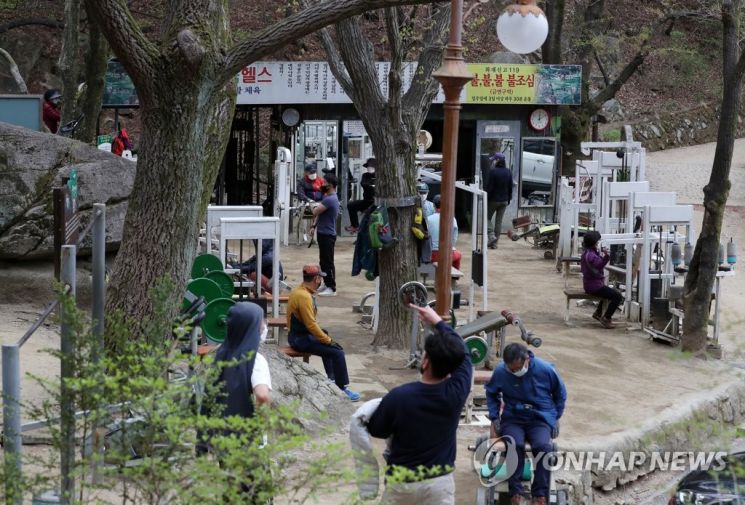 Outdoor exercise facilities on Apsan Mountain in Nam-gu, Daegu are becoming crowded. The photo is unrelated to specific expressions in the article. [Image source=Yonhap News]
[Asia Economy Reporter Heo Midam] "The gym is closed, so where should I exercise?", "Today, I'm going to 'Sansjang'."
With strengthened social distancing measures centered around the metropolitan area, indoor sports facilities such as gyms have been ordered to close, leading many to seek an alternative known as 'Sansjang.' 'Sansjang' is a newly coined term combining 'san' (mountain) and 'health club,' referring to exercise facilities installed in parks or neighborhood hills.
Some express concerns that even though 'Sansjang' is outdoors, if mask-wearing and social distancing guidelines are not followed, there is still a risk of COVID-19 infection. Experts emphasize the importance of strictly adhering to personal quarantine rules regardless of indoor or outdoor settings.
Since July 30, social distancing level 2.5 measures have been implemented in Seoul and the metropolitan area to curb the spread of COVID-19. As a result, all indoor sports facilities such as gyms, billiard halls, badminton courts, and swimming pools in the metropolitan area have been shut down.
Given this situation, many are turning to 'Sansjang.' Being outdoors allows for some physical distancing and the freedom to exercise without worrying about others' eyes.
Recently, a post titled 'Real-time Sansjang Status' was uploaded on an online community. The author wrote, "There are currently 34 people at Sansjang. Most are in their 20s and 30s. Seems like everyone came after hearing the rumor," along with a photo. The photo shows citizens using exercise equipment set up along a hiking trail.
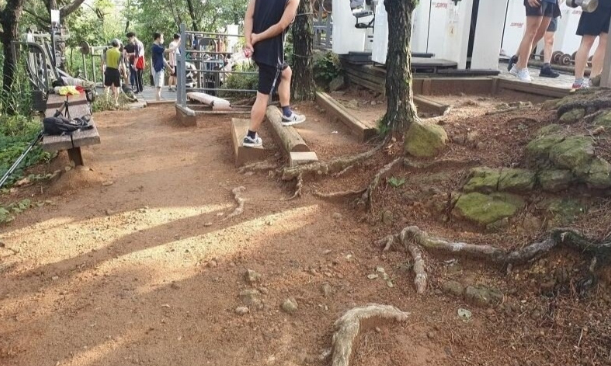 A post titled "Real-time Sansjang Situation" was recently uploaded on an online community. Photo by Online Community Capture.
On social media platforms like Instagram, many photos tagged with '#Sansjang' show people exercising on mountains. With gyms closed due to COVID-19, they visit 'Sansjang' in neighborhood hills to work out and even climb the mountains, showing passionate dedication.
The problem lies in the fact that COVID-19 infection can occur outdoors as well if social distancing and other quarantine rules are not observed.
On July 30, at an outdoor camping site in Hongcheon, Gangwon Province, a large number of people were infected with COVID-19 after failing to comply with quarantine rules such as mask-wearing. They gathered closely to eat meals together at the campsite with acquaintances, disregarding social distancing guidelines.
Also, the Liberation Day rally held on August 15 in Gwanghwamun, Seoul, was conducted outdoors, but some participants removed masks and shared prepared food, violating quarantine rules and causing a cluster infection to spread.
In summary, adherence to quarantine guidelines, including mask-wearing, is crucial both indoors and outdoors. However, it is practically difficult to follow these rules at 'Sansjang.' Wearing a mask while exercising is not easy, and if many people gather in the limited space of 'Sansjang,' maintaining distance becomes challenging.
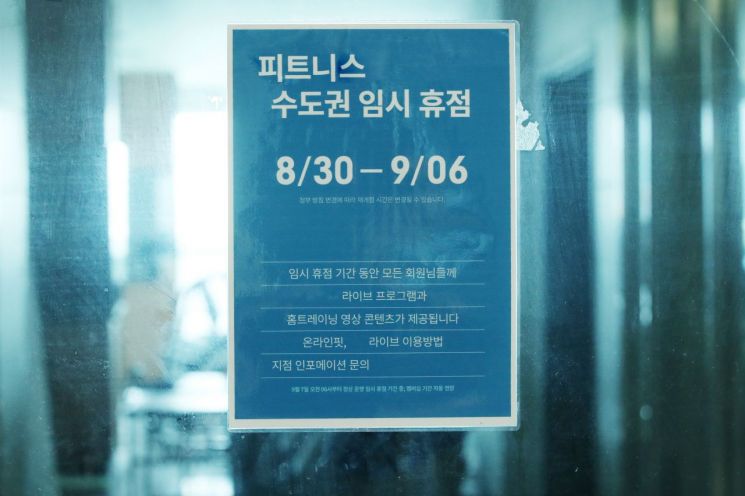 On the afternoon of the 30th of last month, when social distancing level 2.5 was implemented in the Seoul metropolitan area to prevent the spread of COVID-19, a closure notice was posted at a gym in downtown Seoul.
 [Image source=Yonhap News]
As a result, some citizens criticize those who go to 'Sansjang.' With sporadic small-scale cluster infections continuing across the metropolitan area, there is a prevailing atmosphere of citizens refraining from going out and outdoor activities, and these individuals are accused of violating government quarantine guidelines solely for exercise.
Office worker Kim (27) said, "I wonder if it's really necessary to go outdoors to exercise," adding, "With COVID-19, companies have shifted to remote work, and students cannot attend school. Everyone needs to be cautious, so such behavior seems careless."
He continued, "Everyone's effort is needed to end COVID-19 as soon as possible. I also avoid unnecessary appointments to refrain from outdoor activities," and criticized, "When I see people insisting on going out for their own satisfaction, I think they are selfish."
There are also concerns that it is even harder to follow quarantine rules when exercising outdoors than indoors. University student Kim (25) said, "Gyms have air conditioners and cooling systems, so it's easier to keep masks on, but outdoors, these are absent, making mask-wearing more difficult."
He added, "Exercise equipment on walking trails is rarely disinfected. It seems wiser to wait until COVID-19 subsides and social distancing is eased before going to the gym."
Experts suggest that it is important to follow quarantine rules such as maintaining social distancing even outdoors.
Professor Eom Jung-sik, an infectious disease specialist at Gachon University Gil Medical Center, said, "There is a risk of infection when social distancing is difficult outdoors," adding, "Especially during exercise, mask-wearing guidelines are often not followed. Also, if hand sanitizers are not provided outdoors, there is a possibility of COVID-19 infection." He emphasized, "Personal quarantine rules such as social distancing and mask-wearing must be observed even outdoors."
© The Asia Business Daily(www.asiae.co.kr). All rights reserved.
![Clutching a Stolen Dior Bag, Saying "I Hate Being Poor but Real"... The Grotesque Con of a "Human Knockoff" [Slate]](https://cwcontent.asiae.co.kr/asiaresize/183/2026021902243444107_1771435474.jpg)













