KOSPI Falls 2.6%, KOSDAQ Drops 3.75% Early Amid US Stock Market Plunge
Individual Investors' Inflows Largely Offset Declines
[Asia Economy Reporter Oh Ju-yeon] The domestic stock market also declined following the plunge in the U.S. stock market. However, compared to the 3-4% drop in the U.S. market, the adjustment was relatively moderate. Although there seemed to be a sharp decline in the early trading hours, the index drop was mitigated as individual investors poured in funds, helping to defend against the fall.
According to the Korea Exchange on the 4th, as of 9:35 a.m., the KOSPI recorded 2354.50, down 1.71% from the previous trading day, and the KOSDAQ index fell 1.89% to 857.56. Compared to the sharp opening drop of 2.64% to 2332.68 for KOSPI and 3.75% to 841.37 for KOSDAQ, a significant portion of the decline was recovered.
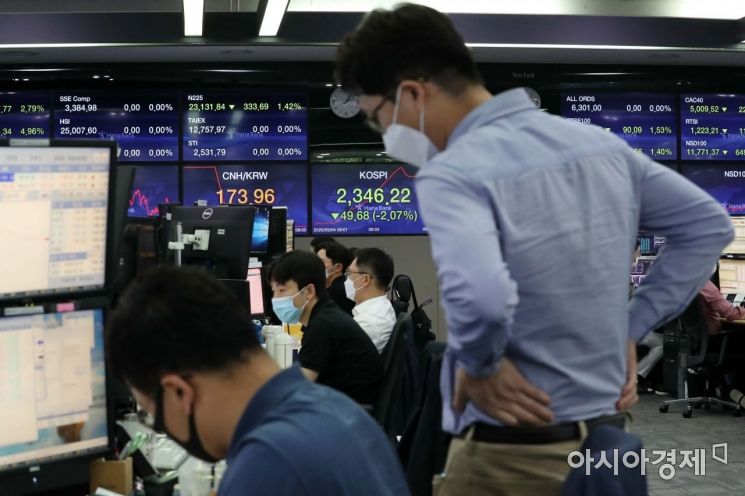 On the 4th, the KOSPI index started sharply lower due to the plunge in the U.S. stock market. On this day, dealers were busy working in the Hana Bank dealing room in Euljiro, Seoul. Photo by Mun Ho-nam munonam@
The impact of net buying by individuals was significant. In the KOSPI market, individuals net purchased stocks worth 317 billion KRW. This contrasted with foreigners and institutions who sold stocks worth 28.7 billion KRW and 238.9 billion KRW, respectively. On the previous day, the refund of subscription payments for Kakao Games’ IPO, which closed with a record-high subscription deposit of 58.55 trillion KRW and a competition rate of 1500 to 1, was returned on this day. It is also speculated that some of these funds flowed into the stock market. According to Hana Financial Investment, Kakao Games’ public offering amount was 3.2 million shares (76.8 billion KRW), about 40% of the recent SK Biopharm offering, but the subscription deposits far exceeded 31 trillion KRW at that time, with refund payments estimated at around 58 trillion KRW. Consequently, investor deposits surpassed 60 trillion KRW, suggesting that a market supported by abundant liquidity is expected to continue.
Lee Jae-sun, a researcher at Hana Financial Investment, forecasted, "The adjustment in U.S. tech stocks is likely to temporarily dampen risk asset preference sentiment but is more likely a period adjustment to cool down the previous overheating."
Although all 15 of the top market capitalization stocks in the KOSPI showed a downward trend on this day, the decline was limited to the 1-2% range, supporting the view of a period adjustment. Samsung Electronics (-1.42%), SK Hynix (-1.78%), and Naver (NAVER, -1.62%) started the day with declines of 2-4% but later reduced their losses to around -1%. Particularly, companies included in the government’s 'New Deal Fund' (supporting the Korean New Deal project) and 'New Deal Index,' announced to lead the post-COVID era, continued to rise. Companies associated with the Green New Deal momentum, such as Hyosung Heavy Industries (20.19%), CS Wind (18.10%), LS (16.92%), Douzone Bizon (14.55%), Hanwha (12.37%), and Hanwha Solutions (10.94%), showed remarkable gains.
In the securities industry, opinions are divided on the recent U.S. stock market plunge, with views ranging from 'temporary adjustment' to 'Minsky momentum' (the point at which a financial crisis occurs). However, in the domestic market, more weight is given to a September period adjustment rather than a trend decline.
Lee Kyung-min, a researcher at Daishin Securities, said, "The U.S. stock market plunge can be interpreted as a reaction following somewhat excessive gains," adding, "It is a nervous reaction due to fatigue from the excessive rise and increased valuation burdens." He also noted that while the domestic market’s mid- to long-term upward trend can continue, a short-term adjustment in September is possible, and it is better to use this correction as an opportunity to increase exposure.
Kim Yong-gu, a researcher at Samsung Securities, said, "The domestic market can be seen as having already resolved technical overheating through the adjustment at the end of August," adding, "Considering the recent notable improvements in major countries’ manufacturing indicators and the absence of special issues in the exchange rate and interest rate markets, the volatility of the domestic stock market is expected to be limited."
© The Asia Business Daily(www.asiae.co.kr). All rights reserved.

















