15 Institutions with Small Wage Gaps Have Longer Female Tenure
Institutions with Large Wage Gaps Have Lower Proportion of Women in Senior Regular Positions
Gender Wage Gap Among Regular Employees in Public Institutions is Decreasing
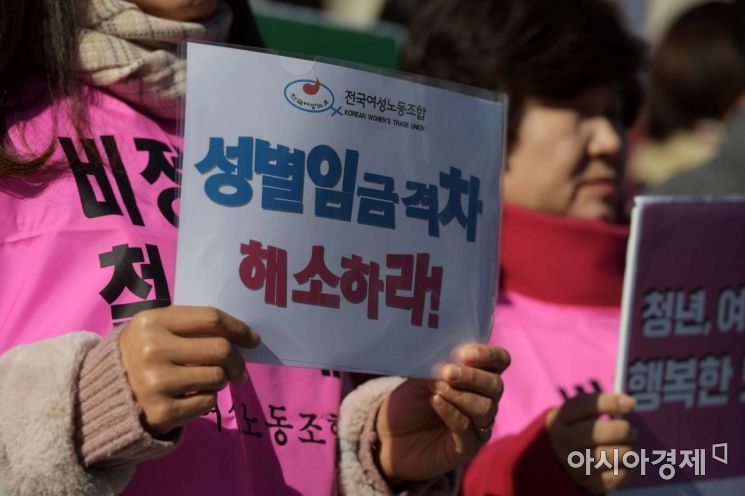 On November 22, 2018, in front of the Sejong Center for the Performing Arts in Seoul, a joint press conference titled "Youth, Women, and Irregular Workers Representatives Economic and Social Labor Committee Main Committee Launch" was held, co-hosted by the National Women's Labor Union, Youth Union, and Korea Irregular Workers Center. The Economic and Social Labor Committee is scheduled to hold its first main committee meeting at the Blue House in the afternoon under the slogan "Together, Further." / Photo by Moon Honam munonam@
[Asia Economy Reporter Hyunju Lee] It was found that among regular full-time employees working in public institutions, men earn about 20% more than women.
The Ministry of Gender Equality and Family announced the results of a survey on the gender wage gap in public institutions on the 2nd.
This survey was announced ahead of the enforcement of the Basic Act on Gender Equality, newly established in May this year, which designates one day during Gender Equality Week as "Gender Equality Wage Day" and requires the publication of gender wage statistics. The survey targeted 362 public institutions as of this year, and the gender wage gap was calculated by dividing the average male wage by the average female wage, subtracting from 1, and then multiplying by 100.
The survey results showed that the gender wage gap among regular full-time employees last year was 19.9%, a decrease of 1.2 percentage points compared to 2017. The Ministry of Gender Equality and Family explained, "Considering that the gender wage gap in the private sector is 30.1%, this is a considerably low level," and added, "It is the result of increased long-term tenure due to efforts to utilize female workforce and support work-life balance in public institutions." The gender wage gap among indefinite-term contract workers last year was 14.5%, down 2.6 percentage points from 2017.
Among public institutions, Seoul Nursing Home had the smallest gender wage gap at 0.1%, followed by the National Gwangju Science Museum (0.8%) and the Software Policy Research Institute (1.0%).
Even with a High Proportion of Female Regular Full-Time Workers in Healthcare,
Gender Wage Gap Higher than Average
Significant Impact of Large Gender Wage Gap in Hospitals
Among the 15 institutions with a small gender wage gap, the average length of service last year was longer for women than men. Conversely, in the 15 institutions with a large gender wage gap, the average length of service was longer for men than women, and the proportion of women in higher positions among regular full-time employees was lower than that of men.
By industry, excluding industries with fewer than five institutions, the financial and insurance sector had the largest gender wage gap at 26.0%, while the education services sector had the smallest at 15.7%.
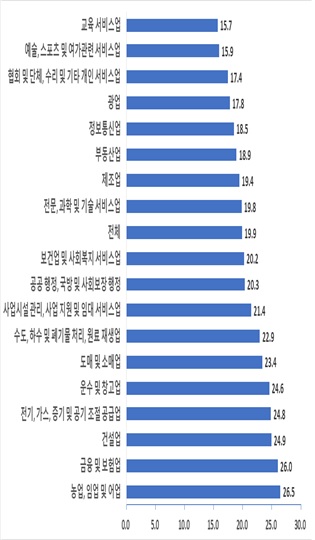 2019 Gender Wage Gap by Industry for Regular Employees (Provided by Ministry of Gender Equality and Family)
However, as an exception, the "Healthcare and Social Welfare Services" sector, where the proportion of female regular full-time employees is the highest at 64.2% compared to other industries and the gender length of service gap is small at 7.6%, had a gender wage gap of 20.2%, which is higher than the overall institutional average of 19.9%. Among these, hospitals showed the largest gender wage gap at 21.9%.
Among 353 institutions that disclosed wage information for regular full-time employees from 2017 to last year, the institutions with the greatest reduction in gender wage gap were Korea Gas Corporation, Housing and Urban Guarantee Corporation, Seoul Olympic Memorial National Sports Promotion Corporation, Korea Fire Industry Technology Institute, and National Research Council of Science & Technology.
Jeon Ki-taek, senior research fellow at the Korean Women's Development Institute who conducted the survey, said, "As this is the first time the gender wage gap in public institutions has been surveyed, we were able to confirm that the gender wage gap is on a decreasing trend," adding, "Government policies supporting work-life balance and enhancing female representation have a positive effect on reducing the gender wage gap."
© The Asia Business Daily(www.asiae.co.kr). All rights reserved.
![Clutching a Stolen Dior Bag, Saying "I Hate Being Poor but Real"... The Grotesque Con of a "Human Knockoff" [Slate]](https://cwcontent.asiae.co.kr/asiaresize/183/2026021902243444107_1771435474.jpg)
















