Professor Hwang Jun-mook, Solver of Geometry's Great Problems
Leading the Complex Geometry Research Group at IBS
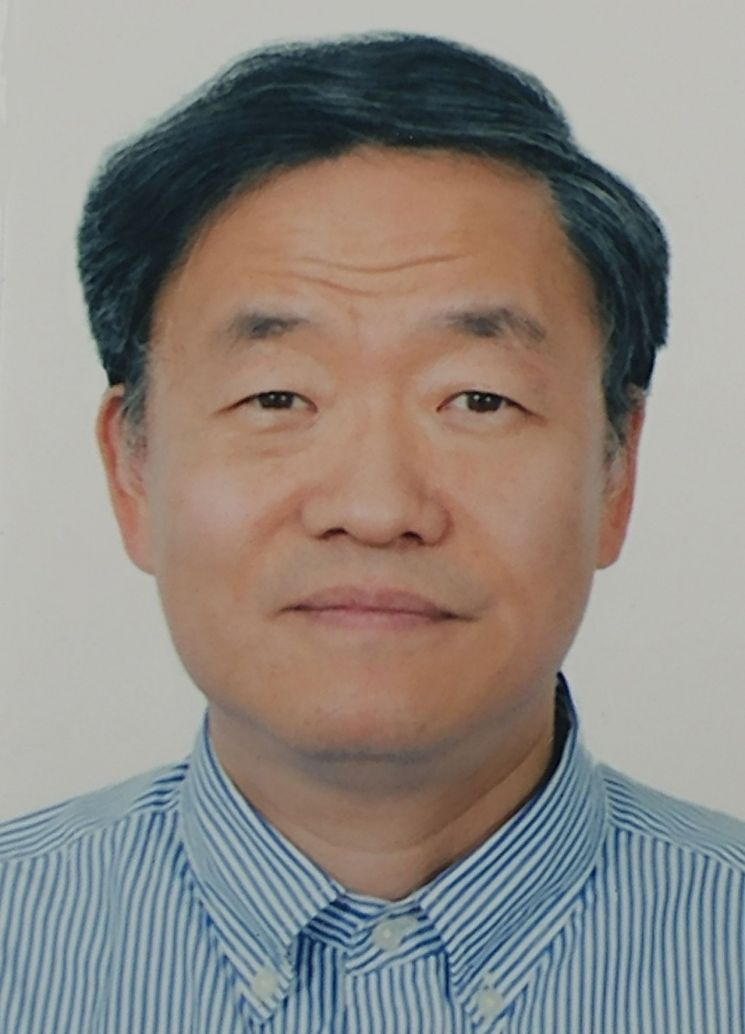 Hwang Jun-mook, Head of the Complex Geometry Research Division at the Institute for Basic Science (IBS)
[Asia Economy Reporter Junho Hwang] Professor Junho Hwang, a Korean mathematician who has solved several challenging problems in geometry with unique methods, will lead the Complex Geometry Research Division at the Institute for Basic Science (IBS). IBS announced on the 31st that Professor Junho Hwang has been appointed as the head of the Complex Geometry Research Division, which will begin research from the 1st of next month.
Professor Hwang is a mathematician known worldwide. He graduated from the Department of Physics at Seoul National University and earned his Ph.D. in Mathematics from Harvard University in the United States. After conducting research at the Mathematical Sciences Research Institute (MSRI) in the U.S., he served as a professor at the University of Notre Dame and Seoul National University, and since 1999, he has been a professor at the Korea Institute for Advanced Study, dedicating himself to research in complex geometry and algebraic geometry.
He began to gain international recognition in the mathematics community by proving the Lazarsfeld conjecture in 1999. From 1997 to 2005, he completed the proof of the deformation invariance of homogeneous spaces. Subsequently, he established himself as a world-class mathematician through solving the Matsusida problem in complex symplectic geometry (2008) and proving the Bovil conjecture (2013). Last year, he announced the proof of the Hirschowitz conjecture, a problem concerning "when the power series solution of an equation converges," which had seen no progress since Hirschowitz proposed it in 1981.
Based on these achievements, Director Hwang has received the Korea Science Award (2001), the Republic of Korea's Highest Science and Technology Award (2006), and the Ho-Am Prize (2009). In 2010, he was selected as a National Scientist. He was the first Korean to deliver an invited lecture (in the algebraic geometry and complex geometry section) at the International Congress of Mathematicians (ICM), where the Fields Medal ceremony is held, in 2006, and also gave a keynote lecture in 2014. He serves as an editor for several international mathematics journals, including the Crelle Journal, which has the longest history among mathematics journals.
The evaluation committee that selected Director Hwang stated, "Director Hwang has conducted cutting-edge research at the intersection of different mathematical fields, and his achievements are at the level of distinguished endowed professors at top universities worldwide. With his unique originality and high recognition, if he leads the research division, it will produce outstanding results comparable to any research institute globally."
Over the past decade, Director Hwang has conducted long-term research with postdoctoral researchers at the Korea Institute for Advanced Study through the "National Scientist Project" of the National Research Foundation of Korea. At IBS, young and mid-career researchers in the field of complex geometry will also participate in the research division to conduct more focused research.
Director Hwang said, "I expect to immerse myself in research with new stimulation at IBS, which has a different atmosphere from the Korea Institute for Advanced Study where I have been for the past 21 years. I want to contribute to the world with research that has a unique character of our research division in the field of complex geometry, which has a long history, by challenging several unsolved problems that I have been interested in for a long time."
Meanwhile, with the launch of the Complex Geometry Research Division, IBS will operate a total of 31 research divisions.
© The Asia Business Daily(www.asiae.co.kr). All rights reserved.
![Clutching a Stolen Dior Bag, Saying "I Hate Being Poor but Real"... The Grotesque Con of a "Human Knockoff" [Slate]](https://cwcontent.asiae.co.kr/asiaresize/183/2026021902243444107_1771435474.jpg)















