Professor Jang Jaesung of Ulsan National Institute of Science and Technology
Develops Airborne Virus Diagnostic Technology
Collects Viruses with an Electric Device
Rapid and Accurate Diagnosis Using Paper Immunosensor

[Asia Economy Reporter Junho Hwang] A technology to measure the amount of airborne viruses, such as the novel coronavirus infection (COVID-19), has been developed. It is expected to make a significant contribution to public safety by accurately and rapidly measuring the amount of viruses.
On the 31st, a research team led by Professor Jaesung Jang of the Department of Mechanical Engineering at Ulsan National Institute of Science and Technology (UNIST) announced that they developed a virus detection system composed of a device that can concentrate airborne viruses using electrical force (electric field) and a paper sensor kit that can quickly measure the concentrated amount of viruses. Professor Jang's research paper was published in Environmental Science & Technology on the 24th (local time).
Collection of Airborne Viruses
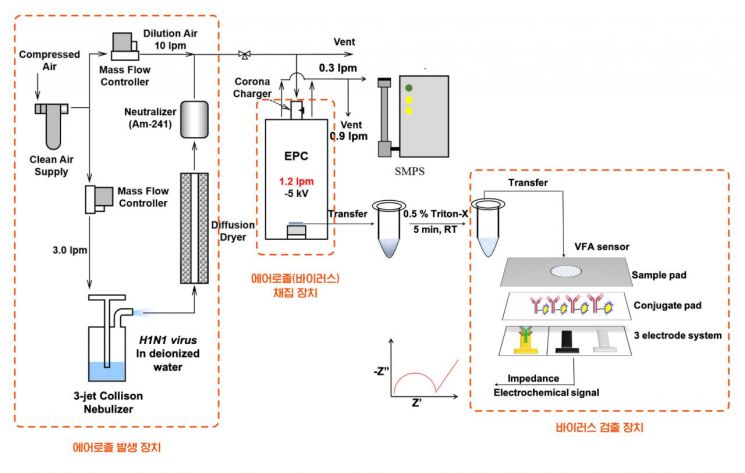
The research team developed a technology that can collect airborne viruses without damage and diagnose them quickly and accurately.
First, they developed an electrostatic virus concentrator that collects airborne viruses without damage. This technology collects viruses by utilizing electrostatic force. Using this device, even virus particles smaller than 1 micron (μm, 1 μm is one-millionth of a meter), which are smaller than airborne droplets, can be effectively collected.
Through experiments, the research team found that although the electric field causes some denaturation of the virus, it does not damage the viral nucleoprotein, and they implemented this in the concentrator. Since the nucleoprotein necessary for diagnosis is not damaged, they judged it to be an effective collection method and realized it as a device.
Existing airborne virus collection technologies used a method similar to vacuum cleaners that suck in air. In the collection process, viruses were often damaged.
Professor Jaesung Jang explained, "The 'inertial impaction method,' which accelerates particles and collects viruses by colliding them onto solid or liquid media, captures less than 10% of fine particles sized 0.03 to 0.1 μm," adding, "The newly developed method can capture over 99% of particles smaller than 1 μm."
Accurate Diagnosis and Future Measurement of COVID-19 Levels in Air

Additionally, the research team developed a virus detection system using an immunosensor. This device rapidly and accurately detects viruses by utilizing a paper immunosensor functionalized with NP-Ab (antibody).
The team conducted experiments detecting Influenza A virus (A H1N1) using their self-developed electrostatic virus concentrator and detection system. The results showed a relative virus concentration of 80.7%, which is comparable in accuracy to qPCR (76.8%) and ELISA (84.7%).
Professor Jaesung Jang stated, "Although this study was conducted only on the novel influenza virus (H1N1), it can also be used for coronaviruses, which have similar size, structure, and an envelope." He added, "Once the necessary conditions for experimenting with the COVID-19 virus are established, experiments on it can also be conducted." He further mentioned, "Research is currently underway on concentrator devices capable of drawing in larger volumes of air."
© The Asia Business Daily(www.asiae.co.kr). All rights reserved.
![Clutching a Stolen Dior Bag, Saying "I Hate Being Poor but Real"... The Grotesque Con of a "Human Knockoff" [Slate]](https://cwcontent.asiae.co.kr/asiaresize/183/2026021902243444107_1771435474.jpg)


















