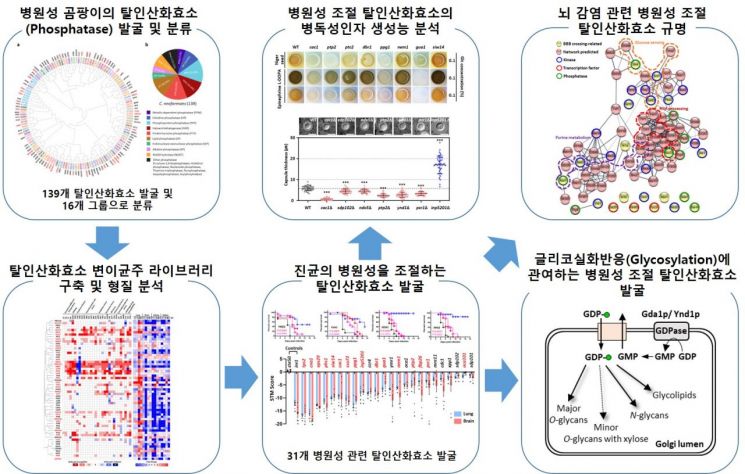
 Study on the Production and Functional Analysis of a Dephosphorylase Mutant Library of Pathogenic Fungi Causing Meningitis (Provided by Yonsei University)
[Asia Economy Reporter Hyunju Lee] Yonsei University announced on the 28th that Professor Yongseon Ban's research team from the Department of Biotechnology has succeeded in the "mass discovery of dephosphorylases controlling fungal infections" through support from the Agricultural and Food Technology Planning and Evaluation Institute's agri-food R&D project. Professor Ban's team, which led this research, utilized Cryptococcus neoformans, a pathogenic fungus causing meningitis, as a model system and identified 114 dephosphorylase genes at the genome level within the pathogenic fungus. Furthermore, through integrated functional analysis and large-scale animal experiments, they successfully discovered 31 dephosphorylases that play important roles in causing fungal meningitis. The research team revealed through studies on these 31 dephosphorylases regulating fungal pathogenicity that some of these enzymes are involved in Cryptococcus's temperature resistance, production of virulence factors such as melanin and capsule formation, and responses to various stress conditions. Among them, the dephosphorylases Xpp1, Ssu72, Siw14, and Sit4 were found to be involved in critical brain-blood barrier adhesion and penetration during the brain infection process of Cryptococcus. This research was supported by the Microbial Genome Strategy Research Project of the Ministry of Agriculture, Food and Rural Affairs, the Basic Research Project (individual research) and Leading Research Center Support Project of the National Research Foundation of Korea under the Ministry of Science and ICT, and was published in Nature Communications, a world-renowned multidisciplinary scientific journal.
© The Asia Business Daily(www.asiae.co.kr). All rights reserved.
![Clutching a Stolen Dior Bag, Saying "I Hate Being Poor but Real"... The Grotesque Con of a "Human Knockoff" [Slate]](https://cwcontent.asiae.co.kr/asiaresize/183/2026021902243444107_1771435474.jpg)















