Introduction of Flexible Work System as Major Corporations' COVID-19 Response
Flexible Work Including Remote Work Implemented... 57% of Large Corporations, 30% of SMEs
"Concerns Over Workforce Reduction Outweigh Expectations for Remote Work"
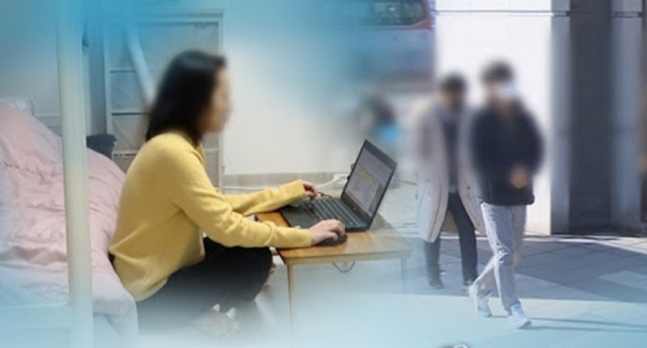
[Asia Economy reporters Seunggon Han and intern Yeonju Kim] "Everyone is in a dangerous situation, but we have no choice but to go to work because of company guidelines," "I know the conditions for working from home are not ideal, but the anxiety is real."
As the spread of the novel coronavirus disease (COVID-19) originating from Seoul and the metropolitan area continues, emphasizing quarantine measures, companies have started implementing emergency management systems such as working from home and flexible work arrangements. However, small and medium-sized enterprises (SMEs) that lack the capacity are still commuting to the workplace due to issues like system setup.
According to the business community, major conglomerates have returned to a work-from-home system in response to the rapid spread of COVID-19. They are also implementing staggered commuting and rotational work-from-home schedules to prevent the spread of the virus.
Since the COVID-19 outbreak, 57% of large companies have implemented flexible work systems such as working from home, but only 30% of SMEs have done so.
According to a recent survey by the recruitment platform Saramin targeting 342 companies on the status of flexible work system implementation, 36.3% responded that they "implement it." This is an increase of 14.3 percentage points from last year's survey result (22%).
Among companies that have tried flexible work systems, 50% said they introduced the system after February this year in response to the COVID-19 situation.
However, in the case of SMEs, it has been found difficult to introduce flexible work systems such as working from home due to lack of proper systems including work efficiency and video conferencing setups.
Given this situation, anxiety about COVID-19 infection is growing among SME workers.
A 27-year-old female SME worker A said, "Working from home is only possible in places like large companies where work systems are well established, and it is practically difficult to expect this in SMEs." She added, "Since there is no proper system for work-related aspects such as video conferencing that large companies implement, even if we try to work from home, it would be difficult."
A also expressed, "Even though mask-wearing is mandatory in the office, many employees wear masks on their nose or chin. I understand that wearing masks all day is uncomfortable, but since it is the minimum quarantine measure individuals can take, I hope everyone follows it well."
Some SME workers expressed concerns about company restructuring such as workforce reduction rather than expecting changes in work systems.
B, a 29-year-old male working in a small manufacturing business, said, "I feel that work has significantly decreased as the COVID-19 situation has prolonged. Because of this, everyone is desperate not to lose work orders."
He added, "I don't even expect working from home. I know the company is in a difficult situation, so I just hope there will be no measures like workforce reduction."
Moreover, concerns are growing about the government's consideration to raise social distancing to level 3. If social distancing measures are raised to level 3, private companies will be encouraged to have all employees work from home except essential personnel.
For SMEs that do not have systems in place for working from home under such guidelines, work disruptions are expected to be inevitable.
Meanwhile, quarantine authorities stated that they are discussing whether to raise social distancing to level 3 as new confirmed cases increased to the 300s within three days, but they also expressed a cautious stance, saying more time is needed to observe the situation.
Yoon Tae-ho, head of the Central Disaster and Safety Countermeasure Headquarters' quarantine team, said at a regular briefing, "The official position is to discuss whether to raise to level 3 while observing this week's trend," adding, "There is nothing concrete yet regarding the official level 3 announcement from the Central Disaster and Safety Countermeasure Headquarters."
He continued, "Although the number of patients exceeded 300 as of midnight today, the trend is not as concerning as before, so more observation is needed," and "However, internally, deep discussions are ongoing about the measures necessary for level 3."
The Korea Disease Control and Prevention Agency's Central Disease Control Headquarters announced that as of midnight on the 26th, 320 new COVID-19 cases were confirmed compared to the previous day. The total cumulative number of confirmed COVID-19 cases in Korea is now 18,265.
Among locally transmitted cases, 110 were in Seoul, 92 in Gyeonggi, and 27 in Incheon, all in the metropolitan area. Outside the metropolitan area, 18 cases were confirmed in Gangwon, 12 each in Chungnam and Jeonnam, 7 each in Gwangju, Daejeon, and Jeonbuk, 5 in Gyeongnam, 4 in Busan, and 2 each in Daegu, Ulsan, and Jeju.
© The Asia Business Daily(www.asiae.co.kr). All rights reserved.



















