As the number of new confirmed cases of the novel coronavirus infection (COVID-19) surges again, the time spent staying indoors is increasing. Moreover, with the outbreak of a cluster infection at a Starbucks in Paju, more consumers are refraining from using not only coffee shops but also restaurants, leading to rapid growth in the markets for ramen, instant rice, and home meal replacements (HMR). Until last year, the domestic ramen market was stagnant, but it recorded 1.13 trillion KRW in the first half of this year, growing 7% compared to the same period last year. Asia Economy examines the business status of food companies such as CJ CheilJedang, Ottogi, and Shinsegae Food, whose performance improvement expectations have grown amid the spread of the 'Jipkok' (staying strictly at home) culture due to the COVID-19 impact.
[Asia Economy Reporter Jang Hyowon] Shinsegae Food has experienced both ups and downs due to COVID-19. While the school meal and dining-out businesses suffered from delayed school openings and reduced consumption, the food distribution business performed well thanks to increased HMR sales. The market expects performance normalization from the second half of the year with the launch of the new brand 'No Brand Burger' and the expansion of the HMR market.
◆ Sales lost in school meals compensated by HMR = Shinsegae Food is a company specializing in group meal services, dining-out businesses, and food distribution. It is an affiliate of the Shinsegae Group, with E-Mart and Shinsegae Chosun Hotel holding 55.5% of its shares. As of the end of the first half of this year, the food distribution sector accounted for the largest share of Shinsegae Food’s sales at 57.1%, while school meal and dining-out businesses accounted for 41.6%.
Shinsegae Food recorded sales of 612.1 billion KRW in the first half of this year, a 4.94% decrease compared to the same period last year. Although sales declined, selling and administrative expenses increased, resulting in an operating loss of 1.5 billion KRW. Net loss also turned to 4.2 billion KRW.
The first-half loss is attributed to the impact of COVID-19. As the virus spread early this year, major elementary, middle, and high schools nationwide delayed their openings, shrinking the school meal business. This is why sales in the school meal and dining-out sectors dropped 14.8% from 299.2 billion KRW in the first half of last year to 255 billion KRW.
The food distribution sector performed well. This is attributed to strong HMR sales and increased bakery sales to Starbucks. Food distribution sales in the first half reached 349.9 billion KRW, up 3.8% from 337.1 billion KRW in the same period last year.
Shinsegae Food’s downturn is expected to somewhat recover in the second half with the strengthening of the No Brand Burger and HMR businesses. After Shinsegae Food announced last month that it would enter the No Brand Burger franchise business, it reportedly received 1,300 franchise inquiries. Additionally, the expansion of the HMR market led to a 450% year-on-year increase in SSG.com’s HMR sales, which is expected to boost sales for the affiliate.
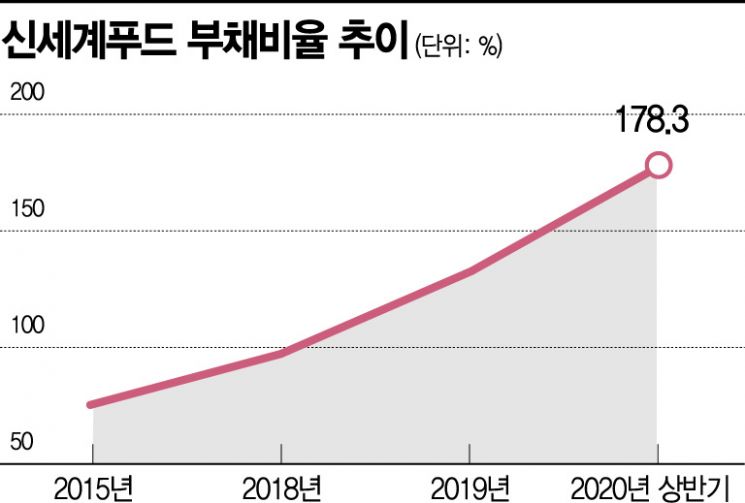
◆ Increased financial burden... rising interest expenses = The poor performance has also increased financial burdens. As of the end of the first half, Shinsegae Food’s consolidated debt ratio stood at 178.3%, up 45.6 percentage points from 132.7% at the end of last year. Net borrowings also surged. Net borrowings, which were 244.5 billion KRW at the end of last year, rose 61% to 393.6 billion KRW in the first half of this year.
On January 30, Shinsegae Food issued its first-ever 100 billion KRW unsecured public bonds to refinance 100 billion KRW of commercial paper (CP) maturing this year. The CP’s interest rate was about 1.8%, while the public bonds carry an interest rate of 2.77%. This means interest payments increased from 1.8 billion KRW to 2.7 billion KRW. In fact, Shinsegae Food’s interest expenses rose 44.8% to 4.2 billion KRW in the first half from 2.9 billion KRW last year. Lee Dong-eun, senior researcher at Korea Ratings, forecasted, “The decline in operating performance this year and increased borrowings due to expansion investments in Jangteo (a U.S. subsidiary) will continue.”
© The Asia Business Daily(www.asiae.co.kr). All rights reserved.
![Clutching a Stolen Dior Bag, Saying "I Hate Being Poor but Real"... The Grotesque Con of a "Human Knockoff" [Slate]](https://cwcontent.asiae.co.kr/asiaresize/183/2026021902243444107_1771435474.jpg)















