Kakao Games and Others in the Industry Face Repeated Gender Conflict Controversies
Repeated Corrections and Staff Replacements
Securing Female Users with High Potential... Considering Business Expansion Challenges
[Asia Economy Reporter Bu Aeri] Recently, Kakao Games faced attacks accusing them of having employees with feminist tendencies internally during the process of revising dialogues in their new game 'Guardian Tales.' The revised dialogues were criticized for being feminist. Ultimately, the company replaced the controversial dialogues and the staff involved due to backlash from male users. Earlier this year, the illustrator of the indie game 'Chrono Ark' had their contract terminated after posting feminist-supporting content on their personal SNS (social network service) account, following demands for their removal by male users. Despite boasting employee welfare and advancements in game technology, the Korean gaming industry still shows no progress in overcoming its male-centered culture when it comes to gender conflicts.
Recurring 'Misogyny Controversies'
According to related industries on the 24th, the Ministry of Culture, Sports and Tourism plans to conduct a survey on misogyny and discrimination throughout the gaming industry, following recommendations from the National Human Rights Commission. The Human Rights Commission has also ordered the Ministry to prepare related improvement measures. The government's involvement stems from the fact that misogyny controversies have repeatedly occurred in the gaming industry for several years.
The gaming industry's misogyny controversies first surfaced in 2016 with Nexon's 'Closers' voice actor replacement incident. At that time, voice actor Kim Jayeon, who played the character 'Tina' in Closers, posted a photo on her SNS wearing a T-shirt supporting the feminist community 'Megalia,' which drew criticism from game users. Nexon eventually replaced the voice actor. Similar incidents where game companies such as Smilegate and Neowiz were scrutinized by users for 'feminist ideology' occurred steadily every year over the next four years.
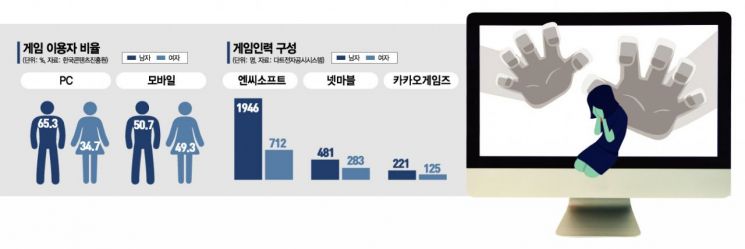
The response from game companies was consistent. Whenever feminist controversies arose, they appeased male users by revising the problematic dialogues or works and replacing the employees involved. This is analyzed to be because the majority of both users and industry workers are male. According to the '2020 Game User Survey,' male users accounted for 65.3% of PC game players, while female users were only 34.7%. Among major domestic game companies, male employees outnumbered females by more than twice. For example, NCSoft had 1,946 male R&D personnel compared to 712 females. Netmarble also had 481 male game staff versus 283 females. Kakao Games had 221 male employees, significantly more than 125 females. Lee Hyun-sook, a member of the Game Rating and Administration Committee, diagnosed, "Since males overwhelmingly dominate the gaming industry, misogyny issues are amplified in the process of creating gaming communities or communicating with each other."
Game Companies Caught in a Dilemma
Amid gender conflicts, game companies are caught in a business dilemma. Securing female users, who represent a significant potential customer base, is also an important issue for business expansion. According to the Korea Creative Content Agency, the number of women playing games is increasing every year. In a recent survey, 67.3% of female respondents said they play games, a 6% increase from last year's 61.3%.
However, it is also a reality that they cannot sacrifice the demands of male users, who currently serve as the cash cow. Ignoring the 'sentiments' of male users could lead to a mass exodus. A representative from a major game company lamented, "If we get labeled as a feminist game now, it's only a matter of time before we fall. While future customers are important, we prioritize listening to men’s voices and resolving controversies rather than suffering a fatal blow to immediate profits."
Experts believe that a business model targeting women is necessary to solve the problem. Professor Wi Jeong-hyun of Chung-Ang University, president of the Korea Game Society, said, "The easiest solution in the industry is to show a successful business model. If female developers create games well and RPGs (role-playing games) with a majority female audience emerge and achieve commercial success, the problem will be resolved."
© The Asia Business Daily(www.asiae.co.kr). All rights reserved.
![Clutching a Stolen Dior Bag, Saying "I Hate Being Poor but Real"... The Grotesque Con of a "Human Knockoff" [Slate]](https://cwcontent.asiae.co.kr/asiaresize/183/2026021902243444107_1771435474.jpg)











