Violation of Constitutional Equality Principle Causes National Division and Conflict
Abandoning the Universal Welfare Line Maintained by the Democratic Party
Accurate Understanding of Disaster Relief Funds Needed for Nationwide Support
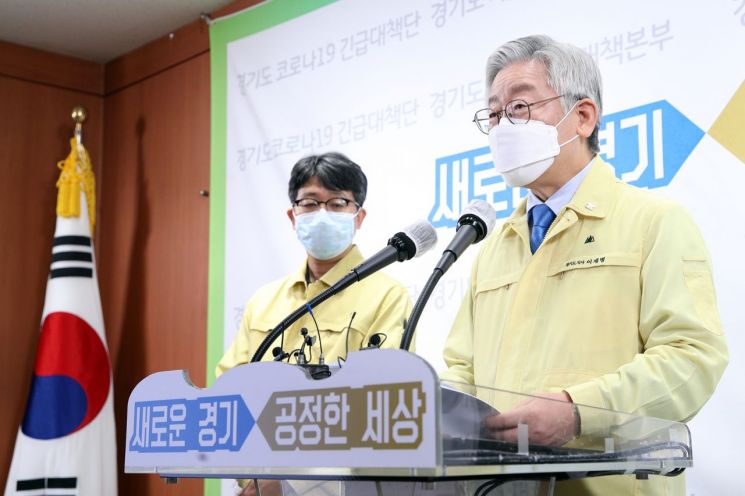
[Asia Economy (Suwon) = Reporter Lee Young-gyu] Lee Jae-myung, Governor of Gyeonggi Province, recently made it clear that he opposes the Democratic Party of Korea's internal discussion about providing the '2nd Emergency Disaster Relief Fund' only to the lower 50%, stating that this misunderstands the nature of the disaster relief fund and abandons the universal welfare path that the Democratic Party has upheld.
He particularly warned that selective support could violate the constitutional principle of equality and cause national division and conflict.
On the 23rd, in a Facebook post titled "Selective Disaster Relief Fund is Unreasonable Discrimination, Why Suddenly Selective Welfare When Advocating Universal Welfare?" he began by saying, "As the 2nd disaster relief fund is being discussed, there are proposals to provide it only to some people or to give double the amount to the lower 50% while not giving it to the upper 50%."
He continued, "To conclude, such proposals misunderstand the nature of the disaster relief fund, violate the constitutional principle of equality, cause national division and conflict, abandon the universal welfare path upheld by the Democratic Party, and align with the conservative opposition party's selective welfare policy," dismissing the idea.
He first clearly defined the nature of the disaster relief fund.
In the context of the deepening economic recession caused by COVID-19 and the problem of insufficient consumer demand, the government should focus on expanding demand to create a virtuous economic cycle. The disaster relief fund provided for this purpose has a welfare aspect that compensates for household economic difficulties, but essentially, it is an economic policy to overcome the economic crisis caused by the disaster and revive the national economy, according to Governor Lee.
Lee also mentioned the fairness issues related to selective payments.
He emphasized, "The disaster relief fund is not a charity to help the poor. When the government, as the people's representative, executes economic policies for the people using resources borne by the people, excluding those who contributed more to the funding and supporting only those with lower or no contribution violates the constitutional principle of equality and discriminates against higher-income earners without reasonable grounds."
Furthermore, he stated, "There is no rational basis for making the lower 50% beneficiaries while excluding the 50.1% who are just 0.1% higher. No citizen has been unaffected by COVID-19, and since the disaster relief fund is covered by taxpayers' money, people who have paid or should pay more taxes should not be excluded from economic policy execution and disadvantaged."
Lee also expressed that the argument for selective support is unreasonable.
He said, "The conservative opposition party has always advocated selective support, so it is not strange if they suggest giving the disaster relief fund only to some. However, the Democratic Party has advocated universal welfare in past welfare policies such as free school meals, which even led to the resignation of the Seoul mayor. Suddenly abandoning universal welfare and insisting that only the disaster relief fund should be selective welfare is unacceptable."
He particularly worried, "Separating fund contributors and beneficiaries and giving welfare benefits only to some poor people will make it difficult to increase total welfare due to opposition from higher-income contributors. Ultimately, higher-income earners benefit while expanding welfare for lower-income earners becomes more difficult due to tax resistance and welfare expansion obstruction."
Lee added, "The conservative opposition party has opposed welfare expansion (tax increases) by advocating 'selective welfare that seems to help the common people but is actually disadvantageous to them,' while the Democratic Party has advocated and implemented 'universal welfare that seems disadvantageous to the common people but actually increases total welfare' to expand welfare. The sudden call for selective welfare is causing confusion."
Regarding concerns about insufficient funds to provide disaster relief to all citizens, Lee explained, "The amount to be paid has not been fixed, so there can be neither shortage nor excess. The disaster relief fund is an economic policy and disaster recovery measure aimed at increasing households' disposable income, forcing consumption within a certain period to boost sales of small and medium-sized businesses, and creating a virtuous economic cycle through increased production. If the necessary and possible funds are first determined and then distributed evenly to all citizens, there will be no shortage."
He then questioned, "In an era where supply capacity overflows but consumption is insufficient causing economic recession, why are hundreds of trillions of won spent generously on supporting supply-side companies, but less than 15 trillion won is considered too much for supporting household consumption that would expand demand and help economic circulation?" He criticized, "We must abandon the outdated frame that company support is investment and household support is waste."
Finally, Lee warned, "The government, as the people's representative in a democratic republic, must follow the will of the sovereign people who pay taxes and delegate authority, and exercise authority fairly toward the sovereign. They must not act arbitrarily as if donating their own money."
He also mentioned, "The current will of the people is not welfare spending for the poor but an economic policy disaster relief fund to be distributed fairly to all citizens. Although more than 20% said in a pre-April general election poll that they would not receive the disaster relief fund, in reality, over 97% received it, and those excluded from partial support that excluded some higher-income earners were angered."
Lee said, "Because of this, the Democratic Party, the United Future Party, and the government all agreed on universal distribution, and there is no reason for the people's will to have changed now. Selective differential payments will cause serious resistance and backlash among citizens already struggling with COVID-19, as well as conflict and division among the people, making welfare expansion more difficult," expressing concern.
Earlier, on the 21st, Lee proposed to the government to hasten the payment of the 2nd basic disaster income amid the COVID-19 resurgence crisis by providing about 300,000 won per person in local currency to all citizens.
© The Asia Business Daily(www.asiae.co.kr). All rights reserved.