"Yubo is 'until the Seoul Metropolitan Area Stabilization Period,' Ministry of Education's delay in notifying quotas is 'for the time being' with conditions"
"Despite the severity of COVID-19 and the anger of young doctors, meaningless investigations are repeated... Not a responsible attitude," criticism
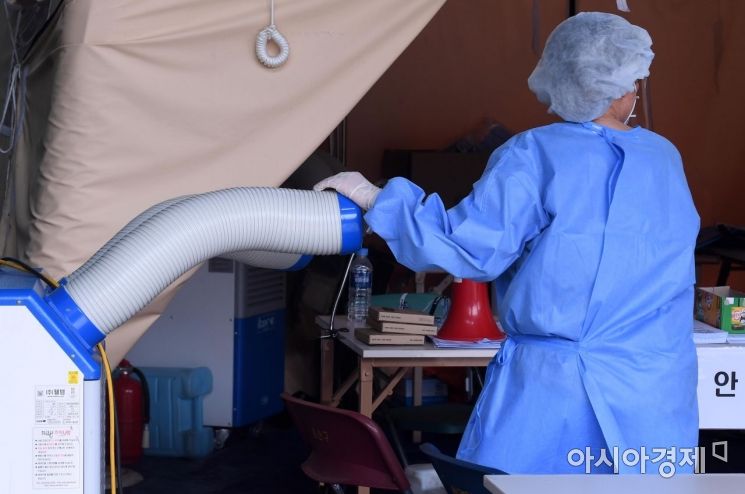 Medical staff, suffering from the double burden of the spread of the novel coronavirus infection (COVID-19) and the heatwave, are cooling off in the breeze of an air conditioner at a screening clinic in Seoul on the 20th. Photo by Kim Hyun-min kimhyun81@
[Asia Economy Reporter Kim Yuri] The Korea Medical Association (KMA) criticized the government's announcement to postpone the policy of expanding medical school quotas and establishing public medical schools until the spread of COVID-19 in the metropolitan area subsides, calling it a political rhetoric with the caveat of "for the time being." The doctors have stated that they will proceed with collective action as planned unless there is a change in the government's stance.
On the same day, Park Neung-hoo, Minister of Health and Welfare, said, "Regarding the expansion of medical school quotas and the establishment of public medical schools, which the medical community is raising concerns about, we will discuss with the medical sector and proceed after the COVID-19 situation in the metropolitan area stabilizes." He also said that the size of the medical school quota, which must be notified to the Ministry of Education by the end of this month, will be postponed until the situation stabilizes.
In response, the KMA criticized it as a "repetition of unreliable political rhetoric." Kim Dae-ha, spokesperson for the KMA, emphasized, "'Postponing' but with the caveat 'until metropolitan area stabilization,' and delaying notification of quotas to the Ministry of Education but adding 'for the time being' as a caveat, clearly indicates that they intend to proceed soon." He said, "Repeating such meaningless rhetoric despite the severe COVID-19 crisis and the high anger of young doctors is not a responsible attitude befitting the executive branch."
The KMA previously stated that it would only postpone the strike if the government withdraws policies such as expanding medical school quotas, establishing public medical schools, pilot projects for coverage of Korean herbal medicine prescriptions, and fostering non-face-to-face medical care. The argument is to first withdraw the policies and then devise appropriate policies if it is concluded that there is a shortage or surplus of doctors.
The medical community is currently engaging in collective action in opposition to the government's health care policies. The Korean Intern Resident Association (KIRA), composed of residents, began an indefinite strike starting with interns and fourth-year residents on the 21st, followed by third-year residents on the 22nd, and first- and second-year residents on the 23rd, sequentially suspending work.
The KMA, centered on private practitioners, has announced a second nationwide doctors' strike scheduled for three days from the 26th to the 28th.
© The Asia Business Daily(www.asiae.co.kr). All rights reserved.
![Clutching a Stolen Dior Bag, Saying "I Hate Being Poor but Real"... The Grotesque Con of a "Human Knockoff" [Slate]](https://cwcontent.asiae.co.kr/asiaresize/183/2026021902243444107_1771435474.jpg)















