Cultivation of Eco-Friendly Pesticide- and Herbicide-Free Vegetables
Gaining Attention as a Food Security Alternative to Climate Change Response
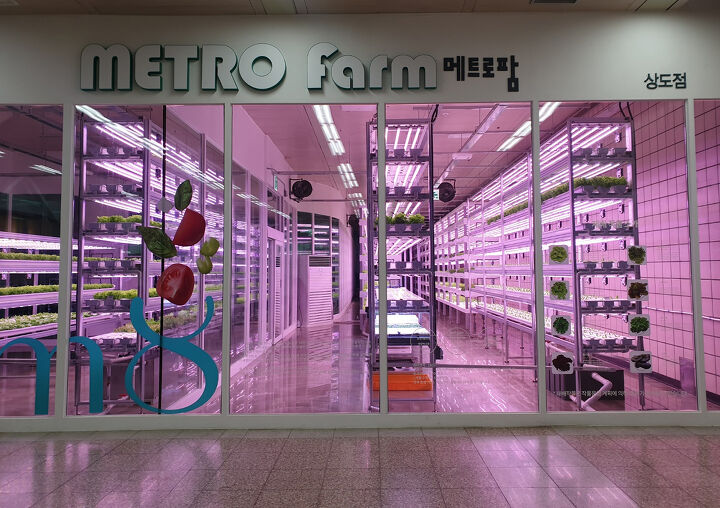
[Asia Economy Reporter Kim Heeyoon] #. Seo Yumi (31, pseudonym), an office worker commuting through Euljiro 3-ga Station on Seoul Subway Lines 2 and 3, buys salad from a farm inside the subway station to have breakfast. At Metro Farm, which opened in June this year, internal staff harvest and package the crops being grown and sell them through vending machines. Ms. Kim said, “Sometimes I want a simple salad for breakfast, and I often use it because I can conveniently purchase freshly harvested fresh crops.”
Smart farms have come close to urban life. Metro Farms, which cultivate crops indoors like factories without sunlight, have appeared at various Seoul subway stations, attracting attention. Operating smart farms inside subway stations is the world's first case.
According to related industries on the 22nd, amid the recent surge in vegetable prices due to prolonged rainy seasons, smart farms capable of stable vegetable supply are emerging as an alternative.
Starting with the Sangdo Station Metro Farm, which opened in September last year, Metro Farms are currently operating in a total of five stations. The monthly production volume is about 1.5 tons, cultivating 30 to 40 types of leafy vegetables and 20 to 30 types of herbs.
The Sangdo Station Metro Farm spans about 70 pyeong (approximately 231 square meters) and cultivates leafy vegetables in a total of over 7,000 pots stacked across six floors. A representative from Farmate, which operates Metro Farm, explained, “To avoid harming local farms, we use European varieties for the leafy vegetables we cultivate.”
Metro Farm produces pesticide-free vegetables without concerns about herbicides or pests by using a certain amount of lighting and indoor air quality control instead of sunlight. It can produce a consistent amount of crops daily without being affected by natural disasters such as floods, droughts, or cold damage, making it a promising alternative for stable food supply amid climate change.
Smart farms can increase production by more than 30% compared to conventional farming. According to the 2018 analysis statistics of smart farm adoption farms by the Ministry of Agriculture, Food and Rural Affairs, production per 3.3㎡ (1 pyeong) increased from 19 kg in conventional farming to 25 kg in smart farms. The quality of crops also improved. The commercial production per 3.3㎡ was 18.6 kg in conventional farming, whereas it increased to 24.4 kg in smart farms. Accordingly, the income of farms adopting smart farms was 34,910 KRW per 3.3㎡, which is 28.6% higher than the 27,150 KRW of conventional farms.
Recently, various smart farms are expanding the scope of urban agriculture centered on Metro Farms opened in subway stations. Seoul City has begun discovering urban sites suitable for smart farms, and Seoul Metro Corporation is creating smart farm platforms at Nambu Bus Terminal Station on Line 3 and Sindang Station on Line 6.
An industry insider said, “Urban agriculture with good accessibility through smart farm adoption will gradually expand,” and predicted, “Although initial facility construction costs are high, once built, the facilities can be used for nearly 10 years, leading the evolution of agriculture as a stable food supply alternative responding to climate change.”
© The Asia Business Daily(www.asiae.co.kr). All rights reserved.