6th Basic Plan for Rational Energy Use Confirmed
Priority Financing Support for Energy Efficiency Improvement Projects Including ESCO Business
2-Year Extension of Special Tax Reduction for SMEs... End of 2020 → End of 2022
Introduction of EERS and Investment in Building Zero Energy... "Creating New Markets"
Energy Diagnosis and Improvement Authority Transferred from Government to City/Province
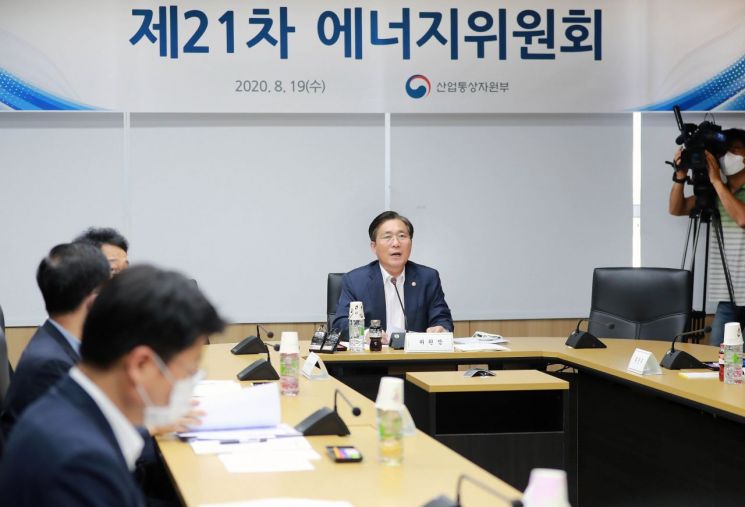 Minister of Trade, Industry and Energy Sung Yun-mo chaired the 21st Energy Committee meeting at 2 p.m. on the 19th at the Government Sejong Complex. Attending the meeting were ex officio members from three ministries including Minister Sung as chairman, Hwang Seok-tae, Director General of the Environmental Policy Bureau at the Ministry of Environment, Kang Ju-yeop, Policy Planning Officer at the Ministry of Land, Infrastructure and Transport, and Hwang Pan-sik, Acting Director General of Basic Science and Technology at the Ministry of Science and ICT, as well as appointed members including Professor Park Jong-bae of Konkuk University, Kim Tae-ho, CEO of Energy Sharing and Peace, Professor Park Jung-gu of Seoul National University of Science and Technology, Professor Cho Sung-kyung of Myongji University, Kwon Kyung-hyun, CEO of Beom Law Firm Jinwoon, Professor Kim Yoon-kyung of Ewha Womans University, Hong Hye-ran, Secretary General of Energy Citizens' Solidarity, Han Young-soo, President of the YWCA Federation, Cho Yong-sung, President of the Korea Energy Economics Institute, Professor Moon Hoe-ri of Ulsan National Institute of Science and Technology, and Kim Chang-seop, Chairman of the Korea Energy Agency. The committee reviewed two agenda items: the designation of an "Energy Industry Convergence Complex (draft)" and the "6th Basic Plan for Rational Energy Use (draft)." (Photo by Ministry of Trade, Industry and Energy)
[Asia Economy Reporter Moon Chaeseok] The government announced on the 19th that it has reviewed and finalized the "6th Basic Plan for Rational Energy Use," which focuses on reducing final energy consumption by 9.3% compared to the business-as-usual (BAU) forecast by 2024. The energy source unit is planned to improve by 13% from this year to 2024.
This 6th plan will be applied from this year through 2024. It is a national mid- to long-term implementation strategy for the demand sector under the top-level "3rd Basic Energy Plan" established by the government in June last year.
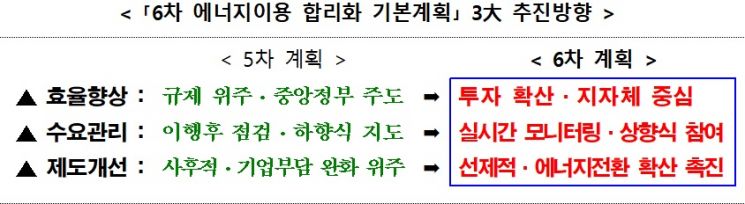
Through the 6th plan, the government announced that it will reduce energy consumption by 9.3%, which is 2.3 times greater than the 5th plan set in 2014. The goal is to reduce from the 2024 demand forecast of 194.7 million TOE to 176.5 million TOE.
The energy source unit is the total amount of energy required to produce 1 million KRW of added value. The government plans to improve it by 13%, from 0.108 TOE this year to 0.094 TOE in 2024. This is 1.5 times better than the 8.7% improvement in the 5th plan.
The three main principles of the 6th plan set by the government are ▲ promoting energy efficiency improvement through investment expansion and local government-centered initiatives ▲ strengthening demand management based on real-time monitoring and bottom-up participation ▲ improving efficiency and demand management systems to promote energy transition expansion.
First, investment will be induced by expanding financial and tax support for promising energy-saving projects. Among small and medium-sized enterprises (SMEs) and mid-sized companies, those conducting ESCO (Energy Service Company) investment projects or projects expected to achieve a savings rate of 10% or more based on energy diagnosis results will be given priority for business loans.
ESCO projects refer to businesses where energy users who want to improve or supplement outdated energy facilities with high-efficiency ones but cannot implement them due to technical or economic burdens install the facilities first and then receive full repayment of the investment cost in installments.
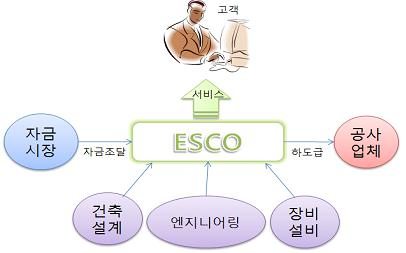 Conceptual Diagram of the ESCO Project. (Photo by Asia Economy DB)
Investment tax credits will be expanded and restructured. For example, the tax credit rates applied to energy-saving facilities were 1% for large enterprises, 3% for mid-sized companies, and 7% for SMEs, but these will be changed to 1%, 3%, and 10%, respectively. An additional 3% credit will be provided.
For industries subject to special tax reductions for SMEs such as ESCOs, the tax reduction period will be extended by two years from the end of this year to the end of 2022.
The government will introduce the EERS (Energy Efficiency Resource Standard) and create new investment markets by investing in "building zero-energy" projects.
The EERS system imposes annual energy-saving targets on energy suppliers such as Korea Electric Power Corporation, Korea Gas Corporation, and Korea District Heating Corporation, mandating investments to improve energy efficiency. They must meet a certain percentage of energy savings relative to sales volume.
In addition to energy suppliers, the "Voluntary Energy Efficiency Target System" will be implemented for high-energy-consuming workplaces using more than 2,000 TOE annually.
Public rental housing, daycare centers, health centers, medical institutions, and other buildings will undergo "green remodeling," and the "Green Smart School" policy will be implemented in 2,890 national, public, and private schools by 2025 to improve energy efficiency.
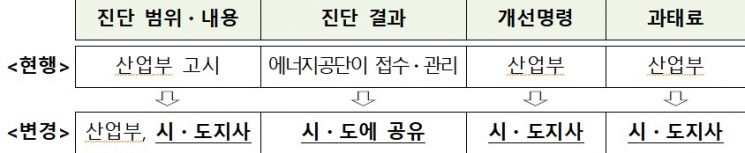
Authority for energy diagnosis and improvement will be delegated to cities and provinces. The scope and content of energy diagnosis will be entrusted to local ordinances, and the authority to issue improvement orders and impose fines will be transferred to local governments.
The real-time inspection system will be strengthened, and data collection, sharing, and utilization will be promoted to digitalize the demand management system.
To this end, a smart energy platform will be established in 10 industrial complexes by 2022. During the same period, a database (DB) of energy diagnosis for 3,000 old buildings will be created.
Efficiency and demand management systems will be improved to promote the spread of energy transition.
The energy consumption efficiency rating system will be improved to establish a value chain for device energy efficiency. A virtuous cycle system will be created among government system reforms, corporate device production, and consumer purchases.
Mid- to long-term target standards for the highest and lowest grades will be presented to induce competition in energy efficiency among businesses. This year, systems related to air conditioners, refrigerators, and TVs will be changed; next year, those for heating and cooling devices, kimchi refrigerators, and washing machines; and in 2022, those for air purifiers, dehumidifiers, and water heaters.
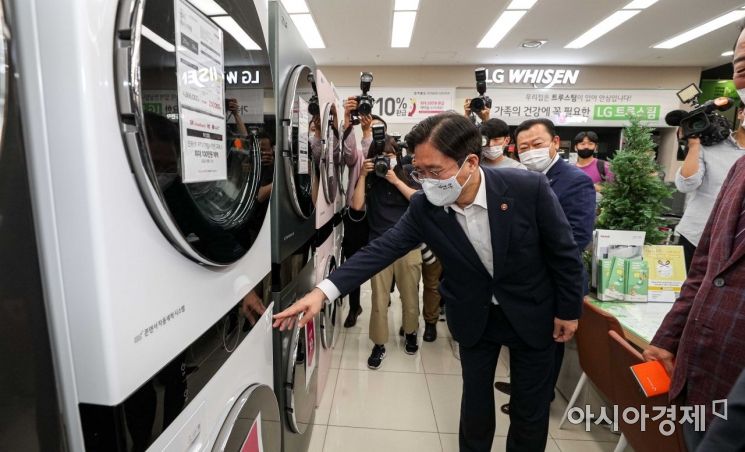 Minister Sung Yun-mo of the Ministry of Trade, Industry and Energy visited Electron Land in Yongsan-gu, Seoul on the 3rd to check the sales status of top-efficiency home appliances. Photo by Kang Jin-hyung aymsdream@
To encourage participation in efficiency competition among SMEs and mid-sized companies, support for technology development related to the highest efficiency grade will be strengthened. Similar to this year's successful "Top-Rated Efficiency Appliance Rebate Program," a certain amount will be refunded when purchasing top-grade products to expand the high-efficiency device market.
Additionally, ▲ the energy use planning consultation system will be improved to strengthen demand management for large-scale facilities, and ▲ the public institution demand management system will be supplemented to promote energy saving and efficiency improvement.
Seong Yun-mo, Minister of Trade, Industry and Energy, said at the Energy Committee meeting on the day, "Innovative energy efficiency improvement and demand management are important cornerstones for establishing and further expanding the energy transition that the government is diligently pursuing," adding, "Through the 6th plan, we will do our best to activate efficiency improvement investments and faithfully implement demand management digitalization to establish a high-efficiency, low-consumption economic foundation."
© The Asia Business Daily(www.asiae.co.kr). All rights reserved.
![Clutching a Stolen Dior Bag, Saying "I Hate Being Poor but Real"... The Grotesque Con of a "Human Knockoff" [Slate]](https://cwcontent.asiae.co.kr/asiaresize/183/2026021902243444107_1771435474.jpg)

















