Conflicting Initial Reactions to Public Maintenance Projects, Key to Government's Metropolitan Housing Supply
Public Redevelopment Emerges as Alternative for Stagnant Areas
Public Reconstruction Ignored Due to Unchanged Sale Price Caps and Excess Reconstruction Profit Recovery System
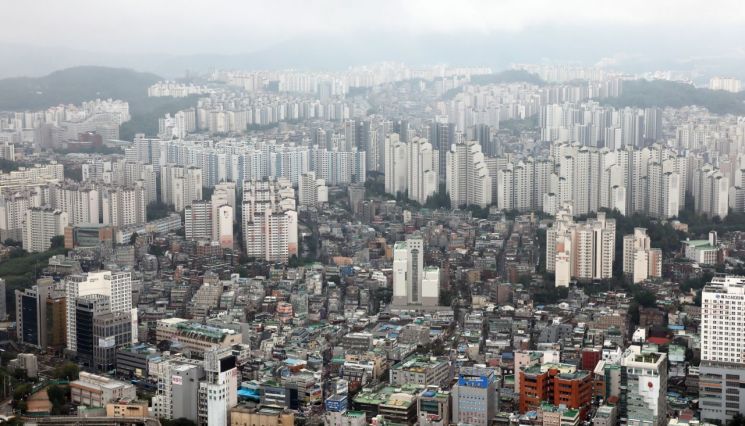
[Asia Economy Reporter Onyu Lim] As the government announced plans to supply 90,000 housing units in the Seoul metropolitan area through public redevelopment projects, the initial responses to public redevelopment and public reconstruction have been mixed. While public redevelopment is attracting interest from stagnant districts, public reconstruction is being largely ignored both in Gangnam and Gangbuk areas.
"Even if they give rental units, as long as the project proceeds..." Public redevelopment draws interest from stagnant districts
According to the real estate industry on the 13th, about 20 districts in Seoul have shown interest ahead of the public redevelopment application in September. Public redevelopment refers to redevelopment projects promoted with the participation of public entities such as SH Corporation. The key incentives include increasing floor area ratio, simplifying approval procedures, and exemption from the price ceiling system in exchange for increasing rental housing. Accordingly, public redevelopment has emerged as a new alternative for districts where projects have stalled or where there is limited capacity for additional contributions.
In fact, more than 50 residents from districts such as Jeonnong 8, 9, and 12, Cheongnyangni 6, Jegi 6, and Dapsimni 17 attended a public redevelopment briefing held at Dongdaemun District Office on the 13th. During the Q&A session after the briefing, numerous questions were raised. A resident of Jeonnong 9 district asked about the method of selecting construction companies, noting that "apartment values can differ by 100 to 200 million KRW depending on the brand." In response, SH Corporation explained, "The choice of construction company and brand is up to the residents, whether in private or public redevelopment," and added, "It is a misunderstanding to think that the construction quality would decline under public redevelopment."
The specific rental ratio was also a topic of interest. SH Corporation explained that rental units account for 50% of the supply excluding the units allocated to association members.
During the briefing, questions continued regarding the construction company selection process, detailed rental ratios, and additional contributions. Residents in the early-stage districts responded relatively positively. A representative of the Jeonnong 9 district promotion committee, which has faced difficulties in district designation, said, "If the rental units are about 50% excluding the association members' allocation, we are willing to proceed."
"Price ceiling system and reconstruction surplus profit recovery remain... no reason to proceed" Public reconstruction ignored due to insufficient incentives
On the other hand, no districts in Seoul have yet expressed interest in public reconstruction. Public reconstruction is a public participation high-density reconstruction method that, when public participation occurs, lifts the height limit from the existing 35 floors to 50 floors and increases the floor area ratio to 300-500%, potentially doubling the number of reconstructed housing units. Of the increased floor area ratio, 50-70% is recovered as public housing donation.
Experts point to weak incentives as the reason why aging complexes are lukewarm about public reconstruction. Unlike public redevelopment, public reconstruction is still subject to the price ceiling system. The reconstruction surplus profit recovery system is also maintained. A real estate industry official said, "Even if public reconstruction proceeds, the profits are not significant, and even if the floor area ratio increases by choosing mixed-use complexes, there is concern that housing values may decline due to poor residential environments," adding, "Except for some districts like single apartment complexes, not many districts are expected to choose this method." It is also known that Seoul City opposed public reconstruction in the housing supply task force due to these concerns.
The government has proposed supplying 50,000 housing units through public reconstruction. This accounts for 45% of Seoul’s total additional housing supply of 112,000 units. If public reconstruction does not proceed, it is expected that the government’s planned housing supply in the metropolitan area will face setbacks.
© The Asia Business Daily(www.asiae.co.kr). All rights reserved.
![Clutching a Stolen Dior Bag, Saying "I Hate Being Poor but Real"... The Grotesque Con of a "Human Knockoff" [Slate]](https://cwcontent.asiae.co.kr/asiaresize/183/2026021902243444107_1771435474.jpg)















