Conflict in Political Circles Over 'Pro-Japanese Collaborators' Exhumation Law' as Graves of Pro-Japanese Actors Are Relocated from National Cemetery
 On the afternoon of June 1, the month of honoring veterans and patriots, a citizen is walking between the graves at the National Seoul Memorial Cemetery in Dongjak-gu, Seoul. Photo by Yonhap News
[Asia Economy Reporter Han Seung-gon] On the occasion of the 75th anniversary of Liberation Day, a conflict has erupted in the political sphere over the so-called 'Pro-Japanese Collaborators' Exhumation Act,' which involves relocating the graves of pro-Japanese collaborators from the National Cemetery. The ruling party appears to be moving forward with the promotion of the exhumation law, including holding public hearings. On the other hand, the opposition party strongly opposes it, calling it 'politics of posthumous humiliation.'
According to the 'Partial Amendment to the Act on the Establishment and Operation of National Cemeteries' submitted on the 14th by 11 members of the Democratic Party including Kwon Chil-seung, the Democratic Party added pro-Japanese anti-national collaborators to the list of people who cannot be interred in national cemeteries. Those designated as pro-Japanese collaborators by the 'Committee for the Investigation of Pro-Japanese Anti-National Acts' are subject to this.
The bill stipulates that the cost of exhuming and relocating the graves of pro-Japanese collaborators shall be borne by the bereaved families. Only if there are no surviving family members will the state bear the cost. For individuals deemed ineligible for interment in national cemeteries, the head of the Ministry of Patriots and Veterans Affairs must immediately relocate them outside the national cemetery.
The controversy over the 'Pro-Japanese Collaborators' Exhumation Act' intensified on May 24 when Democratic Party lawmaker Lee Su-jin visited the National Cemetery in her constituency and participated in the '2020 Sites of Pro-Japanese and Anti-Japanese History, Correcting the History of the National Cemetery' event hosted by the Unam Kim Seong-suk Memorial Association, expressing her intention to promote the bill.
On that day, Lee said, "It is appropriate to exhume pro-Japanese collaborators from the National Cemetery to set history right," adding, "Although several attempts were made until last year, the 'Pro-Japanese Collaborators' Exhumation' bill did not pass." She emphasized, "After visiting the National Cemetery, I thought that a law to exhume the graves of pro-Japanese collaborators should be enacted."
On the 13th, Lee also posted on her Facebook, pointing out, "The National Cemetery is a place where the 'state' promises to eternally remember and honor those who made noble sacrifices for the 'state,' but even now, the graves of pro-Japanese collaborators remain openly next to those of independence activists, an unresolved part of history."
She continued, "Clearing the remnants of pro-Japanese collaborators is the starting point for building a proper nation. We must no longer repeat the principle-less confusion where both nationalists who fought against Japanese colonial rule and anti-nationalists who collaborated with Japan are revered as figures who sacrificed for the country."
◆ United Future Party: "Anachronistic Politics of Posthumous Humiliation"
As the Democratic Party pushes the bill to exhume the graves of pro-Japanese collaborators from the National Cemetery, the United Future Party has collectively condemned it as 'politics of posthumous humiliation.'
Spokesperson Bae Jun-young released a statement on the 14th saying, "Everyone has merits and demerits. Even if there are faults, politics that digs up graves to insult and retaliate is inhumane," adding, "If the Democratic Party wants to engage in such anachronistic politics of posthumous humiliation, they should no longer mention national unity."
Former United Future Party lawmaker Lee Eon-ju also posted on her Facebook that day, saying, "It really brings tears to my eyes. Where on earth is this country heading?" She criticized, "No matter how much they are a leftist pro-North faction, I never imagined they would go this far to insult the defenders of the free Republic of Korea and drive a nail into the hearts of the people." She added, "This is an act of impiety. If not, then was your homeland not the 'free' Republic of Korea?"
Lawmaker Kim Ki-hyun criticized on Facebook, "Less than a month after General Baek Seon-yeop was interred at Daejeon National Cemetery, the ruling party has begun legislative procedures targeting General Baek and others for exhumation," adding, "Judging by the ruling party lawmakers' strong remarks, it seems they are even ready to exhume former President Park Chung-hee."
Former Seoul Mayor Oh Se-hoon also stated on his SNS, "The public knows well that many members of the Democratic Party and this government’s cabinet were once deeply immersed in Juche ideology in their youth, praising Kim Il-sung, who caused the Korean War in which millions died and were injured, as a unique deity, denying the identity of the Republic of Korea," and added, "Yet they were given the opportunity to govern the country." He continued, "According to the Democratic Party's logic, even if those individuals devoted their lives to the country, they cannot be buried in the national cemetery. Should graves be dug up because of youthful mistakes? Be cautious."
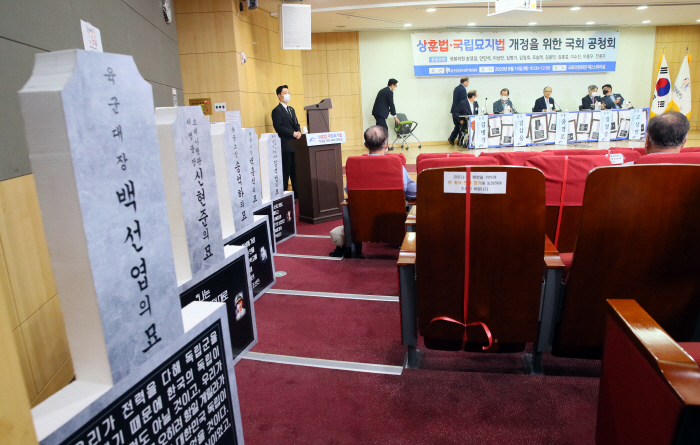 On the 13th, at the National Assembly Members' Office Building, a 'National Assembly Public Hearing for the Amendment of the Decorations Act and the National Cemetery Act,' jointly hosted by the offices of Assemblymen Song Young-gil, Ahn Min-seok, and Lee Sang-min, and organized by the Unam Kim Seong-suk Memorial Project Association, displayed models of tombstones of pro-Japanese collaborators including the late General Baek Seon-yeop.
 [Photo by Yonhap News]
Meanwhile, a public hearing related to the bill was held at the National Assembly on the 13th. Kang Chang-il, former lawmaker and chair of the Democratic Party's 'Special Committee on History and Justice,' said in his keynote speech at the public hearing for amendments to the Awards Act and the National Cemetery Act, "Although it will cause severe social conflict, it is inevitable to uphold the Constitution," emphasizing, "About 40% may oppose it, but the law must be amended for justice."
In particular, former lawmaker Kang criticized the interment of the late General Baek Seon-yeop in the national cemetery, saying, "This is an unacceptable phenomenon in a liberated country, an insult to constitutional values, and a situation that confuses national identity."
He also argued, "If there is an enemy in the national cemetery, the patriots and national heroes cannot rest in peace in the afterlife," and insisted, "The legal basis for exhuming the graves of pro-Japanese collaborators from the National Cemetery must be clearly established."
On the other hand, the bill is expected to face sharp conflicts with the opposition party, making discussions at the National Assembly's standing committees difficult. Kim Jong-in, emergency committee chairman of the United Future Party, criticized the exhumation-related questions that day, saying, "I don't know what their purpose is in doing such things, but it will not be accepted by the public," adding, "I don't understand why they keep bringing up old issues day and night without thinking about the future."
© The Asia Business Daily(www.asiae.co.kr). All rights reserved.
![Clutching a Stolen Dior Bag, Saying "I Hate Being Poor but Real"... The Grotesque Con of a "Human Knockoff" [Slate]](https://cwcontent.asiae.co.kr/asiaresize/183/2026021902243444107_1771435474.jpg)

















