Over 90% of 158 Domestic Units Are Foreign-Made
Seobu Power Promotes Technological Independence and Localization
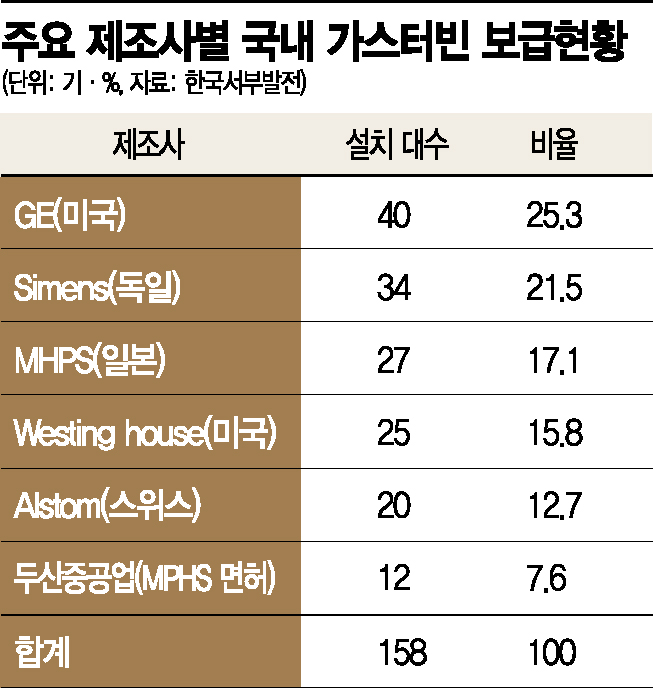
[Asia Economy Reporter Moon Chaeseok] Korea Western Power is actively supporting the localization of combined cycle power generation using liquefied natural gas (LNG). For the government's energy transition to succeed, it is essential to establish an LNG combined cycle power generation system as an alternative to 'coal phase-out.' However, since most of the core equipment, such as power generation gas turbines, relies on foreign imports, strengthening international competitiveness through localization is urgently needed. In response, Western Power has volunteered to serve as a testbed for domestically produced power generation gas turbines.
According to the Ministry of Trade, Industry and Energy on the 18th, a total of 158 power generation gas turbines are installed domestically. Five public power generation companies, including Western Power, own 74 units (10,898 MW), and private power producers such as POSCO Energy own 84 units (15,068 MW). Over 90% of these are imported from countries like the United States, Germany, and Japan. Doosan Heavy Industries has supplied some units under license from Japanese companies, but its technology is considered inferior to that of global firms.
Experts predict that the domestic gas turbine market will expand significantly due to fuel conversion of aging coal-fired power plants. It is forecasted that demand for more than 18 turbines will arise by 2034. This is why urgent discussions on localization for technological self-reliance are emerging.
Accordingly, Western Power has decided to actively engage in the demonstration and performance verification of domestically produced gas power turbines. On the 11th, at the 'Policy Forum on Strengthening Competitiveness of the Gas Turbine Industry' hosted by Song Gap-seok, a member of the Democratic Party of Korea, Kim Young-nam, head of Western Power's Construction Department, stated, "For the risks associated with demonstration after gas turbine development and to play a leading role in the energy industry, proactive participation by the end users, the public power generation companies, is crucial." He added, "Western Power, which has already begun demonstrating the 'Korean-style combined cycle' through the Gimpo Combined Heat and Power Plant, is the most suitable entity to serve as the testbed for newly developed gas turbine models."
Kim said, "If the development of high-efficiency, large-capacity gas turbine follow-up models is delayed, Korea will inevitably become dependent on foreign technology again, raising concerns about the outflow of national wealth due to gas turbine imports. We must quickly secure global-level gas turbine technology to narrow the technological gap with advanced countries and conduct performance verification through demonstration operation."
Accordingly, Western Power and Doosan Heavy Industries proactively agreed on the 13th of last month to jointly build the next-generation Korean-style combined cycle power plant. In the mid-to-long term, they plan not only to develop and distribute next-generation gas turbine models domestically but also to foster small and medium-sized enterprises in related fields and explore overseas markets for exports.
If public power generation companies adopt domestically produced gas turbines, it is expected to reduce power plant equipment and construction costs, thereby lowering the cost of electricity production.
© The Asia Business Daily(www.asiae.co.kr). All rights reserved.
![Clutching a Stolen Dior Bag, Saying "I Hate Being Poor but Real"... The Grotesque Con of a "Human Knockoff" [Slate]](https://cwcontent.asiae.co.kr/asiaresize/183/2026021902243444107_1771435474.jpg)















