Chairmen's Business Trips Blocked by COVID-19
Large-Scale Investment Attraction and More Canceled
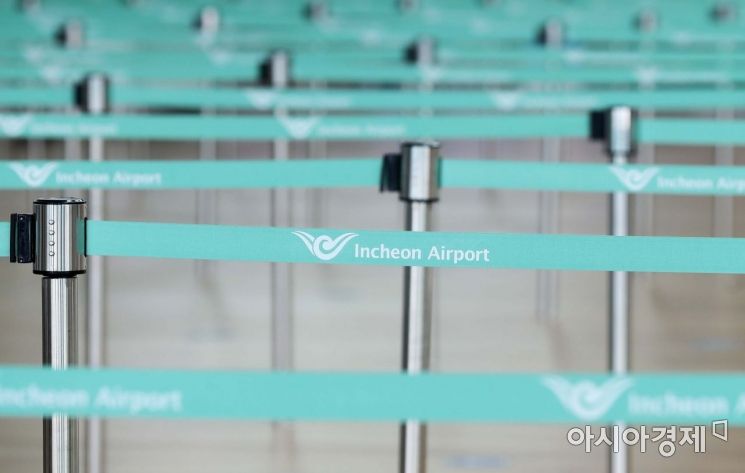 On the 18th, the departure hall of Terminal 1 at Incheon International Airport was deserted due to the impact of the novel coronavirus infection (COVID-19), as the aviation industry, hit hard by COVID-19, faces a wave of layoffs. Photo by Mun Honam munonam@
[Asia Economy Reporter Kim Min-young] As international travel restrictions continue due to the novel coronavirus disease (COVID-19), the four major financial holding companies are facing ongoing difficulties in advancing their global operations. With CEOs unable to travel abroad to meet institutional investors in person, not only have they failed to achieve large-scale investment attraction results, but overseas subsidiaries and branch offices are also struggling in their sales efforts. Financial companies are focusing on strengthening non-face-to-face (untact) strategies and localization in their global divisions, but setbacks to the internal goals set at the beginning of the year have become inevitable.
According to the financial sector on the 13th, none of the chairpersons or bank presidents of the four major financial holding companies?Shinhan, KB, Hana, and Woori?have traveled overseas this year. The holding company chairpersons typically embark on overseas tours annually to hold investor relations (IR) presentations in the Americas, Europe, Southeast Asia, or to inspect overseas subsidiaries and branches of their affiliates. Overseas IR is generally an effective means of attracting foreign investors. This year, the chairpersons and bank presidents had planned several overseas IR events. However, all plans made at the beginning of the year were canceled due to COVID-19, leading to a scaled-back and adjusted global strategy.
Difficulty in Attracting Overseas Investors
In particular, it is known that very few financial companies have achieved investment results in the IR sector. One reason cited is that investors hesitate due to uncertainty about how COVID-19 will develop in the future. Each holding company’s IR department is meeting investors through conference calls and video meetings, but these interactions remain indirect and limited.
A financial industry insider lamented, “High-profile overseas institutions tend not to show much interest unless CEOs come in person.”
As there are no signs of improvement in COVID-19, financial companies are substituting with untact strategies even in their global operations. Although online meetings and conference calls have been used in the past due to physical distance constraints, now almost all work processes and meetings are conducted online.
Strengthening Non-Face-to-Face Management in Global Divisions
Shinhan Bank held its global management strategy meetings, which were previously conducted at the Yongin Giheung Training Center, via video conference this year. The meetings were held on February 5 and 6 during the height of COVID-19, and another online meeting was held on the 20th of last month in the second half of the year. In May, they newly established the ‘Concord Meeting,’ which is held once a month. This video conference aims for in-depth discussion and communication regarding the sales status of global branches and key local issues. One or two overseas branches are selected for focused discussions led by the head office department heads. It is evaluated as more efficient in terms of cost and time savings compared to traveling by plane to visit the sites in person. A Shinhan Bank official explained, “Concord means ‘harmony’ in the dictionary sense, and it is part of efforts to maintain mutual understanding between the headquarters and overseas branches and continuously create the synergy of ‘One Shinhan’ even in difficult circumstances.”
KB Kookmin Bank is pursuing a Southeast Asia-focused strategy. In April, it received preliminary approval to establish a local subsidiary in Myanmar and subsequently obtained the final approval. It has also resolved to acquire additional shares in Indonesia’s Bank Bukopin. KB Kookmin Bank has dispatched staff to Myanmar, Cambodia, and Indonesia to complete the Southeast Asian financial belt. This decision reflects the judgment that they cannot miss the new growth opportunities in Southeast Asia despite the COVID-19 situation.
A Hana Bank official also stated, “We conduct untact meetings with overseas staff through video conferencing systems and selectively send employees on business trips only when absolutely necessary.”
Woori Bank is focusing on untact management of overseas branches. In particular, through an organizational restructuring in the second half of the year, it established a Global Corporate Banking (IB) Review Department. This is an effort to build capabilities in preparation for ‘global deals’ starting from the head office.
As financial companies aggressively expand overseas operations, their assets and number of branches continue to grow steadily. At the end of last year, the total assets of overseas branches of domestic banks amounted to $133.69 billion, an increase of 16.4% ($18.88 billion) compared to 2018. There are 195 overseas branches in 35 countries.
© The Asia Business Daily(www.asiae.co.kr). All rights reserved.
![Clutching a Stolen Dior Bag, Saying "I Hate Being Poor but Real"... The Grotesque Con of a "Human Knockoff" [Slate]](https://cwcontent.asiae.co.kr/asiaresize/183/2026021902243444107_1771435474.jpg)















