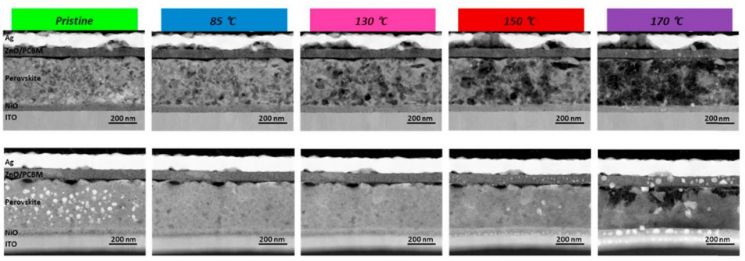
 Real-time Transmission Electron Microscopy Images of Structural Changes in Perovskite Solar Cells by Composition Due to Temperature Increase
[Asia Economy Reporter Junho Hwang] Domestic researchers have identified the cause of the lifespan degradation issue in perovskite solar cells, which are attracting attention as the next-generation solar cells due to their higher power conversion efficiency compared to silicon solar cells. This research is expected to contribute to the commercialization of perovskite solar cells in the future.
The research team led by Dr. Heeseok Jeong at the Jeonju Center of the Korea Basic Science Institute and the team led by Professor Seokin Na at the Graduate School of Flexible Printed Electronics, Jeonbuk National University, announced on the 13th that they analyzed in real-time the cause of performance degradation due to temperature increase in perovskite solar cells using a STEM aberration-corrected transmission electron microscope, and their related paper was introduced in the international journal Nano Energy.
The STEM aberration-corrected transmission electron microscope is a device capable of observing atomic arrangements at a resolution of up to 0.1 nm (nanometers). Using this device, the research team observed in real-time the chemical structural changes such as thermal decomposition caused by temperature increase in perovskite solar cells at the nanometer scale. Through this, they analyzed in real-time the causes of device performance degradation, such as the formation of internal voids and elemental migration due to temperature rise.
Professor Seokin Na stated, "By elucidating the thermal decomposition mechanism of perovskite through real-time STEM aberration-corrected transmission electron microscopy, we will be able to provide important clues for designing and manufacturing more durable perovskite solar cells in the future."
Dr. Heeseok Jeong said, "The ability to analyze the causes of perovskite performance degradation at the nanoscale in real-time was mainly due to the role of the real-time STEM aberration-corrected transmission electron microscope," adding, "The world-class advanced research equipment and researchers possessed by KBSI will be able to contribute more to solving nationally important research challenges such as the development of next-generation semiconductor and energy devices."
© The Asia Business Daily(www.asiae.co.kr). All rights reserved.
![Clutching a Stolen Dior Bag, Saying "I Hate Being Poor but Real"... The Grotesque Con of a "Human Knockoff" [Slate]](https://cwcontent.asiae.co.kr/asiaresize/183/2026021902243444107_1771435474.jpg)















