Ahead of the compliance agreement review meeting on the 15th, possibility of Chinese interference in the presidential election raised
China's military demonstration by violating Taiwan airspace
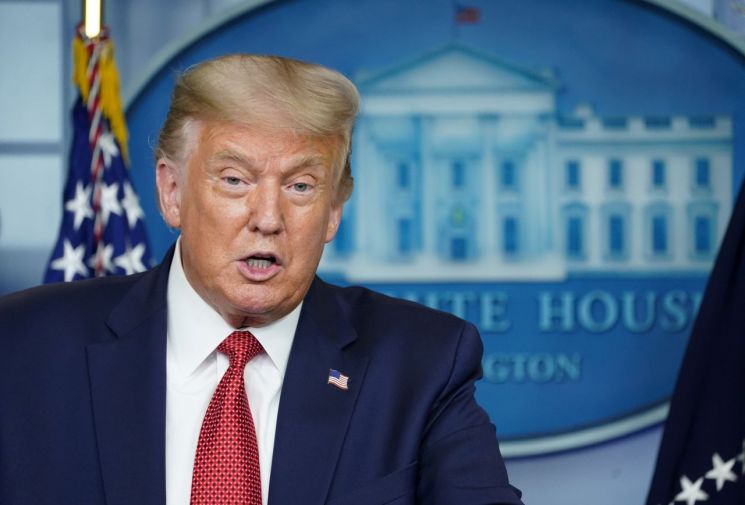 President Trump is giving a briefing at the White House on the 10th. [Image source=Reuters Yonhap News]
[Asia Economy New York=Correspondent Baek Jong-min, Beijing=Correspondent Cho Young-shin] U.S. President Donald Trump on the 10th (local time) downplayed the Phase One trade agreement between the United States and China as "meaningless."
In a situation where U.S.-China tensions have escalated to the brink, he hinted at the possibility of nullifying the trade agreement, which has served as a safety net between the two countries. Especially with a high-level meeting scheduled on the 15th to review the implementation of the trade agreement, some interpret his remarks as a deliberate attempt to pressure China.
At a press conference held at the White House that day, President Trump said, "The Phase One deal was really great, but suddenly the overall imports have become meaningless. We see China differently than we did eight months ago." He added that even if U.S. exports to China increase under the agreement, "it cannot compensate for the lives lost in our country and around the world."
President Trump's remarks are notable because they differ somewhat from his previous stance. When Peter Navarro, director of the White House Office of Trade and Manufacturing Policy, said in June that "the U.S.-China Phase One trade deal is over," Trump patched things up via Twitter, saying, "The trade deal is fine, and we hope China continues to comply with the agreement." The New York Times interpreted Trump's remarks that day as emphasizing that China's imports of U.S. goods have fallen short of expectations.
Trump's attacks on China did not stop there. At the briefing held that day, he also expressed strong concerns about the possibility of Chinese interference in the U.S. presidential election. He criticized, "China wants us to lose very badly (in the election)." He claimed that many countries want Democratic presidential candidate former Vice President Joe Biden to win and warned, "There will be great chaos."
Steven Mnuchin, Secretary of the Treasury, who joined the briefing, supported Trump by stating that Chinese companies listed on U.S. stock exchanges would be delisted if they do not comply with U.S. accounting standards. This follows a working group formed under Trump's directive last week recommending delisting Chinese companies that do not disclose audit documents to U.S. regulators.
China Conducts Military Demonstration Timed with Meeting Between U.S. Health Secretary and Taiwan President
China is not backing down either. While leaving room for trade negotiations with the U.S., the Chinese government emphasizes it will not yield on the core interest of "One China." Two Chinese fighter jets entered Taiwan's airspace timed with the meeting between U.S. Health and Human Services Secretary Alex Azar and Taiwan President Tsai Ing-wen the previous day. This was effectively a military demonstration.
Chinese state-run Global Times and Huanqiu Shibao on the 11th described the airspace intrusion as "a clear response from the mainland to the U.S. Health Secretary's visit to Taiwan," revealing intent. They warned, "The risks Taiwan faces will increasingly grow."
Tensions also rose in Taiwan, which strengthened military alertness. Taiwanese military aircraft scrambled urgently to issue warnings, and surface-to-air missiles entered a state of readiness. Taiwan's Ministry of National Defense explained, "Chinese fighter jets deliberately violated the Taiwan Strait, seriously undermining regional stability," and added, "Taiwan's military fully controls the situation in the surrounding sea and airspace of the Taiwan Strait."
The Chinese Communist Party's official newspaper, People's Daily, emphasized in an editorial that day, "China's determination to safeguard its sovereignty and territorial integrity is firm," and stressed that it will not tolerate external interference in China's internal affairs.
Alongside this, the Chinese government announced sanctions against 11 individuals, including U.S. Senator Marco Rubio, banning their entry into China and freezing their assets within China. This is a retaliatory measure against the U.S. Treasury Department's sanctions on July 7, which froze assets and banned financial transactions of 11 individuals, including Hong Kong Chief Executive Carrie Lam, for suppressing political freedoms in Hong Kong. However, there were no sanctions against Trump administration officials, suggesting a calibrated approach.
© The Asia Business Daily(www.asiae.co.kr). All rights reserved.
![Clutching a Stolen Dior Bag, Saying "I Hate Being Poor but Real"... The Grotesque Con of a "Human Knockoff" [Slate]](https://cwcontent.asiae.co.kr/asiaresize/183/2026021902243444107_1771435474.jpg)















