Designation of Land Transaction Permission Zones in 4 Gangnam Districts
Transactions Plummet... Jamsil-dong from 106 to 14 Cases
Prices of Ultra-Small Apartments Available for Transaction Soar
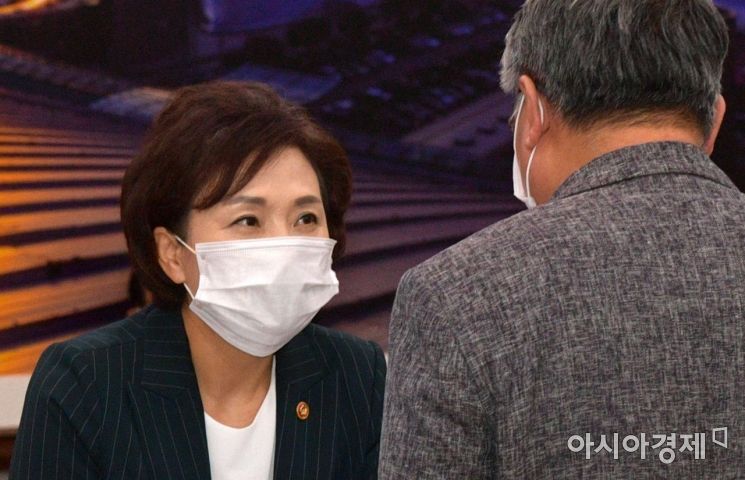 Minister of Land, Infrastructure and Transport Kim Hyun-mi attended the full meeting of the Land, Infrastructure and Transport Committee held at the National Assembly on the 29th and is talking with Cho Eung-cheon, the Democratic Party of Korea's floor leader. Photo by Yoon Dong-ju doso7@
[Asia Economy Reporter Moon Jiwon] Although the government designated four neighborhoods (dong) in the Gangnam area as land transaction permission zones to curb rising housing prices, the effect on stabilizing housing prices appears to be limited. Housing prices remain strong, and prices of small apartments in surrounding areas or those excluded from the permission zones have surged even more, resulting only in a balloon effect. The land transaction permission zones, intended to block speculative inflows into the land market, were forcibly applied to the housing market, but critics argue that while transactions were suppressed, housing prices were not controlled.
According to the Ministry of Land, Infrastructure and Transport's real transaction price disclosure system and frontline real estate brokerage industry on the 11th, apartment sales transactions sharply declined in Daechi, Samsung, Cheongdam neighborhoods of Gangnam-gu and Jamsil-dong of Songpa-gu, which were designated as land transaction permission zones from June 23. Since the designation until the 10th of this month, there were 12 transactions in Daechi-dong, 16 in Samsung-dong, 6 in Cheongdam-dong, and 14 in Jamsil-dong. Considering that Jamsil-dong had 106 transactions in May alone, the trend of transaction decline is clear.
This transaction halt is because housing transactions for purposes other than actual residence are not allowed. To purchase a house with a land area (including shares) of 18㎡ or more, permission must be obtained from the local district office before signing the contract, and even with permission, the buyer must move in immediately and reside for at least two years. A Songpa-gu office official said, "Since Jamsil-dong was designated as a land transaction permission zone, 27 applications have been received, and 22 have been approved. No applications have been rejected yet."
As transactions themselves are blocked, the upward trend in apartment prices in the area has slowed, but there is no sign of price decline. In fact, some complexes have recorded new highs. For example, a 149.4㎡ unit in Trizium, Jamsil-dong, Songpa-gu, was traded for 2.74 billion KRW on the 16th of last month, rising by more than 200 million KRW compared to June. The 84.99㎡ unit in Licenz also approached its highest price (2.3 billion KRW) at 2.25 billion KRW on the 18th of last month.
For Licenz units of 27.68㎡ (exclusive area), which can be traded without permission due to their small land share, prices were mainly in the 800 million to 900 million KRW range before the designation of the regulated area, but now the asking prices are generally in the 1 billion to 1.1 billion KRW range, nearly 100 million KRW per pyeong. A representative of real estate agency A in the area said, "For small apartments, many transactions are investment-oriented, involving purchasing with jeonse (long-term deposit lease) due to expectations of the balloon effect."
Another agency representative said, "With the passage of the Lease Protection Act, current tenants can stay for at least two more years, so there are not many properties that can be purchased and immediately occupied."
The price rise of apartments in adjacent neighborhoods that escaped regulation is also significant. For example, Parkrio in Sincheon-dong, which is practically part of the Jamsil area but excluded from the permission zone due to different legal dong designation, has seen prices rise sharply across all unit sizes. The 84.97㎡ unit in this complex was traded in the 1.7 to 1.8 billion KRW range until mid-June, but after Jamsil-dong was designated as a permission zone, actual transaction prices surged to the 2 billion KRW range.
Because of this, there are criticisms that while the government fails to control overall housing prices in Seoul, artificially blocking transactions in specific areas only distorts the surrounding market. Recently, there is also a trend of funds flowing into the auction market, which does not require permission or funding plans, following the tightening of transaction regulations. According to Gigi Auction, the Seoul apartment bid-to-asking price ratio last month was 106.6%, the highest in 20 months since November 2018 (107%). Especially, Yongsan-gu and the Gangnam area are known to be popular.
Experts believe that while the designation of land transaction permission zones restricts investment-oriented sales and may help actual buyers or the homeless to purchase homes, there are concerns about side effects such as transaction cliffs, jeonse shortages, and balloon effects in neighboring areas.
The Korea Housing Finance Institute analyzed in its 'Housing Finance Insight' report at the end of last month, "The land transaction permission system has caused a transaction cliff in the designated areas, leading to a shortage of jeonse properties and a balloon effect with rising housing prices in neighboring areas such as Sincheon-dong in Songpa-gu and Nonhyeon-dong in Gangnam-gu."
© The Asia Business Daily(www.asiae.co.kr). All rights reserved.
![Clutching a Stolen Dior Bag, Saying "I Hate Being Poor but Real"... The Grotesque Con of a "Human Knockoff" [Slate]](https://cwcontent.asiae.co.kr/asiaresize/183/2026021902243444107_1771435474.jpg)
















