Apartment Price Increase, Strengthened Apartment Regulations Cause Balloon Effect
Seoul Row Houses and Multi-Unit Transactions Reach Over 6,000 for Two Consecutive Months in June and July
Highest in 12 Years... Rising Demand Also Fuels Gap Investment Atmosphere
Experts Say "Value Increase Is Limited, Investment Requires Caution"
[Asia Economy Reporter Onyu Lim] "If I don't buy a villa now, I think I will live as a lifelong homeowner without a house."
A newlywed couple in their 30s, Mr. A, living in a villa in Dangsan-dong, Yeongdeungpo-gu, Seoul, is facing a dilemma ahead of the expiration of their jeonse contract in January next year. Last year, they had their eyes on an apartment in Seoul priced around 400 million KRW, but the price has risen by more than 100 million KRW in just one year. Mr. A ultimately gave up on the apartment and decided to purchase a nearby multi-family house instead. He said, "I think a new multi-family house close to work is better than an old apartment on the outskirts of Gyeonggi," but added, "People around me say 'villas are no good,' so I am troubled."
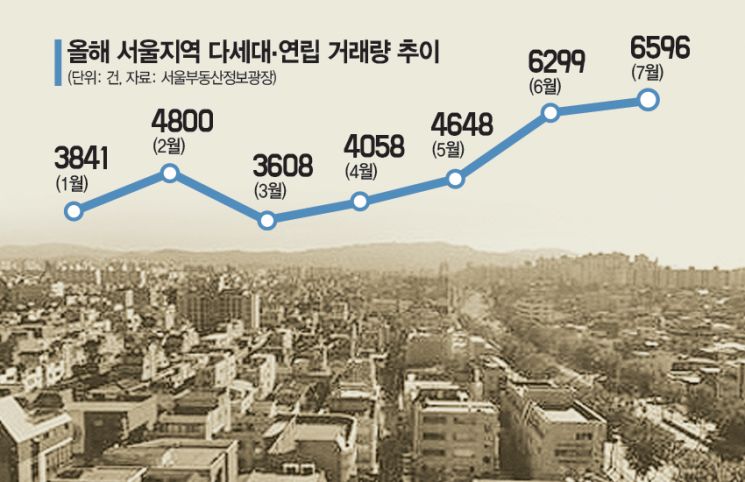
The 'panic buying' by people in their 30s triggered by the rapid rise in apartment prices has spread to the multi-family and row house market. According to the Seoul Real Estate Information Plaza on the 11th, last month there were 6,596 transactions of multi-family and row houses (villas) in Seoul. Following 6,299 transactions in June, this marks two consecutive months with over 6,000 transactions. This is the highest volume in 12 years since April 2008 (7,686 transactions).
The number of multi-family and row house transactions was only in the 3,000 to 4,000 range from January to May this year. By region, Gangseo-gu including Hwagok-dong recorded 725 transactions, Eunpyeong-gu including Bulgwang-dong had 734, and Yangcheon-gu including Mok-dong had 464, in that order. As demand for villas increased, the Seoul multi-family housing sales supply-demand index announced by the Korea Real Estate Board last month rose to 102.8, the highest ever. The sales supply-demand index is based on 100; a value above 100 means demand exceeds supply.
The increase in transactions of multi-family and row houses, which had been neglected compared to apartments in the real estate market, is interpreted as a balloon effect caused by rising apartment prices and strengthened government regulations. Young people who have been blocked from entering the apartment market are turning to relatively affordable housing as a desperate measure. Mr. B, a man in his 30s who recently signed a contract for a villa in Mangwon-dong, Mapo-gu, Seoul, said, "For people in their 30s, buying an apartment in Seoul is only possible if they have inherited wealth or work for a large corporation," adding, "I chose a villa for stable actual residence."
As demand increases, a gap investment atmosphere aiming for capital gains is also detected. This is because regulations are relatively weaker compared to apartments. According to the June 17 measures, if you purchase an apartment worth more than 300 million KRW in speculative or overheated speculation areas, you cannot receive a jeonse loan. However, such regulations do not apply to multi-family or row houses. A representative from a real estate agency in Bulgwang-dong said, "Villas have a high demand for jeonse compared to sales, and the price gap between sales and jeonse is often less than 30 million KRW," adding, "Recently, many young people looking for villas near subway stations have increased significantly."
As the government and Seoul City announced policies to revitalize redevelopment projects such as public redevelopment, investors are flocking to purchase old multi-family houses. This is seen as an effect of the government’s plan to supply 20,000 to 40,000 households in Seoul through public redevelopment, expanding the target not only to redevelopment zones but also to areas where redevelopment zones have been lifted and planned redevelopment zones. In Yongsan-gu, the number of multi-family and row house transactions rose from 92 in January this year to 176 in June.
However, experts advise caution when investing in multi-family and row houses. An industry insider said, "Compared to apartments, villas have limited potential for value appreciation," adding, "During market downturns, the villa market, which has lower liquidity, may suffer more damage."
© The Asia Business Daily(www.asiae.co.kr). All rights reserved.
![Clutching a Stolen Dior Bag, Saying "I Hate Being Poor but Real"... The Grotesque Con of a "Human Knockoff" [Slate]](https://cwcontent.asiae.co.kr/asiaresize/183/2026021902243444107_1771435474.jpg)
















